Why This Matters
You're 25 minutes into a system design interview. You've proposed replicating your database across two regions for fault tolerance. The interviewer leans forward and asks, "Okay, but what happens when the network between those regions goes down? Do your users see stale data, or do they see errors?" You know the letters C, A, and P. You can probably recite that you "pick two out of three." But right now, with the interviewer waiting, you're not sure what to actually say. That follow-up question is where interviews are won or lost.
Here's the thing most candidates get wrong: CAP theorem isn't a menu where you choose your favorite two toppings. Network partitions aren't optional. They will happen in any distributed system, whether it's a flaky cable in a data center or a transatlantic link going dark for 30 seconds. The only real question CAP asks is this: when that partition hits, do you let your system keep serving responses that might be wrong, or do you shut part of it down until things heal? That's the tradeoff. Every time you propose adding a read replica, picking DynamoDB over PostgreSQL, or putting a cache in front of your database, you're implicitly choosing a side. Interviewers notice whether you realize it. Think about how Amazon handles a Prime Day sale: the product catalog keeps showing items even if inventory counts are a few seconds stale (favoring availability), but the payment system will reject your order rather than double-charge your card (favoring consistency). Same company, two different CAP choices, each driven by a specific business reason.
By the end of this lesson, you'll understand exactly when the CAP tradeoff kicks in, how to reason through it for any system you're designing, and how to articulate your choice in a way that sounds like an engineer who's actually built distributed systems. Eric Brewer formalized this idea back in 2000, and it was proven as a theorem two years later, but none of that history matters in your interview. What matters is that you can look at a whiteboard diagram, spot the moment where consistency and availability are in tension, and explain which one you'd sacrifice and why.
How It Works
Forget the Venn diagram with three overlapping circles. That mental model is what causes most candidates to botch this. Instead, think about two database nodes sitting in a bank's data center, both holding your checking account balance.
You deposit $500 into Node A. Before Node A can replicate that write over to Node B, the network cable between them gets cut. A customer service rep now queries Node B for your balance. What should happen?
That's the entire theorem, right there. Everything else is details.
The Three Letters, Grounded in Reality
Consistency means both nodes return the same account balance at any given moment. If Node A says $1,500, Node B must also say $1,500. Not eventually. Right now. (Technically, this is linearizability, which we'll distinguish from ACID consistency in a later section.)
Availability means every request to a non-crashed node gets a response. Not a timeout. Not an error page. An actual answer with data. Node B doesn't get to say "sorry, come back later."
Partition tolerance means the system continues operating when the network link between nodes is severed. This one isn't really a choice. Networks break. Switches fail. Cables get unplugged by a contractor who didn't read the label. In any distributed system, partitions will happen.
Think of it like two bank tellers who normally pass notes to each other after every transaction. A partition is the moment someone slams a soundproof wall between them. They can't communicate, but customers are still walking up to both windows.
The Moment the Tradeoff Kicks In
Here's the step-by-step of what actually happens:
- Both nodes are humming along, syncing writes between them. Consistency and availability are both fine. No tension.
- The network link between Node A and Node B drops. A partition has occurred.
- A client sends a read request to Node B, asking for the account balance. Node B hasn't received the $500 deposit that just hit Node A.
- Now the system has exactly two options.
Option 1: Preserve consistency. Node B refuses to answer. It knows it might be stale, so it returns an error or blocks until the partition heals. The client doesn't get a response. Availability is sacrificed.
Option 2: Preserve availability. Node B responds with the data it has, even though it might be outdated. The client sees $1,000 instead of $1,500. Consistency is sacrificed.
There is no Option 3.
Here's what that flow looks like:
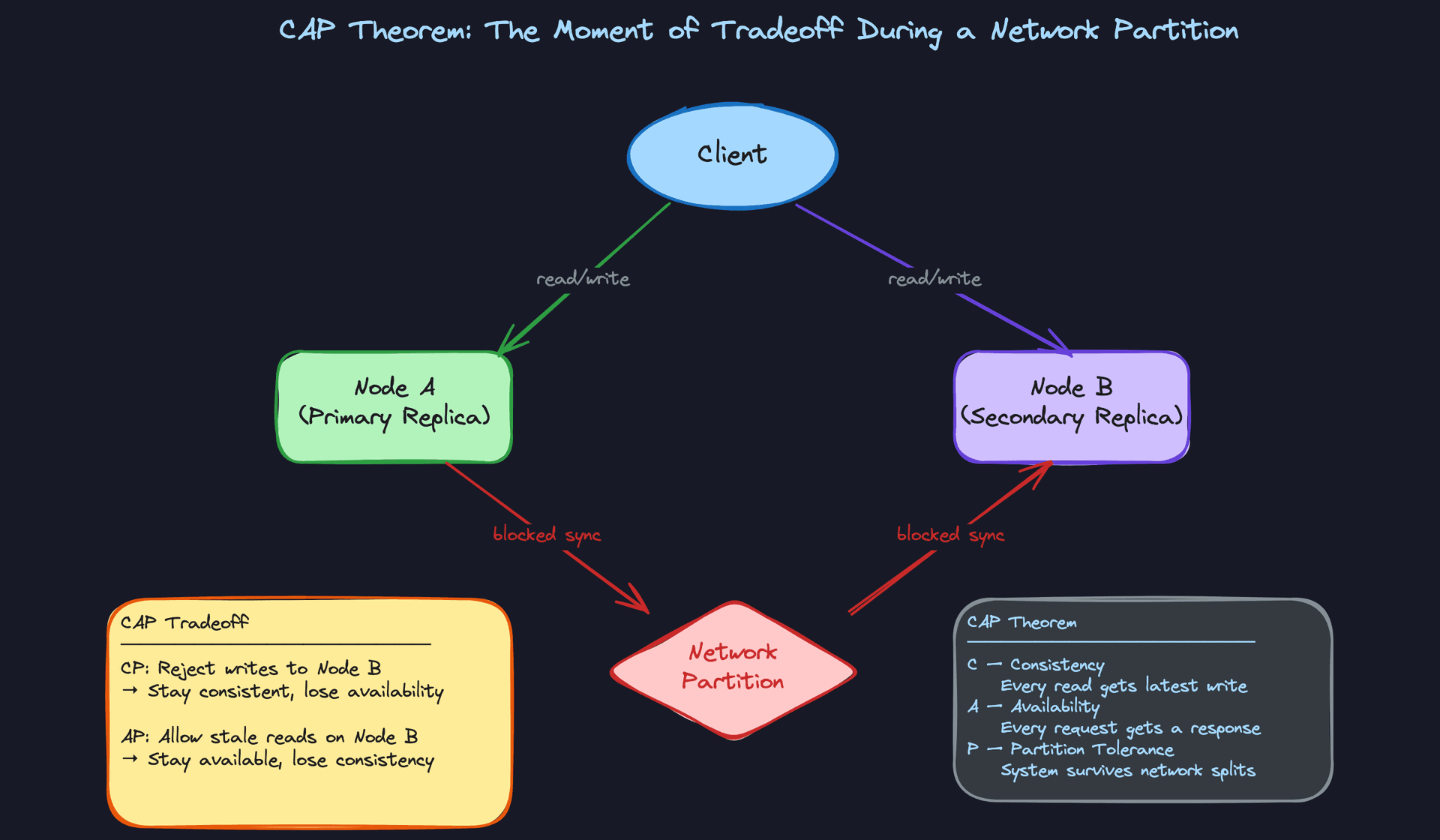
Your 30-second explanation: "CAP says that in a distributed system, network partitions are inevitable. When one happens, you have to choose: either some nodes stop responding to maintain consistency, or all nodes keep responding but might return stale data. The real decision is always consistency versus availability during a failure."
Why Your Interviewer Cares About Each Guarantee
Consistency matters because wrong data can be worse than no data. If this is a banking app and Node B shows the old balance, a customer might overdraw their account. If it's a ticket-selling system, two people might buy the same seat. When you tell your interviewer "I'd choose consistency here," you need to connect it to a consequence like this. The business reason is what makes the answer land.
Availability matters because downtime has a cost too. If Node B refuses to answer, that's a customer staring at a spinner. For an e-commerce product page, showing a price that's 30 seconds stale is vastly preferable to showing nothing at all. Your interviewer wants to hear you weigh these costs against each other, not just pick a side reflexively.
Partition tolerance isn't a knob you turn. This is the thing most candidates miss. You don't "choose" partition tolerance the way you choose between consistency and availability. You accept it as reality. Saying "I'd pick C and A" is like saying "I'd prefer it if the network never failed." Your interviewer will immediately push back.
The Nuance That Separates Good Answers from Great Ones
When there's no partition, you get both consistency and availability. The tradeoff only activates during a failure. Most of the time, your system is running happily with full consistency and full availability. CAP is about what happens in those bad minutes, not about normal operation.
This matters because candidates often describe systems as if they're permanently degraded. They'll say "Cassandra sacrifices consistency" as though every read returns garbage. In reality, Cassandra is perfectly consistent most of the time. It's only during a partition that the AP behavior shows up.
And real systems don't flip a binary switch between CP and AP. Cassandra lets you set consistency levels per query. A quorum read (requiring a majority of replicas to agree) pushes you toward CP behavior. A single-replica read pushes you toward AP. Same database, different tradeoff, chosen at query time.
Interview tip: If you mention tunable consistency, you'll stand out. Say something like: "We could use quorum reads for the checkout flow where correctness matters, and single-replica reads for the product browsing pages where speed matters more than perfect freshness." That shows you understand CAP isn't a one-time architectural decision; it's a per-operation choice.
Patterns You Need to Know
In an interview, you'll usually need to pick a specific approach. Here are the ones worth knowing.
CP: Consistency Over Availability
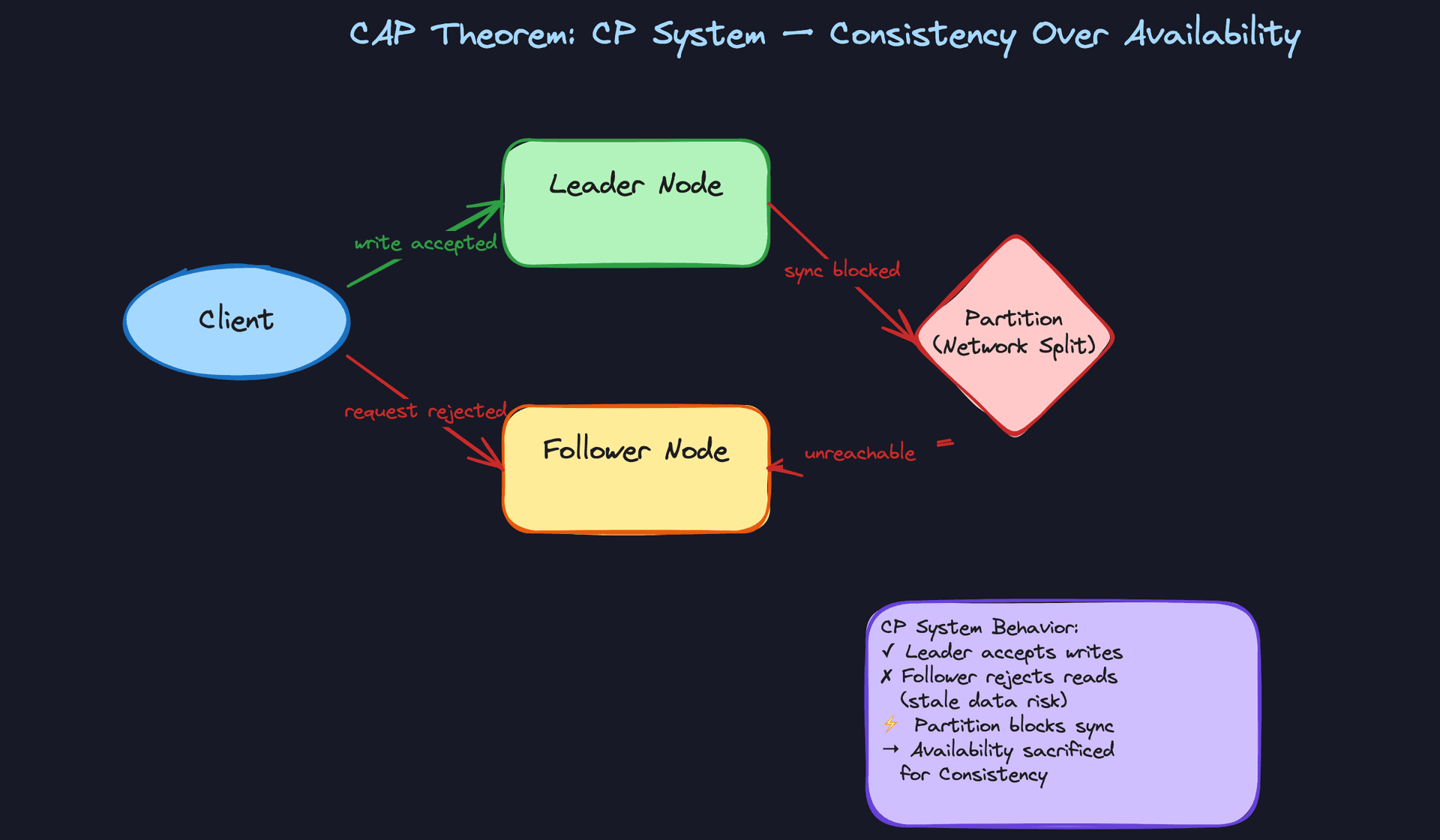
Imagine a banking system with three database nodes. A network partition splits them apart: the leader ends up isolated on one side, and the two followers are together on the other. In a CP system, the isolated leader detects that it can no longer reach a majority of the cluster. It stops accepting writes because it can't get quorum confirmation. Clients hitting that leader get errors or timeouts. Meanwhile, the two followers on the other side of the partition can elect a new leader between themselves (they are the majority), form a new quorum, and continue serving reads and writes.
This is exactly how systems like ZooKeeper, etcd, and Consul behave. They use leader-based consensus protocols (Raft, ZAB) where a majority quorum must agree before any write is committed. If a partition isolates a node from the majority, that node won't pretend everything is fine. It goes read-only or fully unavailable until it can rejoin the cluster and catch up. The side with the majority keeps operating, which means the system sacrifices availability for some clients (those routed to the minority side) in order to preserve consistency everywhere.
When to reach for this: any time the interviewer's scenario involves money, inventory counts, distributed locks, or leader election. If serving stale data would cause a real-world problem (double-charging a customer, overselling a product), tell your interviewer you'd lean CP and explain why.
Interview tip: Don't just say "I'd pick a CP database." Say something like: "For the payment service, I'd rather return a temporary error to the user than risk processing a duplicate charge with stale state. So I'd choose a CP-leaning store like etcd or a strongly consistent configuration of MongoDB."
AP: Availability Over Consistency
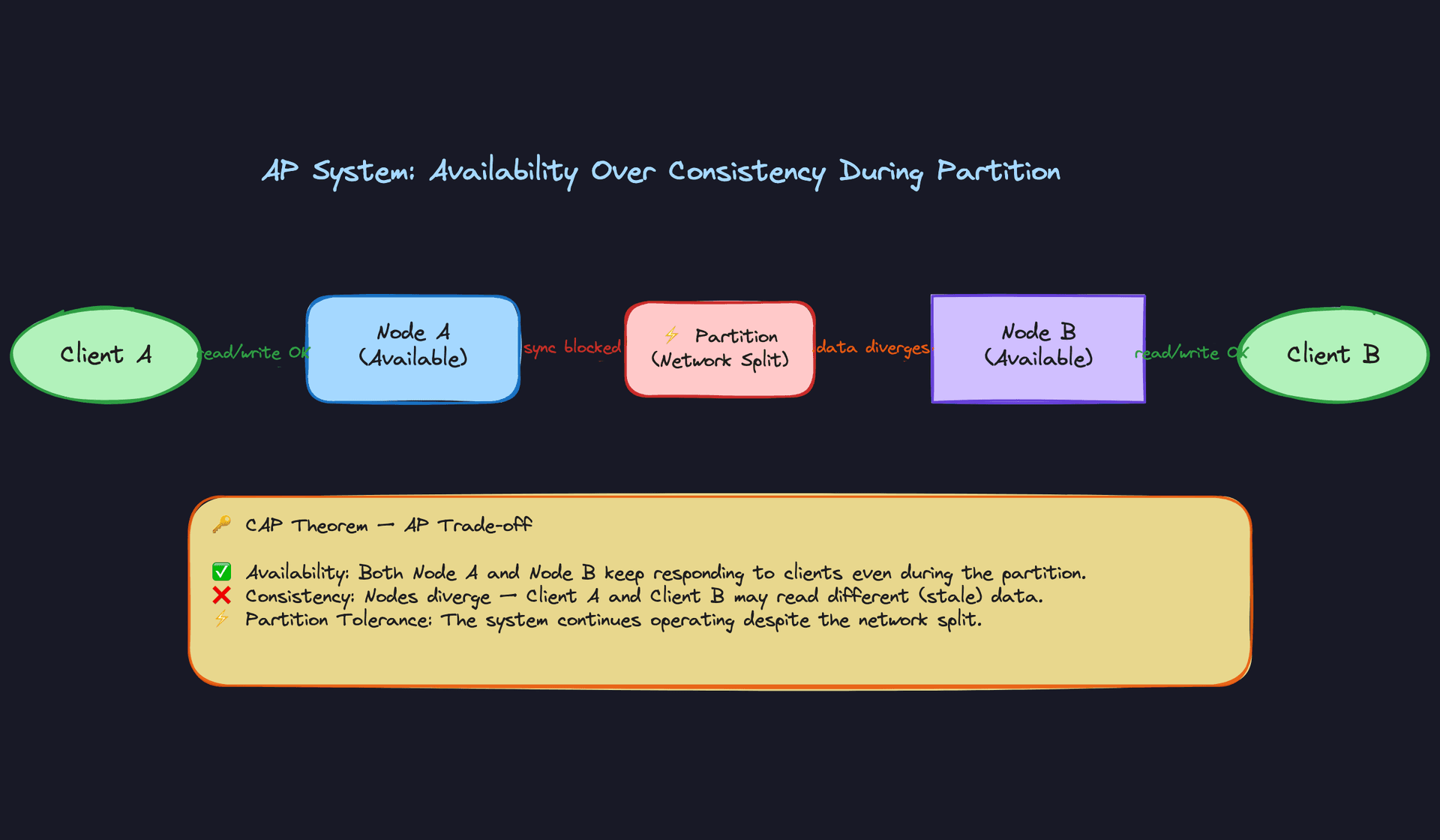
Now flip the scenario. You're running a global product catalog. A network partition hits, and suddenly your US and European nodes can't talk to each other. In an AP system, both sides keep accepting reads and writes. A customer in Paris can still browse and add items to their cart. A customer in New York sees the same responsiveness. The catch? If someone updates a product description on the US side, the European node won't know about it until the partition heals. For those minutes (or hours), the two sides have divergent data.
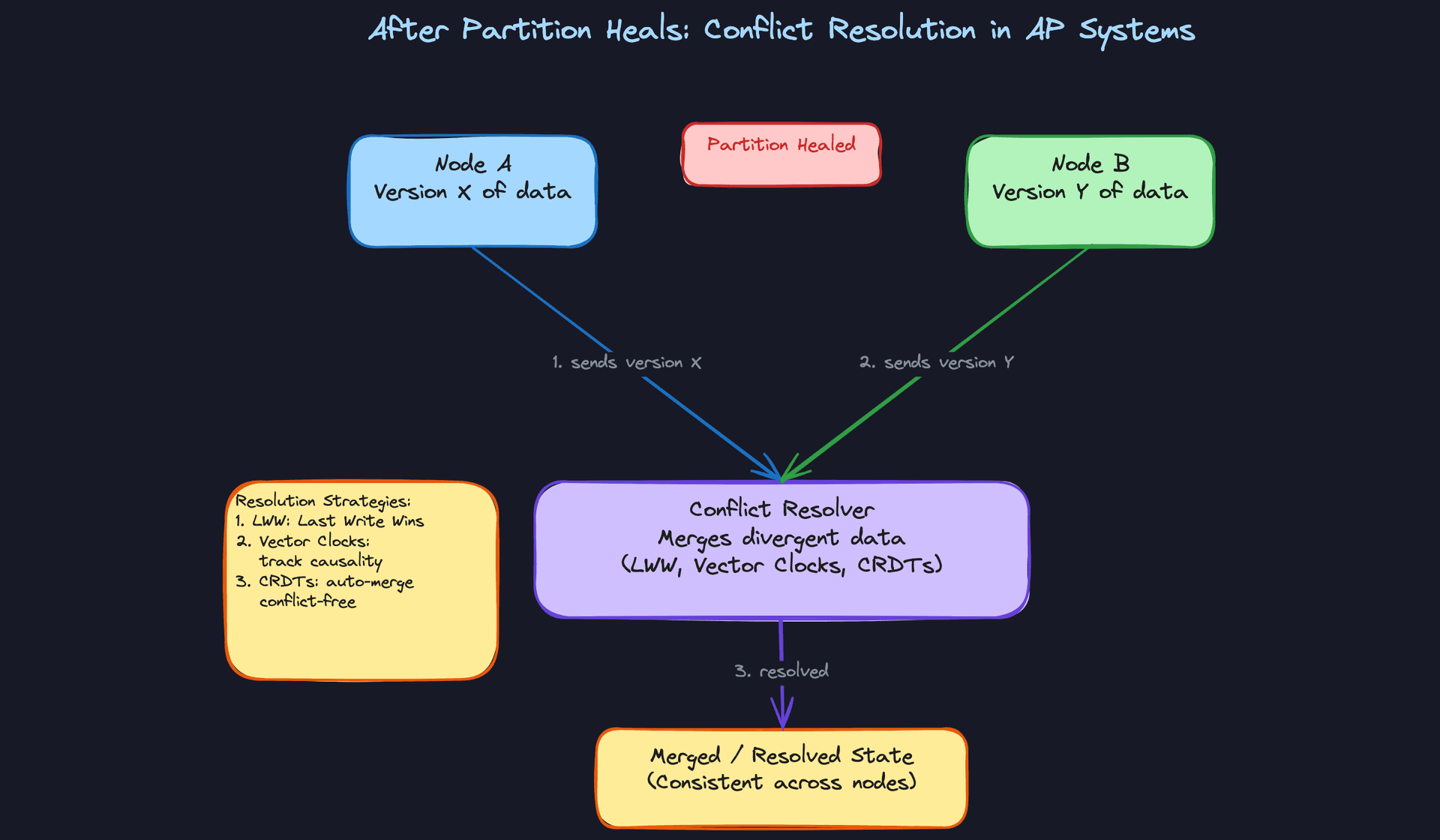
Cassandra and DynamoDB are the textbook examples here. Every node is a peer; there's no single leader that becomes a bottleneck or single point of failure. When the partition heals, the system needs to reconcile the differences. This is where conflict resolution strategies come in. Last-write-wins (LWW) is the simplest: compare timestamps, keep the newer value. It's easy to reason about but can silently drop writes. Vector clocks track causal relationships between updates so the system can detect true conflicts rather than guessing. CRDTs (Conflict-free Replicated Data Types) are data structures designed so that concurrent updates can always be merged automatically, like a counter that both sides increment independently and then sum together.
When to reach for this: high-availability, user-facing systems where a brief period of stale data won't cause harm. Social media feeds, product catalogs, shopping carts, session stores. If the interviewer says "this needs to work across five regions with minimal latency," you're almost certainly in AP territory.
The reconciliation step after a partition heals is where most candidates stop talking, and it's exactly where you should keep going. Mentioning how conflicts get resolved shows the interviewer you've thought past the theoretical tradeoff into the messy operational reality.
CA: The Trick Answer
You'll occasionally hear someone say "I'd pick CA" in an interview. This is a trap, and falling into it is a bad look.
A single PostgreSQL instance on one machine is technically CA. It's consistent (one copy of the data, no replication lag) and available (it responds to every request as long as the server is up). But there's no partition tolerance because there's no partition possible. It's one node. The moment you add a second node, a network link exists between them, and that link can fail. Partitions become a fact of life, not a checkbox you can decline.
So "CA" isn't really a category for distributed systems. It's what you have before you distribute. Saying this in an interview is a strong move. It signals you understand that CAP's "pick two" framing is misleading, and that the real decision space is always CP vs. AP once you go distributed.
Common mistake: Candidates say "We could just avoid partitions with better networking." No. Partitions happen because of hardware failures, misconfigured firewalls, cloud provider issues, GC pauses that mimic network drops. You can reduce their frequency, but you cannot eliminate them. Interviewers know this.
Mixed Strategies: The Real-World Answer
Here's what actually happens in production, and what the best interview answers sound like: a single system uses different CAP strategies for different features.
Think about an e-commerce platform. The payment processing pipeline is CP. You absolutely cannot have two nodes disagree about whether a charge went through. But the product recommendation engine? That's AP all day. Showing slightly stale recommendations for 30 seconds during a partition is completely fine; nobody even notices.
When you articulate this in an interview, you're demonstrating something interviewers rarely see: the ability to reason about tradeoffs per feature rather than slapping one label on the entire system. Try framing it like this: "The write path for orders would go through a strongly consistent store, but I'd serve the product catalog from an eventually consistent cache replicated across regions. Different parts of the system have different tolerance for staleness."
Key insight: The question isn't "Is this system CP or AP?" The question is "Which operations in this system need to be CP, and which can afford to be AP?" That reframing will set you apart from candidates who treat CAP as a single system-wide toggle.
| CP Systems | AP Systems | |
|---|---|---|
| Examples | ZooKeeper, etcd, Spanner, MongoDB (majority reads) | Cassandra, DynamoDB, Riak, CouchDB |
| During partition | Some nodes refuse requests; errors or timeouts | All nodes keep serving; data may diverge |
| Best for | Financial transactions, locks, coordination, config management | User-facing reads, carts, feeds, multi-region low-latency apps |
For most interview problems involving user-facing features at scale, you'll default to AP with eventual consistency, because availability and low latency are what users feel directly. Reach for CP when the interviewer's scenario involves coordination, money, or any state where "two different answers" would be catastrophic. And when the system has both kinds of requirements, say so explicitly. That's the answer that gets you hired.
What Trips People Up
Here's where candidates lose points, and it's almost always one of these.
The Mistake: "I'd Pick CA"
This is the single most common CAP blunder. A candidate draws the classic Venn diagram, points at the three overlapping regions, and says something like: "For this system, I'd choose consistency and availability, so CA."
The interviewer's internal reaction? They don't actually understand the theorem.
Here's the problem: partitions aren't a feature you opt into. They're a reality of running more than one machine connected by a network. Switches fail. Cables get cut. Cloud availability zones lose connectivity. You don't get to say "I'd prefer no partitions, please" any more than you get to say "I'd prefer no hardware failures."
The only system that's truly CA is a single node. One PostgreSQL instance with no replicas. The moment you add a second node, network partitions become possible, and you're back to choosing between C and P or A and P.
Common mistake: Candidates say "We'll go with CA since partitions are rare." The interviewer hears "This person thinks CAP is a menu with three equal options."
What to say instead: "Partitions will happen eventually, so the real question is what this system does when they occur. For a banking ledger, I'd sacrifice availability on the minority side to preserve consistency. For a product catalog, I'd keep serving requests and tolerate briefly stale data."
That framing shows you understand the theorem isn't about picking favorites. It's about preparing for failure.
The Mistake: Mixing Up CAP Consistency and ACID Consistency
A candidate is explaining their database choice and says: "We need strong consistency here, so the data stays valid and doesn't violate any constraints. That's why I'd go CP."
Two completely different concepts just got mashed together, and experienced interviewers will catch it immediately.
CAP consistency means linearizability. Every read returns the result of the most recent completed write, across all nodes. If you write a balance of $500 to Node A, a read from Node B must return $500 (or block until it can). It's about agreement across replicas.
ACID consistency means something entirely different: the database transitions from one valid state to another, honoring all constraints, triggers, and rules you've defined. A foreign key violation would break ACID consistency. A stale read from a replica would break CAP consistency. They're not even in the same category.
Interview tip: If you're discussing CAP, use the word "linearizability" or say "every read sees the latest write." If you're discussing ACID, talk about "data integrity" or "constraint enforcement." Keeping the vocabulary clean signals that you know these are separate ideas.
The Mistake: Slapping a Permanent Label on a Database
"Cassandra is AP. MongoDB is CP. Done."
This sounds confident but it's wrong in a way that actually matters. Real databases ship with knobs, and those knobs change where the system sits on the consistency-availability spectrum.
Cassandra with QUORUM reads and writes behaves much more like a CP system. Cassandra with ONE consistency level is firmly AP. MongoDB with majority read concern gives you linearizable reads; with local read concern, you're reading from the nearest replica regardless of whether it's caught up. Same database, very different CAP behavior.
When you label a system as "CP" or "AP" without qualification, you're telling the interviewer you've memorized a cheat sheet rather than understanding the mechanics. And they'll test that. They might ask, "What if we relaxed the consistency requirement for read-heavy endpoints?" If your mental model is a fixed label, you won't have an answer.
What works better: "Cassandra defaults to AP behavior, but if we configure quorum reads and writes, we get stronger consistency guarantees at the cost of higher latency and reduced availability during partitions. For this feature, I'd tune it to..."
That's the kind of answer that makes interviewers nod.
The Mistake: Ignoring Latency (and Forcing CAP Into Every Conversation)
These are two separate traps, but they tend to show up in the same candidate.
First, latency. CAP says nothing about how fast your system responds. A CP system might technically be "available" in the CAP sense while taking 15 seconds to respond because it's waiting for a quorum across three continents. Your users would call that unavailable. The theorem doesn't capture this, and pretending it does will lead you to bad design decisions in the interview.
This is where PACELC comes in. It extends CAP by asking: even when there's no partition (the normal case), do you optimize for latency or consistency? DynamoDB, for example, favors low latency in the normal case (EL) and availability during partitions (PA). A system using synchronous replication across regions pays a latency cost for consistency even when everything is healthy (EC).
Dropping "PACELC" naturally into your reasoning is a strong signal. Not as a buzzword, but as a framing: "Even outside of partition scenarios, there's a latency-consistency tradeoff here since synchronous replication to our European region adds 120ms to every write."
Common mistake: Candidates bring up CAP when designing a single-server REST API, or when the interviewer simply asked whether they'd use PostgreSQL or DynamoDB. CAP is about distributed state and replication. If the conversation isn't about multi-node systems, failover, or cross-region data, don't shoehorn it in. Save it for when it actually matters, and it'll land much harder.
How to Talk About This in Your Interview
Nobody has ever impressed an interviewer by saying "Well, according to the CAP theorem, you can only pick two out of three." That's the fastest way to sound like you memorized a flashcard. The goal is to weave CAP reasoning into your design decisions so naturally that the interviewer thinks, "This person actually builds distributed systems."
When to Bring It Up
Not every design question is a CAP question. You need to read the room.
Bring it up proactively when you hear any of these signals:
- "This needs to work across multiple regions." Multi-region replication is where CAP tradeoffs live and breathe. If you don't mention consistency vs. availability here, the interviewer will wonder why.
- "What happens if a data center goes down?" They're literally asking about partition tolerance. This is your opening.
- "We need five nines of availability." High availability targets force you to reason about what happens to consistency when things break.
- "Should we use SQL or NoSQL here?" The database choice question is often a proxy for "do you understand the tradeoffs between these systems?" CAP reasoning is how you show depth.
- "How do we keep this data in sync across services?" Any time replication or distributed state enters the picture, you're in CAP territory.
Don't bring it up when you're designing a single-server REST API, a batch processing pipeline, or anything that doesn't involve replicating state across nodes. Forcing CAP into those conversations makes you look like you have a hammer and everything looks like a nail.
Interview tip: A useful template to keep in your back pocket: "During a network partition, I'd rather this service returns an error than serves stale data, because [specific business reason]." Swap the direction for AP systems. The business reason at the end is what transforms a textbook answer into a senior-level one.
Sample Dialogue
Here's how this sounds when done well. Notice the candidate never says "according to the CAP theorem." The reasoning just shows up naturally.
Interviewer: "So for this e-commerce platform, we need the product catalog available in both US-East and EU-West. What database would you use?"
You: "For the product catalog specifically, I'd lean toward Cassandra or DynamoDB. Product listings are read-heavy, and a user in Frankfurt seeing a price that's a few seconds stale is fine. We want every region to serve reads independently without waiting on a cross-Atlantic round trip."
Interviewer: "Okay, but what about the order processing? Same database?"
You: "No, I'd split that out. For orders and payments, I'd use PostgreSQL with a primary in one region and synchronous replication. If there's a network issue between regions, I'd rather the European checkout page shows a brief error than let two regions both accept the same order and end up with conflicting inventory counts. The cost of a double-charge is way higher than a few seconds of downtime."
Interviewer: "But now your European users get hit with latency on every checkout. That's a problem."
You: "Yeah, it is. One option is to keep the primary in the region with the most traffic and accept the latency hit for the smaller region. Another is to use a consensus protocol like Raft across three regions so we can still commit as long as two out of three are reachable. That shrinks the unavailability window. We could also look at a pattern where we accept the order optimistically into a local queue and confirm it asynchronously, but then we're back to dealing with conflicts. It depends on how much inconsistency the business can tolerate for checkout."
That last turn is where the interview is won. The candidate didn't just pick a side; they laid out the spectrum of options and tied each one back to a business consequence.
Follow-Up Questions to Expect
"Can you give me an example of when you'd want AP over CP?" Point to user-facing read paths: social media feeds, product catalogs, recommendation results. A slightly stale feed is invisible to users; a feed that times out is not.
"How does your system recover after the partition heals?" Talk about the specific reconciliation strategy: last-write-wins for simple cases, vector clocks or CRDTs when you need to merge concurrent updates without data loss.
"Isn't this just eventual consistency?" Yes, AP systems typically offer eventual consistency, but be specific about how eventual. Milliseconds under normal operation? Seconds during a partition? The interviewer wants to hear you quantify the window, not just name the concept.
"What about PACELC?" If they bring this up, they're testing depth. PACELC extends CAP by asking: even when there's no partition, do you optimize for latency or consistency? A system like Cassandra trades consistency for lower latency even during normal operation. Mention this and you'll stand out from 90% of candidates.
What Separates Good from Great
- A mid-level candidate says "Cassandra is AP and ZooKeeper is CP" as fixed labels. A senior candidate explains that Cassandra with
QUORUMread and write consistency behaves more like a CP system for those specific queries, and that the tradeoff is configurable per operation. Showing you understand the knobs, not just the labels, is the difference. - A mid-level candidate treats CAP as a theoretical framework to reference. A senior candidate treats it as a practical engineering constraint and immediately talks about minimizing the window where the tradeoff matters: faster partition detection, quicker leader election, read-your-own-writes guarantees so users don't see their own actions disappear. This signals that you think like someone who's been paged at 2am, not someone who just read a blog post.
- A mid-level candidate applies one CAP choice to the entire system. A senior candidate decomposes the system by feature and applies different tradeoffs to each. "Payments are CP, catalog is AP, user sessions are AP with sticky routing." That per-feature reasoning is exactly what interviewers at top companies are listening for.
Key takeaway: Never recite CAP as a definition. Instead, tie every consistency or availability choice to a specific business consequence, and show that you know how to minimize the pain of whichever tradeoff you pick.