
Data Labeling & Annotation Pipelines
Most ML failures aren't caused by the wrong model architecture. They're caused by bad labels. A 2022 analysis of production ML incidents at large tech companies found that data quality issues, including label noise and inconsistency, were responsible for more model degradation events than any algorithmic choice. Your interviewer at Google or Meta almost certainly knows this. The question is whether you do.
A labeling pipeline is the system that takes raw, unlabeled data and turns it into something a model can actually learn from. That sounds simple, but in practice it's a multi-stage operation: you have to decide what to label, design the annotation task, manage the people or programs doing the labeling, catch errors before they corrupt your training set, and feed the results back into your model in a way that keeps improving over time.
There are two fundamentally different ways to approach this. The first is human-in-the-loop annotation, where real people, whether crowdworkers on Toloka, radiologists reviewing scans, or an internal team, look at examples and assign labels. The second is programmatic labeling, where you write heuristics, rules, or use existing models to generate noisy labels automatically, then use something like Snorkel's label model to reconcile the disagreements. Real production systems almost always combine both. Knowing when to reach for each approach, and how to talk about the tradeoffs, is exactly what separates candidates who understand ML systems from those who just understand ML models.
How It Works
Raw data lands in your system every second. Images from users, text from support tickets, video clips from dashboards. None of it is useful for training until someone, or something, decides what it means.
The pipeline starts with ingestion: unlabeled examples get pulled from your data lake or production logs and queued for annotation. But before any human sees them, you need task decomposition. A single "label this image" instruction is too vague. You break it down into atomic decisions: is there a person in the frame? If yes, are they wearing a seatbelt? Each atomic question is faster to answer, easier to quality-check, and produces cleaner signal. Think of it like a factory line where each station does one thing well instead of one person assembling the whole product.
Those decomposed tasks flow into a labeling platform, Scale AI, Labelbox, CVAT, Label Studio, whichever fits your budget and domain. The platform is the orchestration layer. It manages the task queue, serves the annotation UI to workers, tracks who labeled what, and scores inter-annotator agreement as labels come back in. Without it, you're coordinating spreadsheets and email threads, which doesn't scale past a few hundred examples.
Once annotators return their labels, a quality control layer runs before anything touches your training data. Low-agreement examples get flagged. Honeypot tasks (examples with known correct answers, secretly injected) catch workers who are clicking randomly. Only labels that pass review get written to your versioned labeled dataset store.
Here's what that flow looks like:
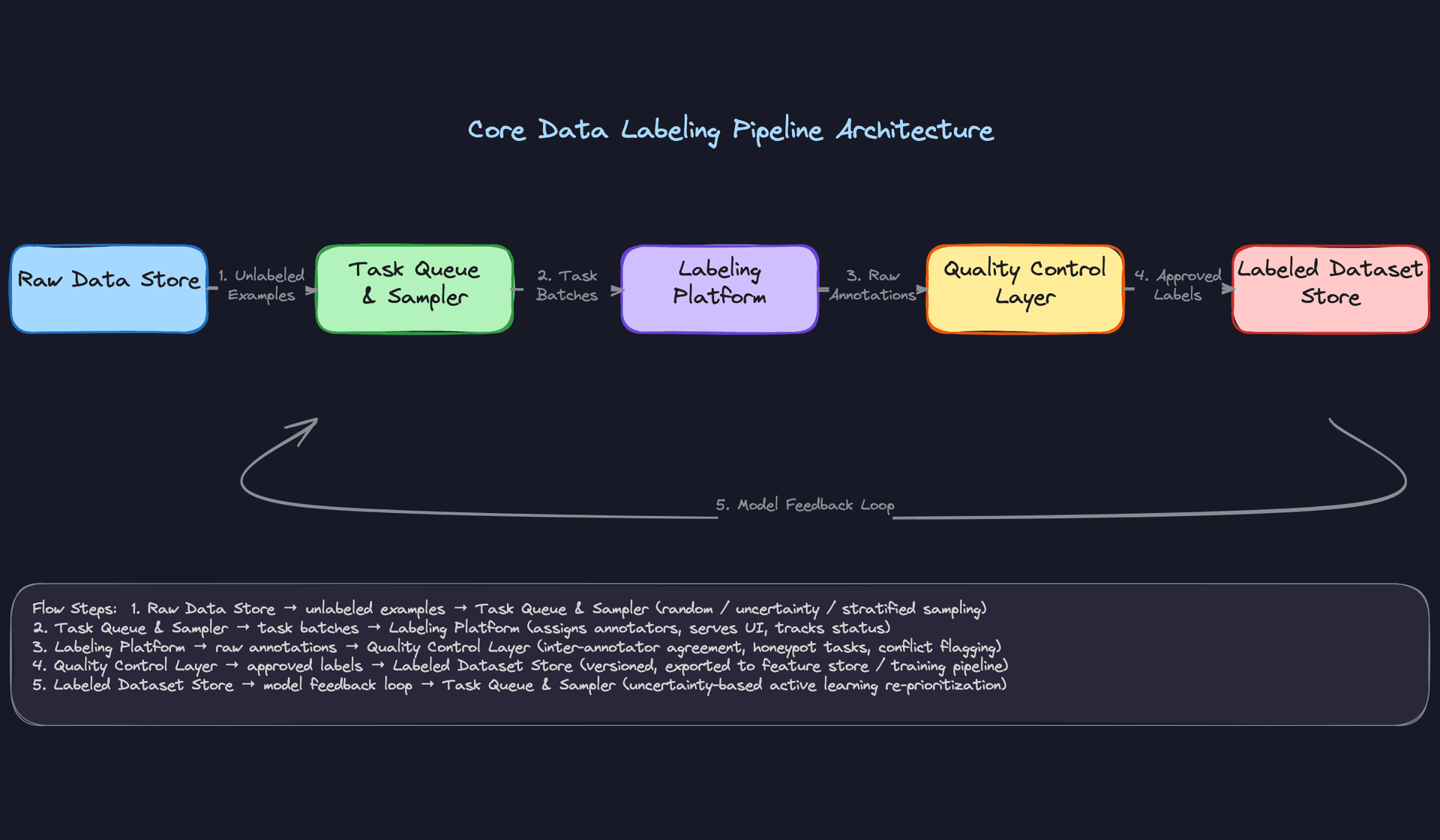
After the diagram, three properties matter most for your interview.
The feedback loop is the whole point. Once your model is deployed, it generates predictions on new data. The low-confidence ones, the cases where the model hedges, become your next annotation batch automatically. You're not manually curating what to label next; the model tells you where it's struggling. Interviewers will ask how you'd prioritize labeling budget, and this is the answer.
Quality signals are continuous, not one-time. Inter-annotator agreement (IAA) tells you whether two annotators looking at the same example agree. Honeypot accuracy tells you whether individual annotators are reliable. Label consistency over time catches annotator drift, the gradual shift that happens when workers get fatigued or guidelines get interpreted differently after week three than week one. You need all three because each catches a different failure mode.
The metadata is as important as the labels. Your pipeline needs to track which examples were labeled, by whom, with what confidence score, under which version of the annotation guidelines, and whether they've been included in any training run. Lose that provenance and you can't debug a model regression, can't audit for bias, and can't safely relabel when your schema changes. Interviewers at companies with mature ML platforms, think Uber, Airbnb, Meta, will probe this directly.
Common mistake: Candidates describe labeling as "send data to Scale AI, get labels back." That's one step in a much longer chain. The interviewer wants to hear about quality control, feedback loops, and metadata tracking. If you skip those, you sound like someone who's read about labeling but never shipped it.
Your 30-second explanation: "A labeling pipeline takes raw unlabeled data, decomposes complex annotation tasks into atomic decisions, routes them through a platform like Labelbox or Scale AI, runs quality checks using inter-annotator agreement and honeypot tasks, and exports versioned labels to training. Once the model is deployed, its low-confidence predictions feed back into the queue automatically, so the pipeline is a loop, not a one-shot process."
Patterns You Need to Know
In an interview, you'll usually need to pick a specific approach. Here are the ones worth knowing.
Crowdsourced Annotation with Consensus Voting
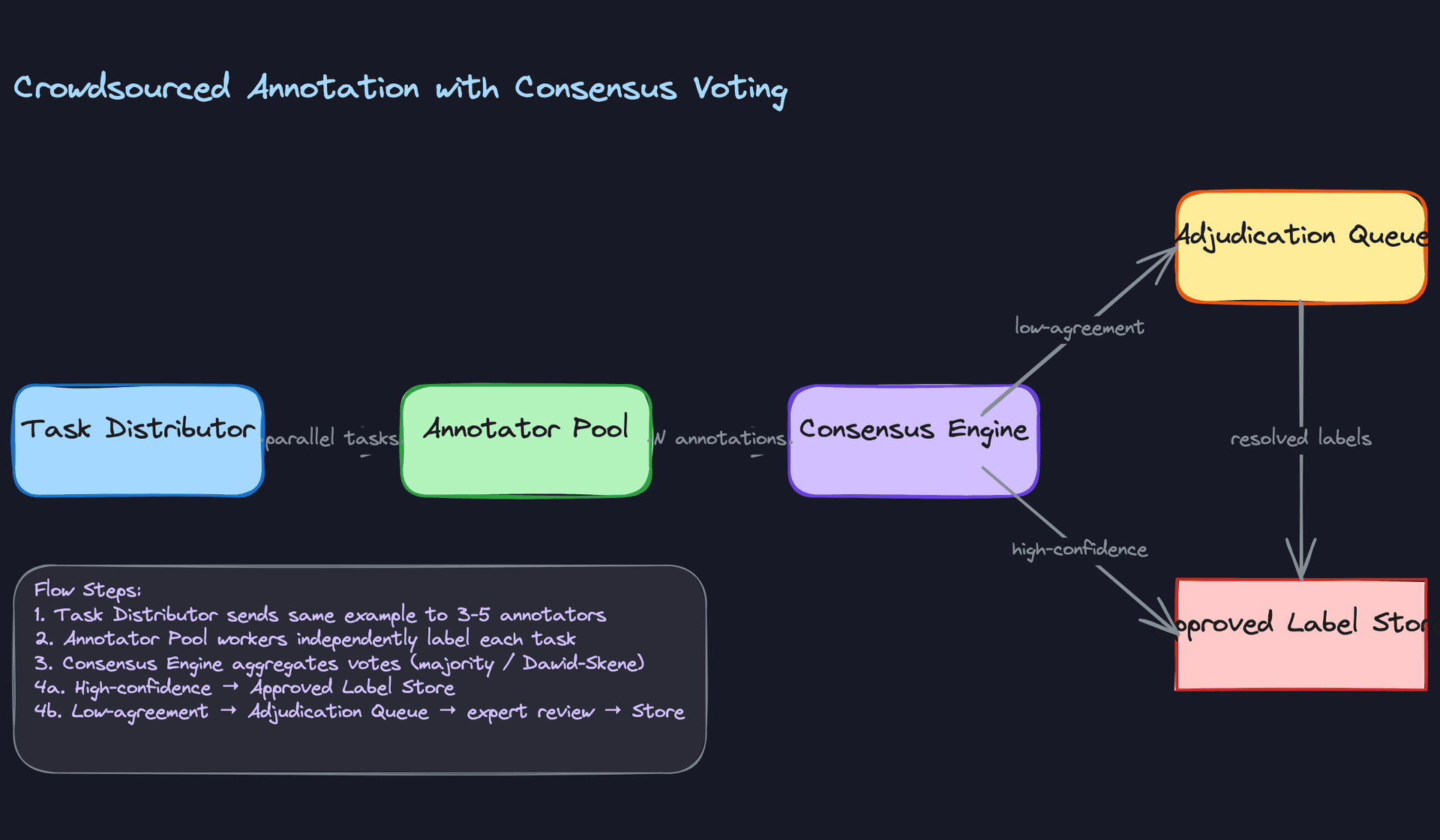
You send the same example to multiple independent annotators (typically 3 to 5), then aggregate their responses. The key word is "independent": annotators shouldn't see each other's answers before submitting. Once you have N responses, a consensus engine resolves them using majority vote, or something more sophisticated like Dawid-Skene, which weights each annotator's vote by their historical reliability. Examples where annotators disagree beyond a threshold get routed to a senior reviewer or adjudication queue.
The tradeoff is straightforward: crowdsourcing gives you high throughput at low cost per label, but individual annotator quality is variable. You compensate with redundancy (multiple annotators per task) and quality gates (honeypot tasks that catch workers who are clicking randomly). This pattern breaks down when the task requires real expertise, like reading a radiology scan or interpreting a legal clause.
When to reach for this: content moderation, sentiment classification, object detection in everyday images, or any task where a non-specialist can reliably make the judgment call.
Programmatic Weak Supervision
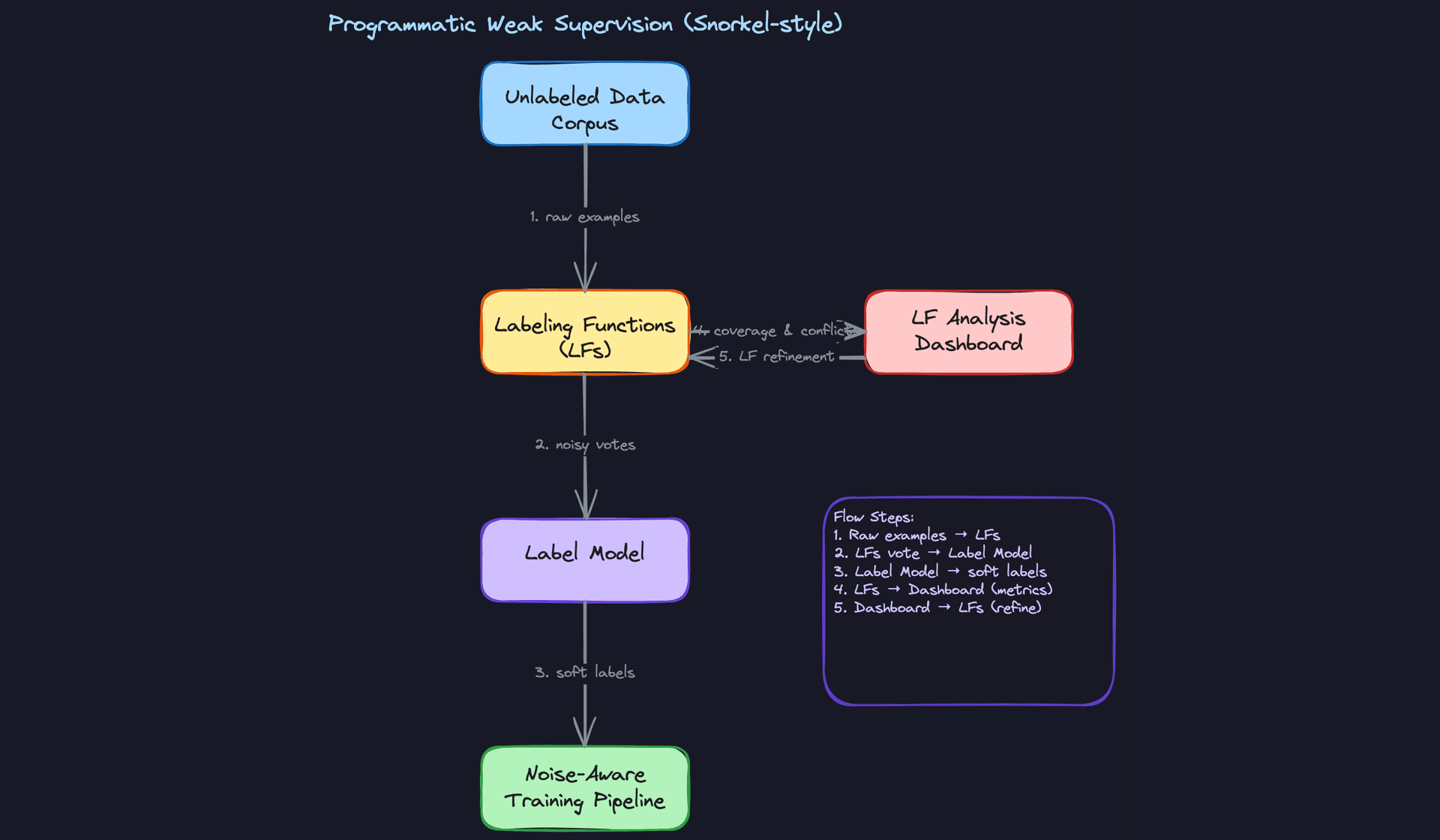
Sometimes you have millions of examples and no budget to hand-label them all. Weak supervision is the answer. Instead of human annotators, you write labeling functions (LFs): short heuristics, regex patterns, keyword lists, or calls to a pre-trained model that each cast a noisy vote on a label. No single LF is reliable, but a label model (Snorkel's generative model is the canonical example) learns each LF's accuracy and correlation with others, then combines their votes into probabilistic soft labels.
The downstream training pipeline then consumes those soft labels directly, often weighting examples by label confidence. You never get perfectly clean labels, but you get coverage over your entire corpus in hours instead of weeks. The practical discipline here is maintaining an LF analysis dashboard: you need to track each function's coverage (what fraction of examples it fires on), conflict rate with other LFs, and empirical accuracy against a small gold-standard validation set.
Interview tip: If you mention Snorkel, be ready to explain what a label model actually does. Saying "it combines noisy votes" is fine. Saying "it learns LF accuracies and their correlations to produce calibrated soft labels" is what gets you the follow-up nod.
When to reach for this: you have abundant unlabeled data, hand-labeling at scale is cost-prohibitive, and you can encode domain knowledge as rules or heuristics. Classic use cases include spam detection, medical record classification, and any NLP task where regex and keyword patterns capture a meaningful signal.
Active Learning Loops
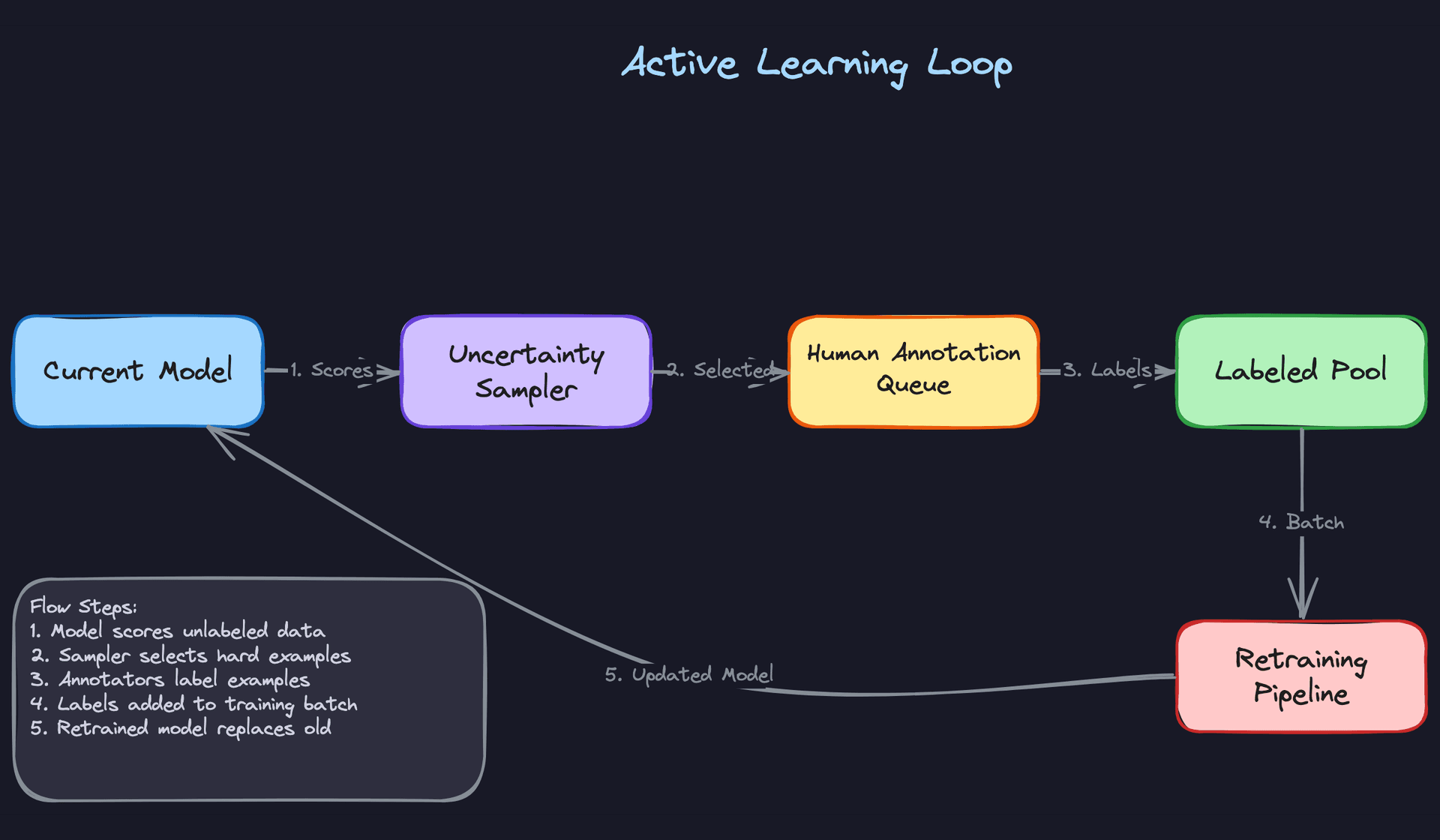
Active learning flips the usual workflow. Instead of randomly sampling what to label next, your current model scores the unlabeled pool and surfaces the examples it finds most confusing. Those are the ones that, if labeled, will move the model's decision boundary the most. Common selection strategies include least confidence (pick examples where the top predicted class has the lowest probability), margin sampling (smallest gap between top two classes), and query-by-committee (disagreement across an ensemble).
The loop looks like this: train a model, score unlabeled data, send the most uncertain examples to annotators, add new labels to the training pool, retrain, repeat. In practice, you batch the uncertainty sampling rather than retraining after every single label, because retraining is expensive. The payoff is significant: active learning can match the performance of random sampling with a fraction of the labeled data, which matters enormously when expert annotation costs $50 per example.
Common mistake: Candidates describe active learning as "we label the hard examples," but don't explain how you bootstrap it. You need an initial labeled seed set (even a few hundred examples) to train the first model. Without that, there's no model to generate uncertainty scores.
When to reach for this: annotation is expensive (expert labelers, legal review, medical imaging), your unlabeled pool is large, and you have the engineering capacity to run the feedback loop. Also a strong choice when you're adapting a general model to a specialized domain and want to minimize the expert time required.
Model-Assisted (Pre-labeling) Annotation
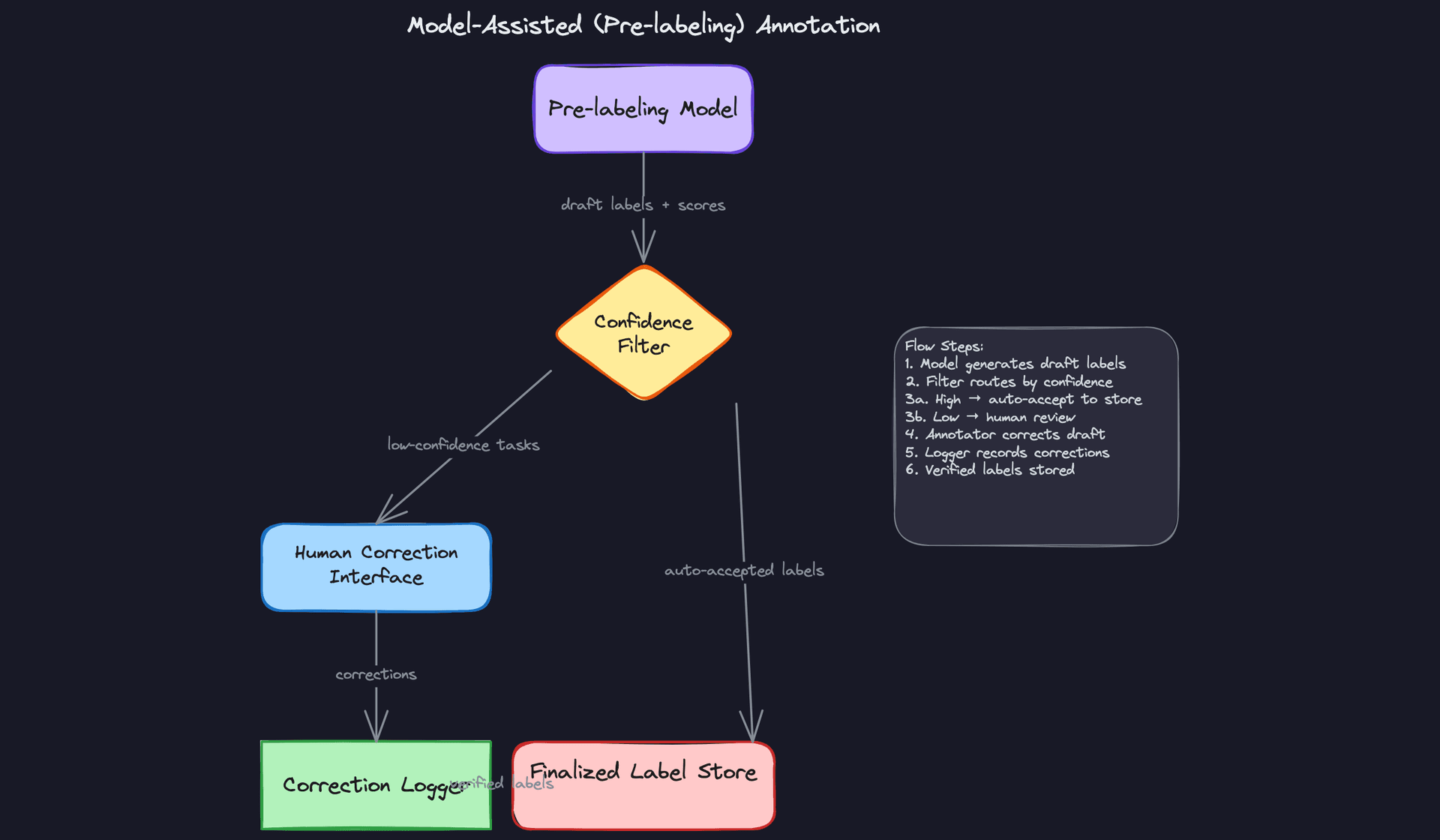
Most candidates forget this one, which is exactly why you should mention it. The idea is simple: run an existing model (or a foundation model like GPT-4 or a fine-tuned BERT) over your unlabeled data to generate draft labels automatically. A confidence filter then splits the output: high-confidence predictions get auto-accepted without human review; low-confidence or ambiguous cases go to a human annotator who sees the draft label and only needs to confirm, correct, or reject it.
That "confirm or correct" interface is the throughput multiplier. Annotators working from scratch might label 200 images per hour. Annotators reviewing model drafts can often hit 600 to 800 per hour, because most predictions are right and a click to confirm is faster than typing a label from scratch. The correction logger tracks which model predictions were wrong and by how much, feeding that signal back into model fine-tuning and LF refinement.
Key insight: Model-assisted labeling creates a compounding flywheel. Better labels produce a better model, which generates better pre-labels, which reduce annotator effort, which makes it cheaper to label more data. When you describe this in an interview, call it out explicitly. Interviewers designing content moderation or e-commerce tagging systems will recognize it immediately.
When to reach for this: you already have a decent model (even a general-purpose one), annotation throughput is the bottleneck, and your task has enough structure that model drafts are right more often than not.
Comparing the Patterns
| Pattern | Cost per label | Throughput | Label quality | Best fit |
|---|---|---|---|---|
| Crowdsourced consensus | Low | High | Medium | General tasks, high volume |
| Weak supervision | Very low | Very high | Noisy (probabilistic) | Rule-encodable domains, massive scale |
| Active learning | High (expert time) | Low | High | Expensive annotations, specialized domains |
| Model-assisted | Low-medium | Very high | High (human-verified) | When a pre-existing model exists |
For most interview problems involving general-purpose classification or NLP at scale, you'll default to crowdsourced annotation or weak supervision depending on whether you can encode domain knowledge as heuristics. Reach for active learning when the annotation cost is high and you need to stretch a limited expert budget as far as possible. Model-assisted labeling is almost always worth layering on top of any of the others once you have a working model: it's the fastest way to scale throughput without sacrificing quality, and mentioning it unprompted signals that you've thought about labeling as an engineering problem, not just a procurement one.
Real production systems rarely pick just one. A common combination: weak supervision generates noisy labels across millions of examples, active learning identifies the highest-uncertainty subset, and expert annotators review only those, with model-assisted pre-labeling to keep their throughput high. That layered approach is worth describing explicitly if your interviewer asks how you'd scale a labeling operation end-to-end.
What Trips People Up
Here's where candidates lose points — and it's almost always one of these.
The Mistake: Treating Labels as Binary
A candidate will say something like: "Once the data is labeled, we feed it into training." Full stop. No mention of confidence, no mention of annotator reliability, no mention of disagreement.
The interviewer then asks: "What if some of those labels are noisy?" And the candidate freezes, or worse, says "we'd just relabel them."
Every label in a real pipeline has a confidence score attached to it, an annotator reliability weight, and a history of how many people agreed. When you train on labels as if they're ground truth, you're lying to your model. The right answer involves soft labels, confidence-weighted loss functions, or at minimum a held-out gold set to calibrate against.
Interview tip: Say something like: "I'd treat labels probabilistically. High-agreement labels from reliable annotators get full weight in training. Low-confidence labels either get routed back for review or trained on with reduced loss weight using something like label smoothing or a noise-aware loss."
The Mistake: Forgetting That Label Schemas Change
This one is subtle, and most candidates never even think about it. You design a content moderation system, you label 500k examples as "toxic" or "not toxic," and six months later your policy team redefines what "toxic" means. Now you have 500k labels built on a definition that no longer exists.
Candidates who don't mention schema versioning are implicitly assuming annotation guidelines are static. They're not. Guidelines evolve as edge cases surface, as legal requirements shift, as your product changes.
What you need is a versioned ontology: every label is tagged with the schema version it was produced under. When the schema changes, you have an explicit decision to make: relabel the affected subset, discard it, or train on a mixture with schema version as a feature. Not mentioning this signals you've never actually shipped a labeling pipeline.
Common mistake: Candidates describe their labeling system as if it's a one-time batch job. The interviewer hears: "I've never had to maintain one of these in production."
The Mistake: Confusing Agreement with Correctness
"We measure inter-annotator agreement to make sure our labels are high quality." Sounds reasonable. It's not wrong exactly, but it's incomplete in a way that will cost you.
High IAA means annotators agree with each other. It says nothing about whether they're right. For subjective tasks like toxicity detection or sentiment analysis, a pool of annotators can consistently agree and consistently be biased in the same direction. If your annotator pool skews toward a particular demographic, they might uniformly under-flag certain types of harmful content. IAA looks great. Your model learns a biased definition of harm.
The fix is separating agreement metrics from accuracy metrics. You need a gold-standard validation set, ideally constructed by domain experts or through adjudication, that you use to measure annotator accuracy independently of how much they agree with each other. Bring this up unprompted and you'll stand out.
The Mistake: Treating Production as Outside the Labeling System
A candidate walks through an elegant offline labeling pipeline: raw data, annotation platform, quality control, training. The interviewer asks: "How does this system improve over time?" The candidate says: "We'd periodically collect more data and label it."
That's leaving the best signal on the table. Once your model is deployed, production is generating implicit labels constantly. User corrections, rejection rates, escalation patterns, click-through behavior on recommendations, these are all weak supervision signals. A user flagging a recommendation as irrelevant is a label. A moderator overriding an automated decision is a label.
Candidates who only think about offline labeling miss the data flywheel entirely. The strongest answer connects your labeling pipeline back to production: low-confidence model predictions get queued for human review, user feedback gets ingested as weak labels, and the system gets smarter with every interaction rather than only between training runs.
Interview tip: Frame it as a closed loop: "After deployment, I'd route the model's uncertain predictions back into the annotation queue, and capture implicit user signals as weak supervision. The labeling pipeline doesn't stop when the model ships."
How to Talk About This in Your Interview
When to Bring It Up
Most candidates wait for the interviewer to ask about data. Don't. The moment you're designing any ML system, labeling is fair game to raise proactively.
Specific triggers to watch for:
- The interviewer says "assume you have labeled data" — that's an invitation to push back gently and ask where it comes from.
- You're designing a content moderation, medical imaging, fraud detection, or recommendation system. All of these have non-trivial labeling problems baked in.
- The interviewer asks about model quality, training data, or how you'd improve the model over time. Labeling is the answer to all three.
- You hear "cold start" or "we're launching a new vertical." That's a labeling problem before it's a modeling problem.
When you proactively bring up labeling, frame it as a data flywheel: better labels produce better models, better models generate better pre-labels, pre-labels reduce annotation cost, and the cycle compounds. Interviewers at Meta, Google, and Airbnb have heard a hundred candidates talk about model architecture. Fewer talk about where the training signal actually comes from.
Sample Dialogue
This first exchange covers the most common probe you'll face.
Interviewer: "Okay, so you're building this content moderation classifier. How do you get labeled data for it?"
You: "Before I commit to a strategy, I want to think through a few dimensions. How much data are we talking? If we need millions of examples to bootstrap, that changes things versus needing a few thousand for fine-tuning. And how complex is the label schema — binary toxic/not-toxic, or multi-class with severity levels?"
Interviewer: "Let's say multi-class, five categories, and we need around 500k examples to start."
You: "At that volume and complexity, I'd probably layer two approaches. First, weak supervision to get noisy labels at scale — write labeling functions based on keyword patterns, existing blocklists, and maybe a pre-trained toxicity model from HuggingFace. That gets us coverage fast. Then I'd use active learning to identify the examples the model is most uncertain about and route those to expert annotators for clean labels. The weak supervision handles breadth, the expert labels handle the hard cases where it matters most."
Interviewer: "What if your labels are noisy? The weak supervision outputs aren't going to be clean."
You: "Right, so I'd treat them as soft labels rather than hard ground truth. Instead of one-hot targets, I'd use the label model's probability distribution as the training signal and apply a confidence-weighted loss — examples where the label model is uncertain contribute less to the gradient. I'd also keep a small gold-standard set, maybe 2-3k examples labeled by domain experts, to calibrate against and catch systematic drift in my labeling functions over time."
Interviewer: "That makes sense. What about the platform — would you build this or buy?"
You: "For most teams, buy first. Scale AI or Labelbox gets you annotator management, IAA scoring, and task queuing out of the box. Building that infrastructure in-house is a significant engineering investment that rarely pays off unless you have very specialized UI needs — think 3D point cloud annotation for autonomous vehicles — or you're doing this at a volume where the per-label cost of a vendor becomes prohibitive. At Uber or Airbnb scale, you might eventually build internal tooling for the high-volume commodity tasks and keep the vendor for complex or sensitive ones."
Now here's what a pushback looks like, and how to handle it without folding.
Interviewer: "You mentioned active learning. Isn't that overkill here? We have budget for annotation."
You: "Fair point — if budget isn't the constraint, active learning adds operational complexity that might not be worth it. The main reason I'd still consider it isn't cost, it's data efficiency. With 500k examples and five imbalanced categories, random sampling means annotators spend most of their time on easy negatives. Active learning steers annotation toward the decision boundary, which tends to produce better-calibrated models faster. But if you're telling me the label distribution is relatively balanced and we have time, I'd simplify and go with stratified random sampling plus consensus voting. Less moving parts."
Interviewer: "Yeah, let's say balanced for now."
You: "Then I'd drop the active learning loop for the initial build and revisit it once we have a deployed model generating uncertainty signals from real traffic. That's actually when it becomes most valuable anyway."
That pivot matters. Defending your answer is good. Updating it when the interviewer gives you new information is better.
Follow-Up Questions to Expect
"How do you measure label quality?" Track inter-annotator agreement (Cohen's kappa for categorical labels), honeypot accuracy against gold-standard tasks, and label consistency over time to catch annotator drift.
"What happens when your annotation guidelines change mid-project?" Version your label schema, flag all examples annotated under the old definition, and decide explicitly whether to relabel them or exclude them from training — mixing schema versions silently is how you corrupt a dataset.
"How do you handle class imbalance in your labeling strategy?" Stratified sampling ensures rare classes get enough annotator attention; without it, you'll have a beautifully labeled majority class and a garbage minority class.
"How do you get labels from production once the model is deployed?" Implicit signals like user corrections, escalations, and rejection rates are labels; explicit signals come from building feedback UI into the product itself — both feed back into the labeling queue.
What Separates Good from Great
- A mid-level answer picks one labeling approach and describes it well. A senior answer reasons through the tradeoff triangle — cost, throughput, quality — and arrives at a hybrid strategy that's calibrated to the specific constraints of the system being designed.
- Mid-level candidates treat labeling as a one-time setup step. Senior candidates describe a closed loop: production traffic surfaces hard examples, those examples become labeling tasks, new labels retrain the model, and the model's improved pre-labels reduce future annotation cost.
- The detail that consistently separates strong candidates is probabilistic thinking about labels. Saying "we'll train on soft labels with confidence-weighted loss" signals you've actually dealt with noisy data before. Saying "we'll just get good labels" signals you haven't.
Key takeaway: Labeling isn't a prerequisite you hand-wave past — it's a system you design, and walking through it deliberately (strategy, quality control, feedback loop) is one of the clearest signals of ML engineering maturity you can send in an interview.
