Feature Engineering at Scale
A team at a major e-commerce company spent months building a recommendation model. Offline metrics looked excellent. They shipped it. Within days, click-through rates were worse than the model it replaced. The culprit wasn't the model architecture or the training data. It was the features. The batch pipeline computing "user's recent browsing history" ran every 24 hours. In production, the model was scoring requests against features that were sometimes 23 hours stale. The "recent" browsing history it saw during training looked nothing like what it saw in production.
Feature engineering at scale is the work of turning raw events (clicks, purchases, searches, page views) into the numerical inputs your model actually consumes, and doing that reliably across training, evaluation, and live inference. In a notebook, this is just pandas and some aggregations. In production, it's a distributed pipeline problem. You're computing features over billions of events per day, storing them so they can be retrieved in under 10 milliseconds, and guaranteeing that the number your model saw during training is the same number it sees when scoring a real request at 3am.
That last guarantee is where most systems quietly fail. Interviewers at companies like Meta, Uber, and Airbnb aren't testing whether you know what a feature is. They're testing whether you can reason about where features come from, how fresh they are, what happens when the pipeline lags, and how you prevent your training data from lying to you. That's what this is really about.
How It Works
Every feature your model consumes started as a raw event somewhere: a click, a transaction, a search query, a page load. The pipeline's job is to take that raw signal and turn it into a number (or embedding, or categorical value) that a model can actually use, then make sure that number is available in the right place at the right time.
Here's the lifecycle, step by step.
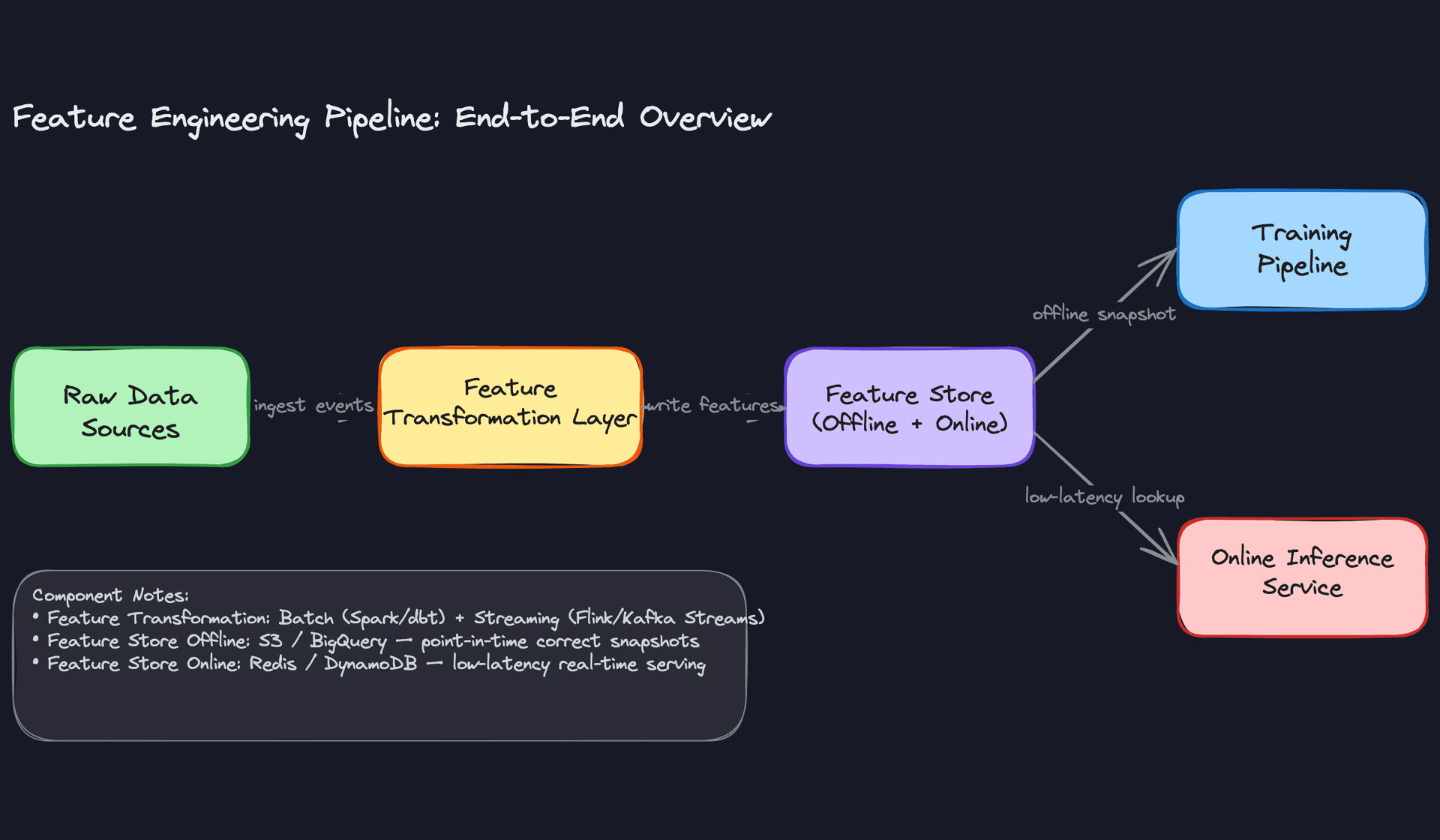
Raw events land in a message queue or data warehouse. Kafka is the typical entry point for real-time events; your data warehouse (BigQuery, Hive, Snowflake) holds the historical record. From there, a transformation layer does the actual feature computation: aggregating, normalizing, joining across tables. This is where "user clicked 14 times in the last hour" gets computed from raw click events. The result gets written to a feature store. At serving time, your inference service looks up the feature by entity ID and gets back a vector ready to feed the model.
Think of it like a supply chain. Raw materials (events) get processed into finished goods (features), stored in a warehouse (feature store), and shipped on demand (serving lookup). The challenge is that every step in that chain adds latency and introduces a new place where things can go out of sync.
Here's what that flow looks like:
The Offline/Online Split
The most important structural decision in this pipeline is where features live and how they're computed.
Offline features are computed in batch, usually by a Spark or dbt job running on a schedule. "User's average order value over the last 30 days" is a classic offline feature. It doesn't change by the second, so recomputing it hourly or daily is fine. These features live in your offline store, typically S3 or BigQuery, and get read by training pipelines to build datasets.
Online features need to be fresh. "Number of items this user viewed in the last 5 minutes" is useless if it's six hours stale. These get computed continuously from a streaming pipeline (Flink, Kafka Streams) and written directly to a low-latency online store like Redis or DynamoDB. Your inference service reads from there at request time, usually in under 10 milliseconds.
Your interviewer will ask you to distinguish these. The answer isn't "streaming is better." It's "it depends on how quickly the feature goes stale and what the compute cost is."
The Feature Store as Connective Tissue
The feature store is what makes this system coherent rather than a collection of ad-hoc pipelines. It serves two masters simultaneously: the training pipeline (which needs high-throughput reads over historical snapshots) and the online inference service (which needs sub-millisecond point lookups).
That's why production feature stores are almost always dual-store systems. The offline store (S3, BigQuery, Hive) optimizes for throughput and historical access. The online store (Redis, DynamoDB) optimizes for latency. Tools like Feast, Tecton, and SageMaker Feature Store manage the sync between them so you don't have to hand-roll that logic yourself.
Key insight: The feature store isn't just a database. It's the guarantee that training and serving see the same feature values, computed the same way. Without it, you're one pipeline bug away from training-serving skew.
Feature Keys: The Lookup Mechanism
Every feature is stored and retrieved by an entity key. User features are keyed by user_id. Item features by item_id. Session features by session_id. At training time, you join your label data to feature snapshots using these keys. At serving time, your inference service passes the same keys to the feature store and gets back the current feature values.
This sounds simple, but it's where a lot of systems break. If your training pipeline joins on user_id but your serving infrastructure looks up features using a hashed session token that doesn't map cleanly to the same user, you'll get mismatches. The key schema has to be consistent end to end.
The Happy Path vs. Reality
What the diagram shows is the clean version. Events arrive on time, transformations run without errors, the feature store is always fresh, and the model sees exactly what it expects.
In practice, events arrive late. Streaming jobs fall behind. Schema changes break downstream consumers. A new feature gets added and someone has to recompute it over three years of history before the next model can ship. Point-in-time correctness gets violated because someone did a naive join without thinking about label leakage.
Most of the interesting interview conversation happens in these failure modes, not the happy path. Know the diagram well enough to draw it, then be ready to talk about what breaks.
Your 30-second explanation: "Feature engineering at scale is a pipeline that takes raw events, transforms them into model-ready values, and stores them in a dual-store feature store: an offline store for training, an online store for serving. Features are keyed by entity ID so training and serving can look up the same values consistently. The hard parts are keeping features fresh, making sure training and serving see identical values, and handling backfills when something changes."
Patterns You Need to Know
In an interview, you'll usually need to pick a specific approach. Here are the ones worth knowing.
Batch Feature Pipeline
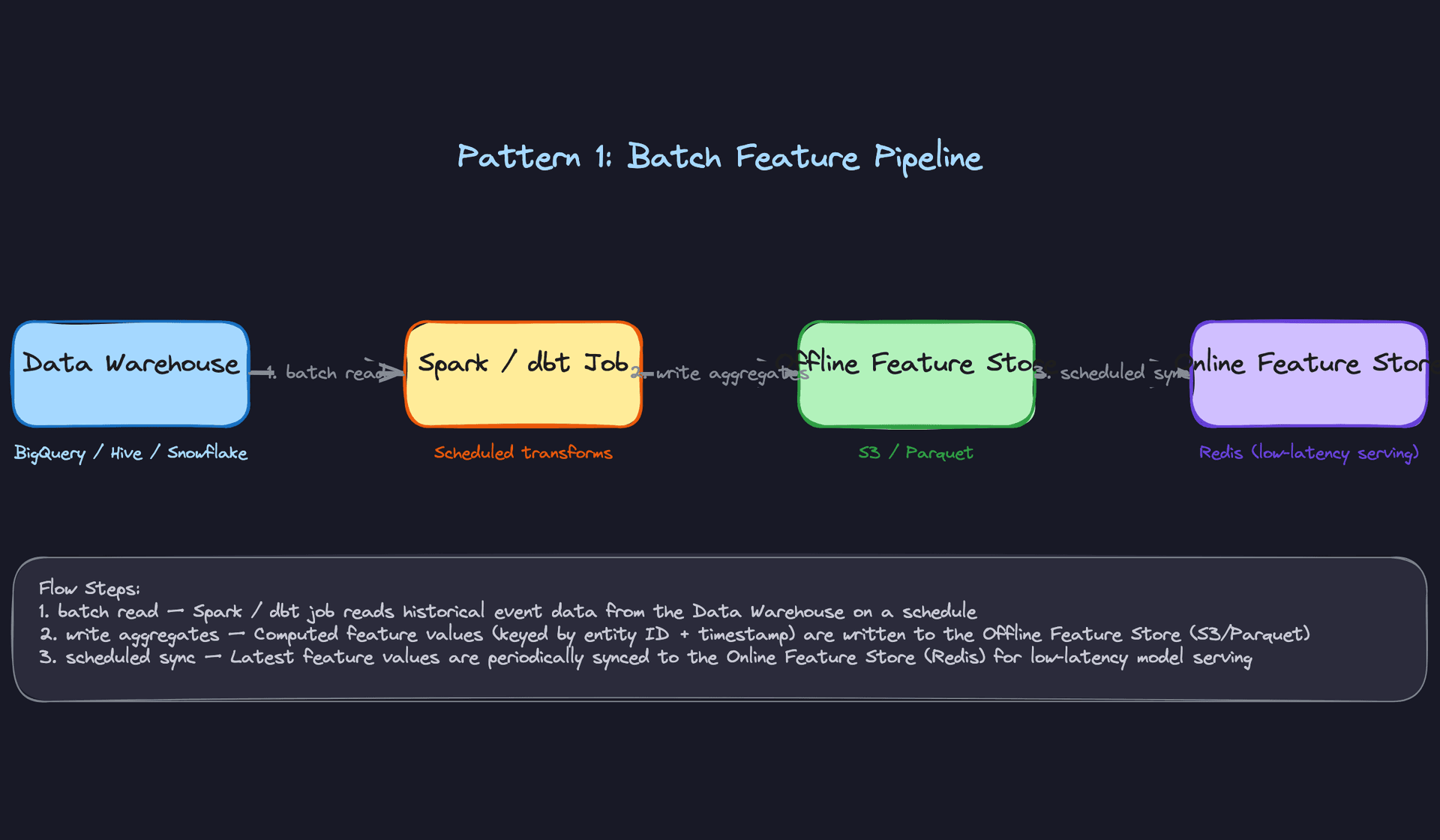
A scheduled job (Spark, dbt, or similar) reads from your data warehouse and computes aggregate features over historical windows. Think "user's total purchases in the last 30 days" or "item's average rating over the past week." The job runs on a fixed cadence, hourly or daily, and writes results to the offline store. A separate sync process then pushes the latest values into the online store (Redis, DynamoDB) so the inference service can look them up at low latency.
The tradeoff is freshness. If your Spark job runs every hour, your features are up to an hour stale. For slowly-changing signals, that's fine. For anything session-level, it isn't. When your interviewer asks "how fresh do your features need to be?", that's your cue to decide whether batch is sufficient or whether you need something faster.
When to reach for this: any feature that aggregates over days or weeks, where staleness of minutes-to-hours is acceptable and compute cost matters.
Streaming Feature Pipeline
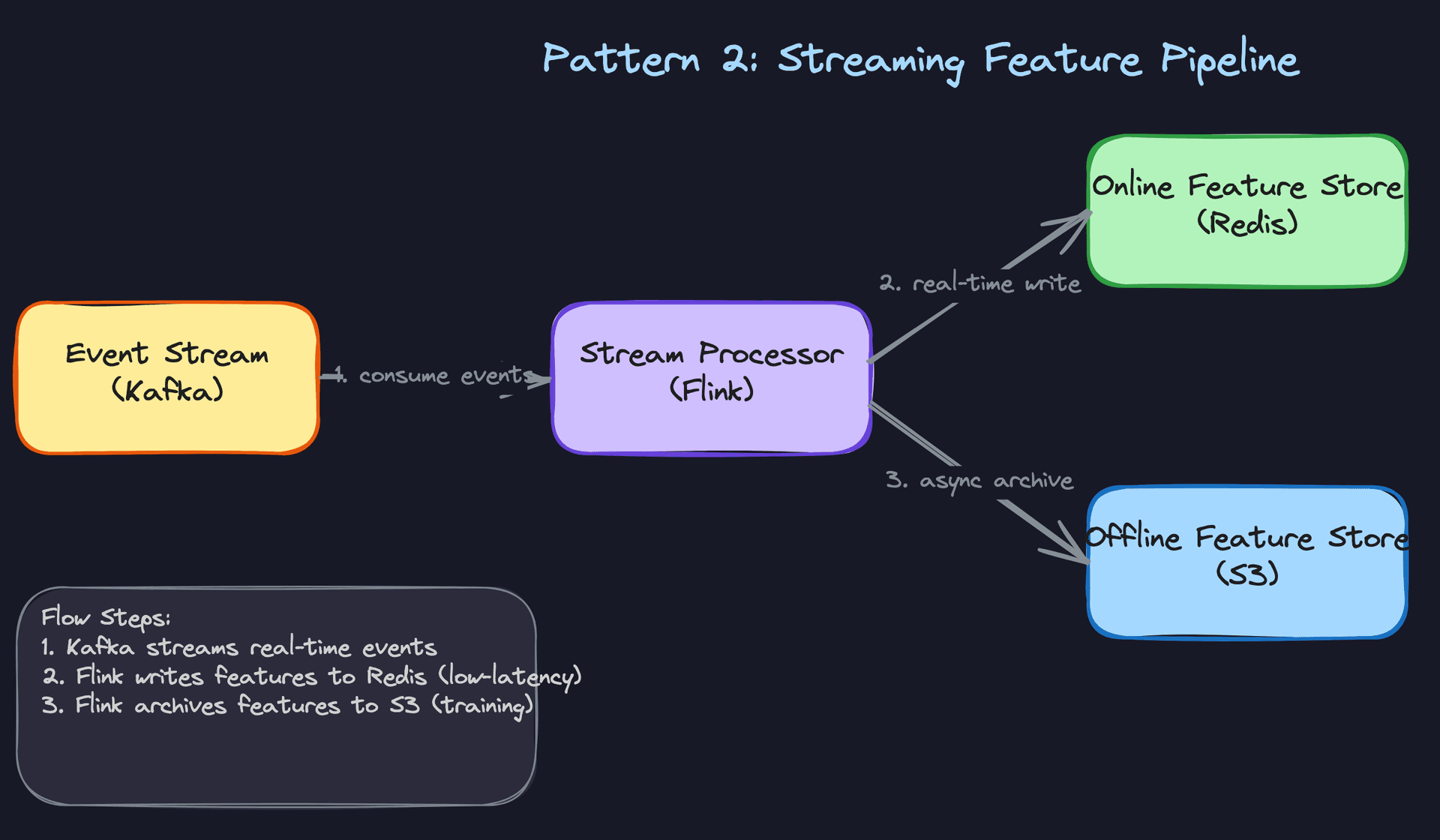
Instead of waiting for a scheduled job, a stream processor like Flink or Kafka Streams consumes events as they arrive and continuously updates feature values. "Clicks in the last 5 minutes" or "number of failed login attempts in the current session" are features that go stale in seconds, not hours. The stream processor writes directly to the online store so inference always sees a near-real-time value, and also archives to the offline store asynchronously for training consistency.
The complexity cost is real. You're now operating stateful stream processing, managing watermarks and late-arriving events, and keeping the offline archive in sync with what the online store served. Interviewers will probe whether you understand this operational overhead, so don't propose streaming just because it sounds impressive. Have a reason.
Interview tip: If you propose a streaming pipeline, expect the follow-up: "What happens when an event arrives late?" Have an answer ready. Flink's event-time processing and watermarks handle this, but you need to know what "handle" actually means for your feature's correctness guarantees.
When to reach for this: real-time personalization, fraud detection, or any feature where a window of minutes-or-less determines model quality.
On-Demand Feature Computation
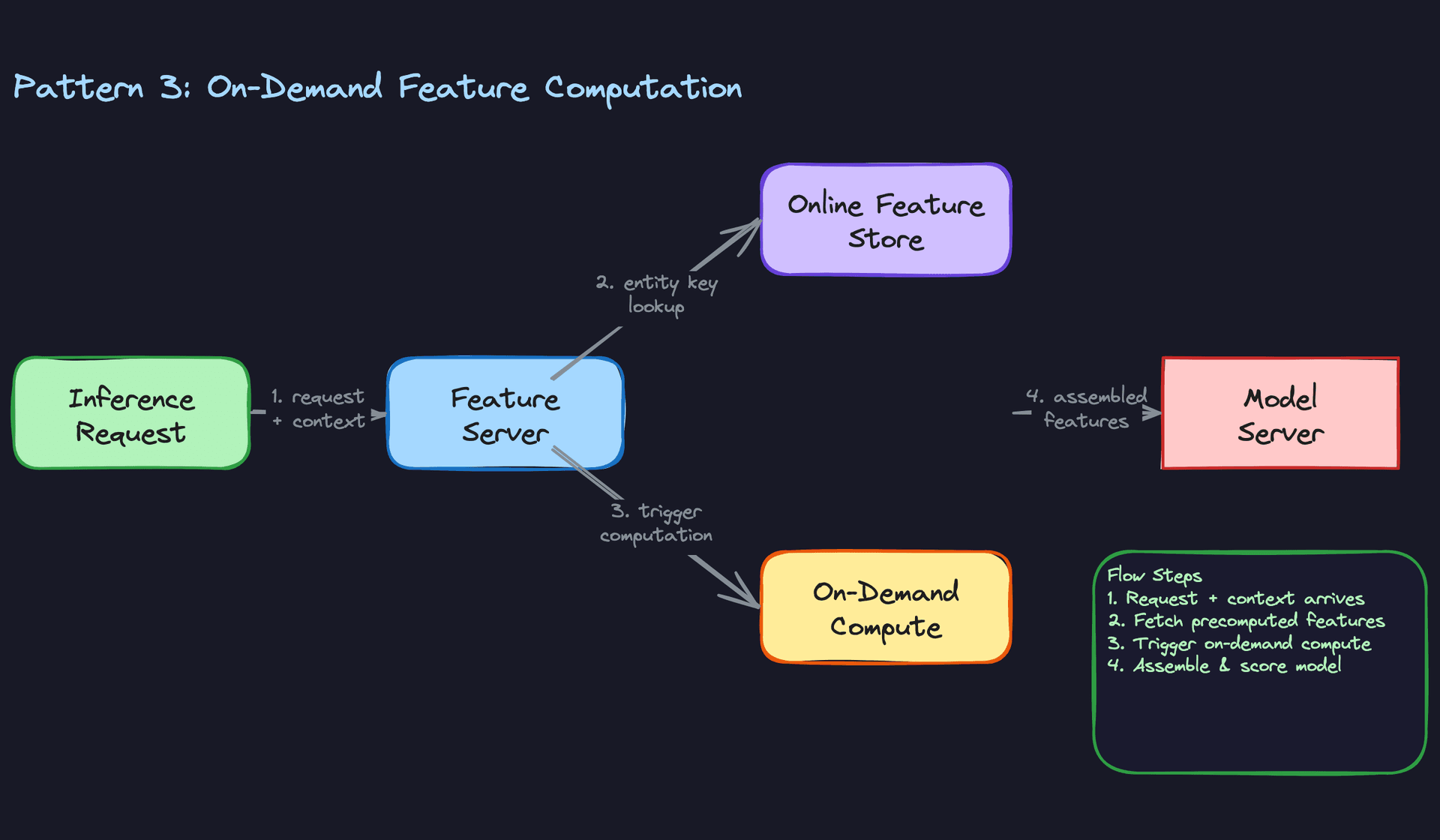
Some features can't be precomputed because they depend on the specific combination of inputs that only exists at request time. Query-document similarity in a search ranking model is the classic example. You don't know the query until the user types it, so you can't precompute similarity scores for every possible query-document pair. Instead, a feature server computes these values inline during inference, after retrieving the precomputed entity features (user profile, item stats) from the online store.
This pattern keeps your feature store lean by offloading context-dependent computation to serving time. The risk is latency. Every millisecond of on-demand computation adds to your p99. In practice, you'll want this computation to be fast (embedding dot products, simple arithmetic) and you'll want to cache results aggressively when the same context repeats.
Common mistake: Candidates propose on-demand computation for features that could easily be precomputed. If a feature doesn't depend on request-time context, precompute it. On-demand is a last resort, not a default.
When to reach for this: cross-entity features (query vs. document, user vs. item), session-derived signals that don't exist until the request arrives, or any feature where the input space is too large to enumerate in advance.
Point-in-Time Correct Training Dataset
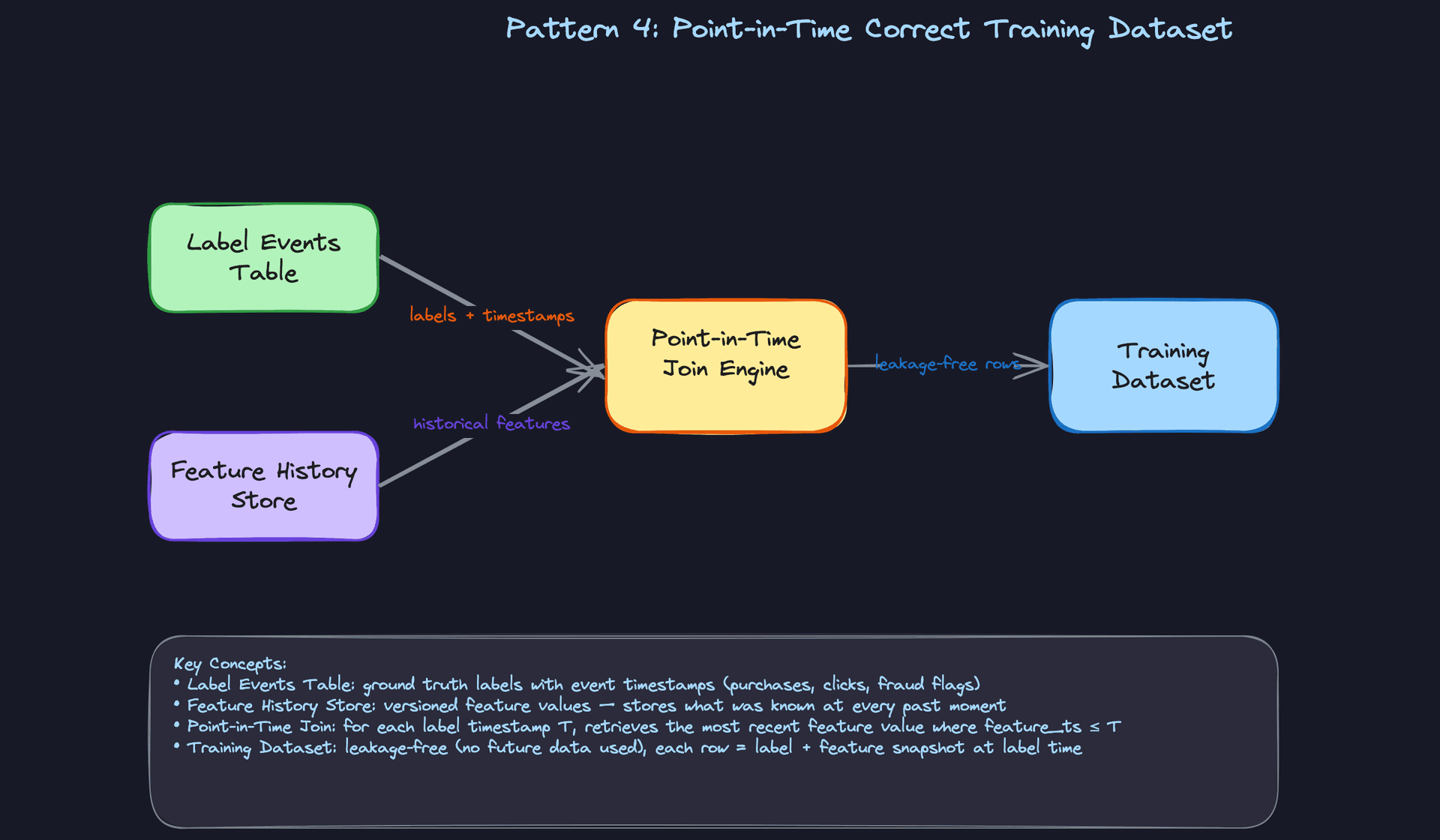
This pattern is about how you build your training data, not how you serve features. When you join feature values to label events, you need to use the feature value that existed at the moment the label was generated, not the value computed later. If a user made a purchase at 3pm and your feature pipeline ran at 4pm, using the 4pm feature values leaks future information into training. The model learns from data it could never have seen in production.
Tools like Feast and Tecton implement "as-of joins" to enforce this. For each label event, they look up the most recent feature value whose timestamp is strictly before the label timestamp. Without this, your offline metrics will look better than your online metrics, and you'll spend weeks debugging a model that "worked in training."
Key insight: Point-in-time correctness is the single most common source of the "great offline, terrible online" failure pattern. Raising this proactively in an interview signals that you've shipped real ML systems, not just trained models in notebooks.
When to reach for this: any supervised learning problem where you're joining historical features to historical labels. This isn't optional; it's always the right approach.
Feature Backfill
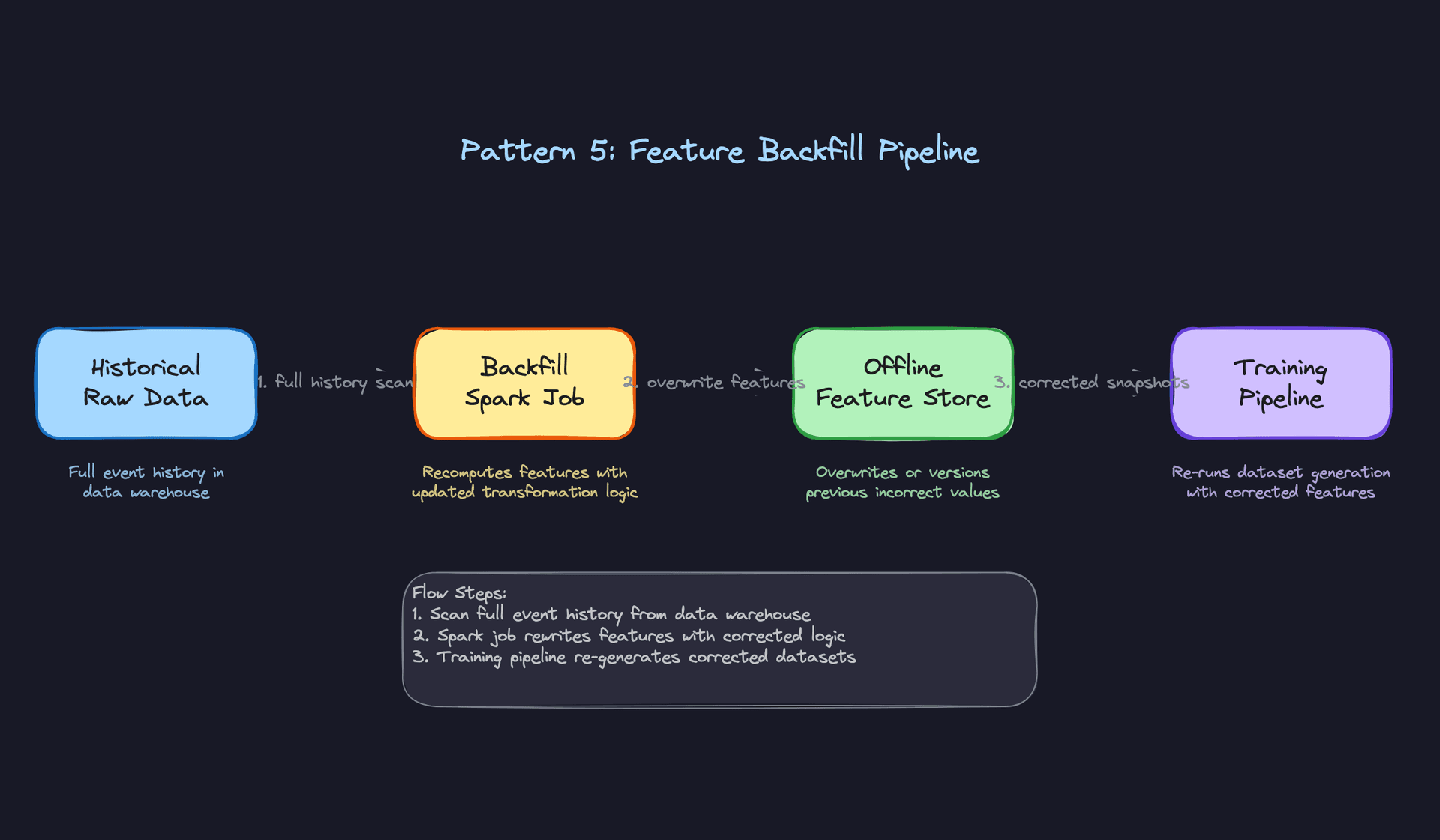
Every time you add a new feature or fix a bug in transformation logic, you need to recompute that feature's values over your entire historical dataset. Otherwise your training data has a gap: old rows have no value for the new feature, and the model can't train on them. Backfill is a Spark job that scans your full event history, applies the corrected transformation, and overwrites or versions the results in the offline store.
The catch is cost. Scanning three years of event data can take 48 hours of cluster time and block your next model release. Teams often underestimate this when planning feature work. A feature that takes a day to implement might take a week to ship because of backfill. Some teams mitigate this by maintaining a "feature backfill queue" and running backfills in parallel, but it's still the most common bottleneck in ML iteration speed.
When to reach for this: any time you introduce a new feature or correct a transformation bug, before retraining. There's no shortcut.
Comparing the Patterns
| Pattern | Freshness | Compute Timing | Primary Use Case |
|---|---|---|---|
| Batch Pipeline | Minutes to hours | Scheduled (offline) | Slowly-changing aggregates |
| Streaming Pipeline | Seconds | Continuous (real-time) | Session-level, time-sensitive signals |
| On-Demand Computation | Request-time | At inference | Cross-entity, context-dependent features |
| Point-in-Time Join | Historical | At dataset creation | Leakage-free training data |
| Feature Backfill | Historical | One-time recompute | New features, bug fixes |
For most interview problems, you'll default to the batch pipeline for aggregate features and layer in streaming only where freshness genuinely matters. Reach for on-demand computation when your feature depends on request-time context that can't be enumerated in advance. And whenever you're describing how you'd build a training dataset, mention point-in-time correctness unprompted. It's a small signal that lands loudly.
What Trips People Up
Here's where candidates lose points — and it's almost always one of these.
The Mistake: Handwaving Training-Serving Skew
A candidate describes their feature pipeline confidently: "We compute a 30-day rolling purchase count in Spark and use it as a training feature." The interviewer nods, then asks: "What runs when the model scores a live request at 2am?"
Silence. Or worse: "We recompute it on the fly."
That's the trap. Describing a feature in training without explaining how the exact same value lands at serving time is one of the most common gaps interviewers probe for. If your Spark job runs a 30-day window with a specific null-handling strategy and a particular timezone assumption, your online serving path needs to produce the same number. Different code paths mean different distributions, and that's skew.
Interview tip: Say something like: "We enforce transformation parity by sharing feature logic through a common library, and we use the feature store as the single source of truth for both training reads and online serving. We also run shadow logging in production to catch drift early."
That answer tells the interviewer you've actually shipped this, not just designed it on a whiteboard.
The Mistake: Skipping Point-in-Time Correctness
Most candidates know what label leakage is in the abstract. Fewer catch it when it's hiding in their own design.
The bad answer sounds like: "We join the user's feature table to the label table on user_id." Full stop. No mention of timestamps. The interviewer hears: "I'm going to train on features that include information from after the event I'm trying to predict."
If you're predicting whether a user will make a purchase, and one of your features is "total purchases to date," a naive join will include the purchase you're predicting. Your model will look incredible offline and fall apart in production. This is one of the most reliable ways to ship a broken model with high confidence.
Common mistake: Candidates treat the training join as a simple table merge. The interviewer hears that the training dataset is contaminated with future information.
The fix is an as-of join: for each label event, retrieve the most recent feature value that existed before that timestamp. Tools like Feast and Tecton enforce this. If you're rolling your own, you need explicit timestamp filtering in your join logic. Proactively raising this in the interview signals senior-level thinking. You don't have to wait to be asked.
The Mistake: Treating the Feature Store as Optional Complexity
"We just compute the features at request time inside the inference service. Keeps things simple."
This works in a notebook. It breaks in production. Computing features inline at serving time means your transformation logic lives in two places (training and serving), which reintroduces skew. It also means every inference request is doing aggregation work that could have been precomputed, which kills your latency SLA under load. And when something goes wrong, you have no historical record of what feature values the model actually saw.
A feature store earns its complexity when you have multiple models consuming the same features, when you need sub-10ms serving latency, or when you need to audit what the model saw for a specific prediction. That's most production ML systems.
Interview tip: You don't have to advocate for a feature store in every scenario. But you should be able to say when it's worth it and why. "For a low-traffic internal tool, inline computation is fine. At scale, the dual-store architecture pays for itself in consistency and debuggability."
The Mistake: Underestimating Backfill Cost
"We can just add the feature and retrain." This is the answer that makes senior engineers wince.
Adding a new feature means computing its values over your entire training history. If your model trains on three years of user events and your Spark cluster takes 48 hours to backfill a single feature, you've just added two days to your release cycle. Do that twice in a sprint and your model launch slips by a week.
Backfill cost is a feature adoption tax. The more complex the transformation (multi-table joins, session reconstruction, sliding windows), the higher the tax. Interviewers at companies with large data volumes will push on this directly, especially if you propose adding several new features as part of your design.
The right framing is to treat backfill as a first-class engineering concern: estimate the compute cost before committing to a feature, design transformations to be parallelizable, and consider whether incremental backfill is possible instead of a full history scan. Saying this unprompted tells the interviewer you've felt this pain before.
The Mistake: Conflating Freshness and Latency
These are different things. Candidates use them interchangeably, and interviewers notice.
Freshness is about staleness: how recent is the feature value? A user's "clicks in the last 5 minutes" feature goes stale fast. A user's "account age in days" barely changes. Latency is about retrieval speed: how fast can you look up the feature at serving time?
A feature can be fresh but slow to retrieve (imagine recomputing it on-demand from a cold data warehouse). It can also be stale but instantly available (a batch-computed aggregate sitting in Redis). These are independent axes, and the right architecture depends on which one your model actually needs.
Common mistake: Candidates say "we need low-latency features" when they mean "we need fresh features." The interviewer asks a follow-up and the answer falls apart.
When you're discussing feature infrastructure, be explicit: "This feature has a freshness SLA of 30 seconds, so we use a streaming pipeline. The retrieval latency target is under 5ms, so we serve it from Redis." Two sentences, two separate concerns, zero ambiguity.
How to Talk About This in Your Interview
When to Bring It Up
Feature engineering infrastructure belongs in the conversation earlier than most candidates think. Don't wait to be asked.
Bring it up when you hear: - "Our model performs great offline but degrades in production" (training-serving skew, almost certainly) - "We need real-time personalization" (streaming features vs. batch, freshness tradeoffs) - "We're adding a new signal to the model" (backfill cost, pipeline complexity) - "How would you build the training dataset?" (point-in-time correctness, as-of joins) - "How does the model get its inputs at serving time?" (feature store, on-demand computation, latency budget)
If the interviewer describes a recommendation, fraud detection, or search ranking system, feature freshness and skew are almost always relevant. Raise them proactively.
Sample Dialogue: Training-Serving Skew
Interviewer: "Walk me through how you'd make sure the features your model trains on match what it actually sees in production."
You: "The core problem is transformation parity. If my training pipeline computes a 7-day rolling click count in Spark, but my serving path recomputes it differently, or pulls it from a different source, the model is effectively seeing a different distribution at inference time. The cleanest solution is a feature store as the single source of truth. Both the training pipeline and the inference service read from the same store, and ideally the transformation logic is defined once and shared."
Interviewer: "But what if the feature store has stale data? How do you catch that?"
You: "Shadow logging. During a canary rollout, you log the feature values the model actually received at serving time, then compare them against what the training distribution looked like. If you see the means drifting or new nulls appearing, that's your signal something's off upstream. You can also set feature freshness SLAs and alert when a feature hasn't been updated within its expected window."
Interviewer: "Okay, and what if the team doesn't have a feature store yet?"
You: "Then skew is almost guaranteed to creep in. You can mitigate it by at least sharing transformation code as a library between the training and serving paths, but you lose the consistency guarantees and the audit trail. I'd treat the feature store as load-bearing infrastructure for any model that needs to stay reliable in production, not a nice-to-have."
Sample Dialogue: Freshness vs. Latency
Interviewer: "You mentioned streaming features. Isn't that overkill for most use cases?"
You: "Honestly, yes, for a lot of features. If I'm using something like a user's account age, their city, or their 90-day purchase history, those change slowly. A batch job running every few hours is completely fine, and it's much cheaper to operate."
Interviewer: "So when does streaming actually matter?"
You: "When the signal goes stale in minutes, not hours. Session-level behavior is the clearest example: if a user just searched for 'running shoes' three times in the last five minutes, that's a strong intent signal. A batch feature computed last night has no idea. Same with fraud detection, where transaction velocity in the last 60 seconds is often the most predictive feature you have. The question I ask is: what's the half-life of this feature's predictive value? If it's under an hour, streaming earns its complexity."
Follow-Up Questions to Expect
"How do you handle point-in-time correctness in your training data?" Explain that for each label event, you join to the most recent feature value before that event's timestamp using an as-of join, and that tools like Feast and Tecton enforce this automatically to prevent future leakage.
"What happens when a feature pipeline goes down?" You serve stale features from the online store (with a freshness SLA breach alert), fall back to default values, or in the worst case, route traffic to a simpler model that doesn't depend on the affected features.
"How do you decide between Feast, Tecton, and SageMaker Feature Store?" Anchor on constraints: Feast if the team wants open-source and has engineering bandwidth, Tecton if they need managed streaming support and can pay for it, SageMaker Feature Store if they're already deep in the AWS ecosystem and want minimal integration work.
"How do you test a new feature before shipping it to the model?" Log the feature values in shadow mode first, check the distribution against expectations, verify there's no leakage by confirming the feature is available at the time of prediction in production, then run an offline ablation before any online experiment.
What Separates Good from Great
- A mid-level answer describes what a feature store does. A senior answer explains why it exists: to eliminate the class of bugs that happen when training and serving compute the same feature differently, and to make that guarantee auditable.
- Mid-level candidates treat point-in-time correctness as a technique to mention if asked. Strong candidates volunteer it unprompted, framing it as a default sanity check: "One thing I always verify when building a training dataset is whether the join is temporally safe."
- The sharpest candidates distinguish freshness from latency without being prompted. Freshness is about staleness of the value; latency is about retrieval speed at serving time. Conflating them signals you haven't operated a real feature pipeline under pressure.
Key takeaway: The interviewer isn't just checking whether you know what a feature store is. They're checking whether you've felt the pain of skew, leakage, and stale features in production, and whether you can reason about the infrastructure decisions that prevent them.