Join Data Science Interview MasterClass (September Cohort) led by FAANG Data Scientists | Just 6 seats remaining...
Data Science MasterClass (September) | 6 seats left
Brownian Motion and Stochastic Processes
Brownian Motion and Stochastic Processes
In 1827, botanist Robert Brown watched pollen grains suspended in water trace erratic, jittering paths he couldn't explain. Nearly a century later, Einstein proved those paths were continuous everywhere but differentiable nowhere. That same pathological object, a curve with no well-defined slope at any point, is the mathematical engine underneath every option price on Wall Street.
Brownian motion is the canonical model for randomness that evolves continuously through time. Think of it as the limiting case of a random walk where you take infinitely many infinitely small steps. It's the unique process with independent, stationary, Gaussian increments, and that uniqueness is exactly why every pricing model from Black-Scholes to Heston starts here.
Goldman, Citadel, and Two Sigma all use Brownian motion as a filter question. Candidates who can recite the five axioms get a polite nod. Candidates who can derive quadratic variation, explain why ordinary calculus breaks down, and connect the whole thing to Ito's lemma get offers. The gap between those two candidates is what this section closes.
How It Works
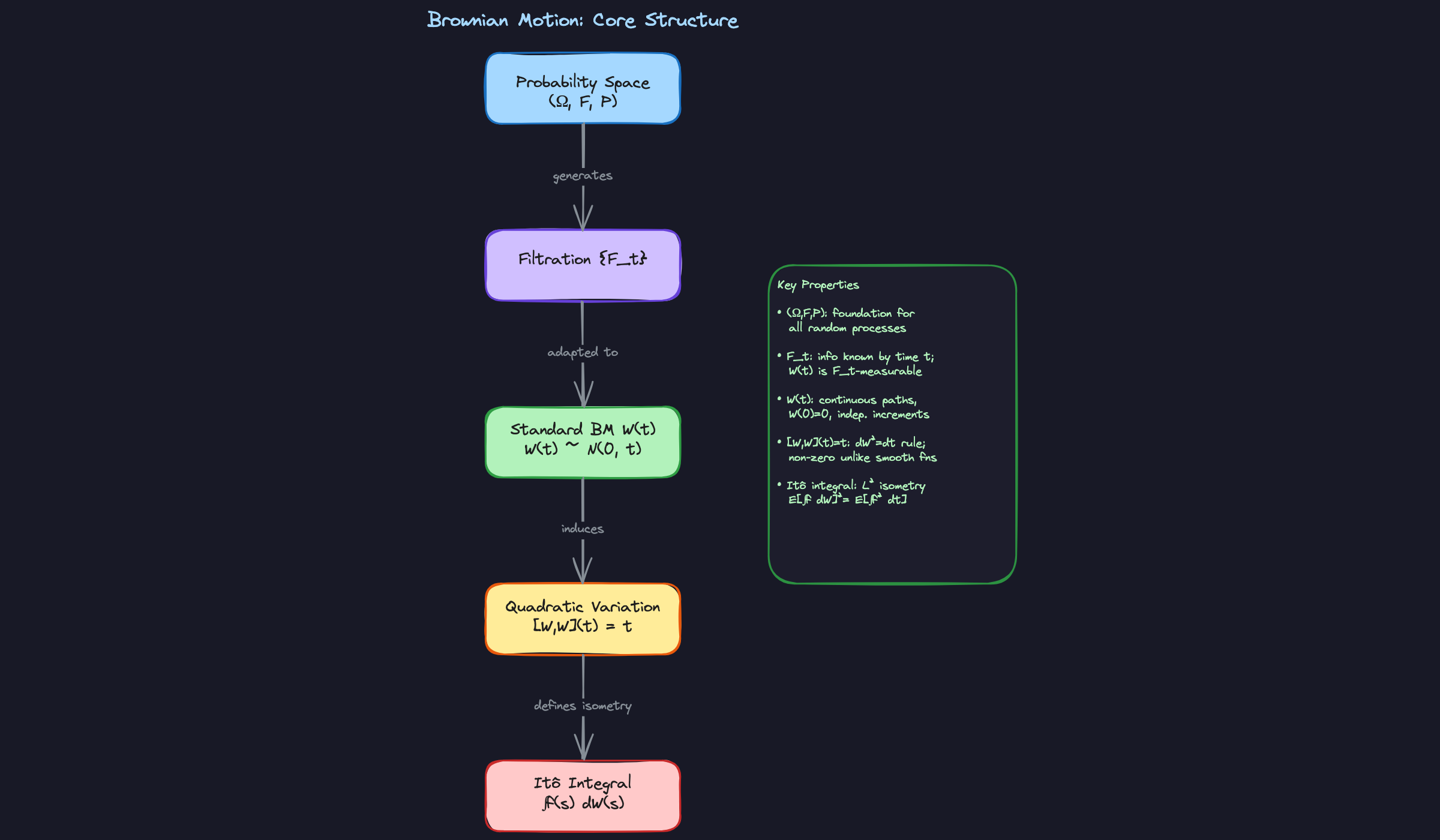
Start with a single increment. You're at time $s$, and you want to know where $W(t)$ lands at some later time $t$. The answer is: you don't know exactly, but you know the distribution. The increment $W(t) - W(s)$ is Gaussian with mean zero and variance $t - s$. That's the heartbeat of the whole theory.
The five axioms pin this down precisely. Standard Brownian motion $W(t)$ satisfies:
- $W(0) = 0$ almost surely (it starts at the origin)
- Independent increments: for any $0 \leq t_0 < t_1 < \cdots < t_n$, the increments $W(t_1) - W(t_0), W(t_2) - W(t_1), \ldots$ are mutually independent
- Stationary increments: $W(t) - W(s) \sim \mathcal{N}(0, t-s)$ for all $t > s$
- Continuous sample paths: $t \mapsto W(t)$ is continuous with probability one
- As a direct consequence: $W(t) \sim \mathcal{N}(0, t)$ for each fixed $t$
Axiom 3 is the one interviewers probe most. The variance of an increment scales linearly with the time elapsed, not with the square of it. That single fact is what makes Brownian motion fundamentally different from a smooth curve.
Here's what that flow looks like:
Why You Can't Differentiate It
This is where most candidates nod along without actually understanding the mechanism. Try to form the derivative the classical way:
$$\frac{W(t+h) - W(t)}{h}$$
The numerator is $\mathcal{N}(0, h)$, so the whole expression is $\mathcal{N}(0, h/h^2) = \mathcal{N}(0, 1/h)$. As $h \to 0$, the variance blows up to infinity. The ratio doesn't converge to anything in $L^2$, and it doesn't converge almost surely either.
This isn't a technicality you can engineer around. It's a fundamental feature of the process. Ordinary calculus, built on the assumption that functions have derivatives, simply doesn't apply here. That's the entire reason Ito calculus exists.
Your interviewer cares about this because if you can't explain non-differentiability, you can't explain why the Ito correction term appears in the first place. The $\frac{1}{2}\frac{\partial^2 f}{\partial x^2}$ term in Ito's lemma isn't magic; it's the direct consequence of $dW$ being too rough to treat like $dt$.
Quadratic Variation: The Key That Unlocks Everything
Take a partition $P = {0 = t_0 < t_1 < \cdots < t_n = t}$ of $[0, t]$ and form the sum of squared increments:
$$[W, W]^P(t) = \sum_{i=1}^{n} \left[W(t_i) - W(t_{i-1})\right]^2$$
As the mesh $|P| = \max_i(t_i - t_{i-1}) \to 0$, this sum converges in $L^2$ to exactly $t$. Not zero. Not a random variable. The deterministic value $t$.
To see why, compute the expectation and variance of each squared increment. Since $W(t_i) - W(t_{i-1}) \sim \mathcal{N}(0, \Delta t_i)$, we have $\mathbb{E}[(W(t_i) - W(t_{i-1}))^2] = \Delta t_i$, so the expected sum telescopes to $t$. The variance of the full sum is $\sum_i 2(\Delta t_i)^2 \leq 2|P| \cdot t \to 0$ as the mesh shrinks. The sum concentrates on $t$.
This gives you the heuristic that every quant interviewer expects on demand:
$$dW \cdot dW = dt$$
Combined with $dt \cdot dt = 0$ and $dW \cdot dt = 0$, this is the multiplication table of stochastic calculus. It's not a shorthand. It's a precise statement about quadratic variation, and it's the reason a second-order Taylor expansion of $f(W(t))$ doesn't discard the $(\Delta W)^2$ term the way classical calculus would.
Markov Property and Martingale Property
$W(t)$ is a Markov process: given $\mathcal{F}_s$ (everything you know up to time $s$), the future of $W$ depends only on $W(s)$, not on the full history of how it got there. Formally, $\mathbb{P}(W(t) \in A \mid \mathcal{F}_s) = \mathbb{P}(W(t) \in A \mid W(s))$. This follows directly from the independent increments axiom.
It's also a martingale: $\mathbb{E}[W(t) \mid \mathcal{F}_s] = W(s)$ for $s \leq t$. Again, this drops straight out of independent increments, since $\mathbb{E}[W(t) - W(s) \mid \mathcal{F}_s] = 0$. The process has no drift; on average, it stays exactly where it is.
These two properties together are what interviewers are really testing when they ask about Brownian motion in a pricing context. The martingale property is why $W(t)$ under the risk-neutral measure can represent a "fair game," and the Markov property is what justifies writing option prices as functions of $(t, S_t)$ rather than the entire price history. If a candidate mentions the Black-Scholes PDE but can't connect it back to these two properties, that's a gap.
Patterns You Need to Know
In an interview, you'll usually need to pick a specific approach. Here are the ones worth knowing.
Geometric Brownian Motion
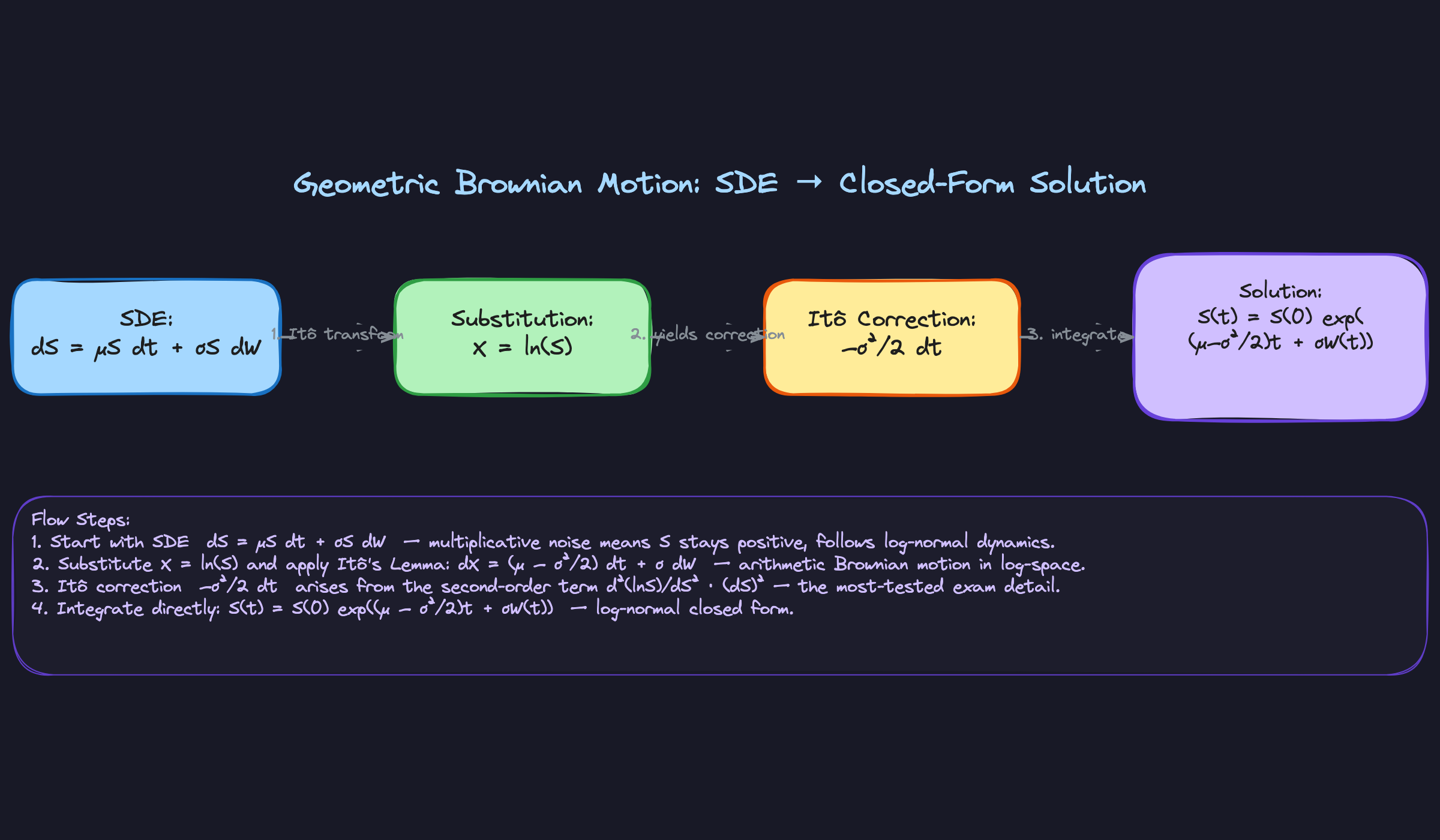
The SDE is $dS = \mu S \, dt + \sigma S \, dW$. The multiplicative noise term $\sigma S \, dW$ is what makes this different from ordinary arithmetic Brownian motion: the volatility scales with the price level, so $S(t)$ can never go negative. That single property makes GBM the default model for equity prices.
To solve it, apply Ito's lemma to $X = \ln S$. The second-order term from $dW^2 = dt$ contributes an extra $-\frac{\sigma^2}{2}$ to the drift, giving:
$$S(t) = S(0) \exp!\left(\left(\mu - \frac{\sigma^2}{2}\right)t + \sigma W(t)\right)$$
That $-\frac{\sigma^2}{2}$ correction is the single most-tested detail in quant interviews. Interviewers at Goldman and Barclays will watch for whether you include it. The intuition: Jensen's inequality. Because $e^x$ is convex, $E[e^X] > e^{E[X]}$, so the log must drift downward to keep $E[S(t)] = S(0)e^{\mu t}$ consistent. The correction lives in the exponent, not in the expectation.
When to reach for this: any time the interview involves equity option pricing, Black-Scholes derivation, or log-normal return distributions.
Ito's Lemma
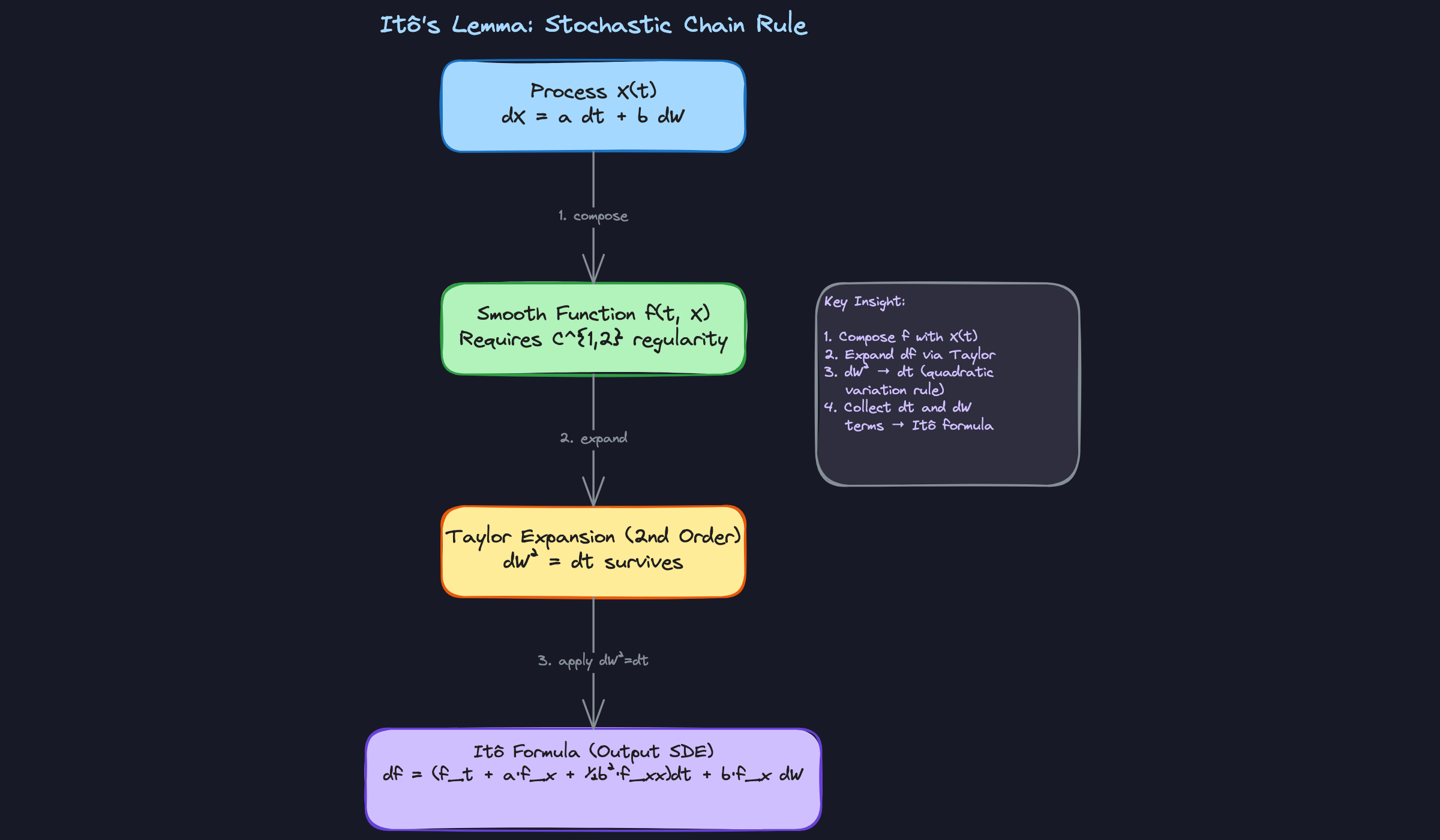
Think of Ito's lemma as the stochastic chain rule. In ordinary calculus, if $X$ is a smooth process and $f$ is a smooth function, then $df = f' \, dX$. Stochastic calculus breaks that rule because $dW^2 = dt$ is not negligible; the second-order term in the Taylor expansion survives.
For a process $dX = a \, dt + b \, dW$ and a $C^{1,2}$ function $f(t, X)$, the full formula is:
$$df = \left(f_t + a \cdot f_x + \frac{1}{2} b^2 \cdot f_{xx}\right) dt + b \cdot f_x \, dW$$
The $\frac{1}{2} b^2 f_{xx}$ term is the Ito correction. It is the entire reason stochastic calculus is its own subject. Without it, every derivation you do in derivatives pricing will be wrong. The Black-Scholes PDE falls out of applying this to $V(t, S(t))$ under GBM, constructing a delta-hedged portfolio, and invoking no-arbitrage. You should be able to do that derivation in under two minutes on a whiteboard.
When to reach for this: every single time you need to find the SDE for a function of another stochastic process. It is not one tool among many; it is the tool.
Ornstein-Uhlenbeck Process
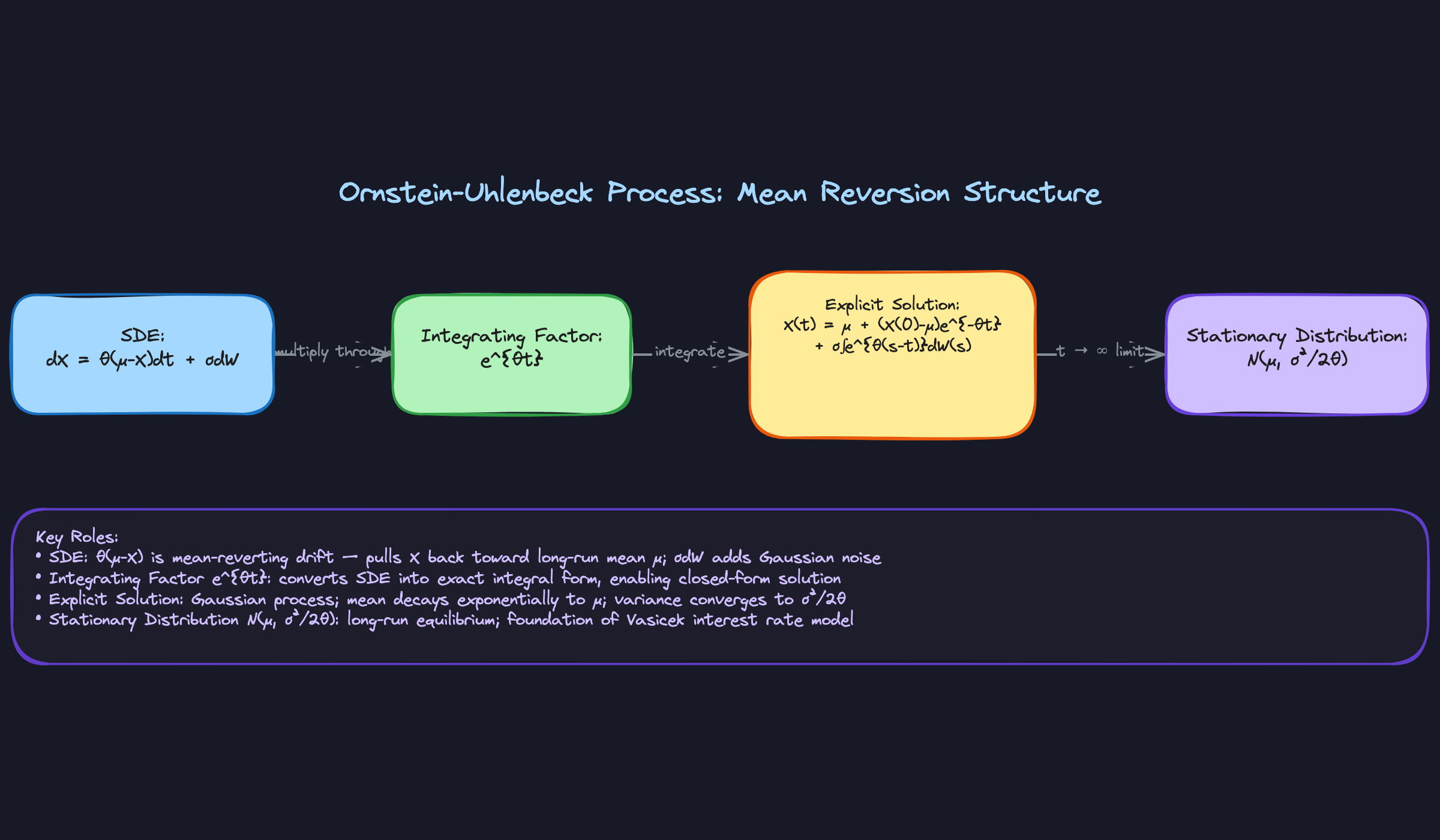
The SDE is $dX = \theta(\mu - X) \, dt + \sigma \, dW$. The drift term $\theta(\mu - X)$ is what separates this from GBM: when $X$ is above $\mu$, the drift is negative and pulls it back down; when $X$ is below, it pulls up. The parameter $\theta > 0$ controls how fast that reversion happens.
To solve it, multiply both sides by the integrating factor $e^{\theta t}$, which turns the left side into an exact differential $d(e^{\theta t} X)$. Integrating gives:
$$X(t) = \mu + (X(0) - \mu)e^{-\theta t} + \sigma \int_0^t e^{\theta(s-t)} \, dW(s)$$
The mean decays exponentially toward $\mu$, and the variance converges to $\sigma^2 / 2\theta$ as $t \to \infty$. That stationary distribution is $N(\mu, \sigma^2 / 2\theta)$, which is what the Vasicek interest rate model exploits directly. In pairs trading, the spread between two cointegrated assets is modeled as OU, and the half-life of mean reversion is $\ln(2) / \theta$.
When to reach for this: interest rate modeling (Vasicek, Hull-White), volatility mean reversion, or any interview question involving a "spread that reverts to zero."
Brownian Bridge
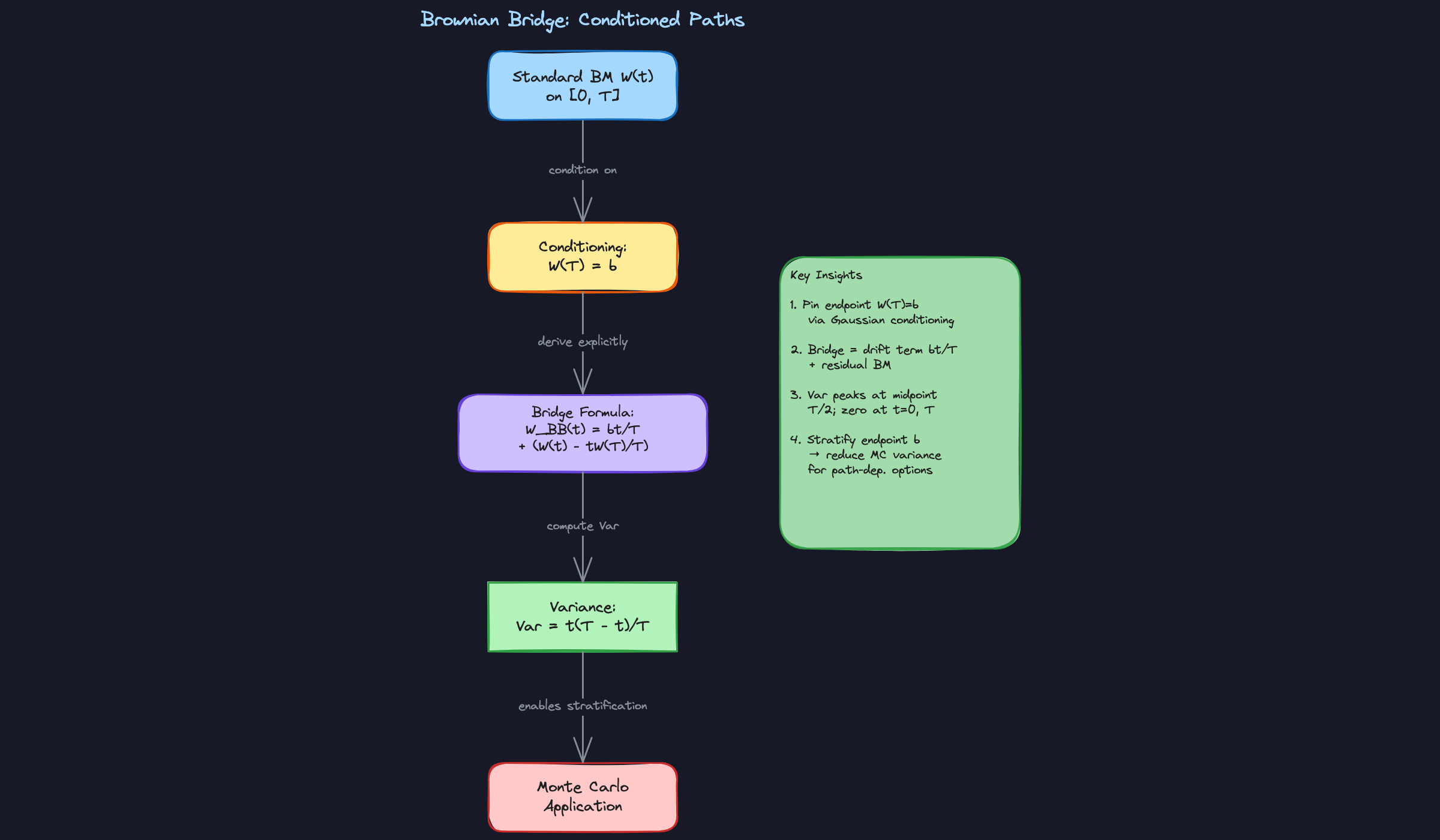
Standard Brownian motion ends wherever it ends. A Brownian Bridge is a Brownian motion conditioned to hit a specific value $b$ at terminal time $T$. The explicit representation is:
$$W^{BB}(t) = \frac{bt}{T} + \left(W(t) - \frac{t \cdot W(T)}{T}\right)$$
The first term is a deterministic linear interpolation toward $b$. The second term is a zero-mean Gaussian correction that vanishes at both endpoints. The variance of $W^{BB}(t)$ is $t(T-t)/T$, which peaks at the midpoint $T/2$ and is exactly zero at $t=0$ and $t=T$ by construction.
The practical payoff is in Monte Carlo simulation. For path-dependent options (barriers, Asians), you can stratify over the terminal value of the underlying by sampling bridge paths conditional on where $S(T)$ lands. This dramatically reduces estimator variance compared to naive path generation, because you are no longer wasting simulation budget on paths that end far from the money. Two Sigma and DE Shaw ask about this specifically in the context of variance reduction techniques.
When to reach for this: any Monte Carlo question where the interviewer asks how you would reduce variance, or any path-dependent pricing problem where the terminal value matters.
Comparing the Four Patterns
| Process | SDE | Closed-Form Solution | Primary Use Case |
|---|---|---|---|
| Geometric BM | $dS = \mu S \, dt + \sigma S \, dW$ | $S(0)\exp((\mu - \sigma^2/2)t + \sigma W(t))$ | Equity pricing, Black-Scholes |
| Ito's Lemma | (transformation rule) | $df = (f_t + af_x + \frac{1}{2}b^2 f_{xx})dt + bf_x \, dW$ | Deriving SDEs for any smooth function |
| Ornstein-Uhlenbeck | $dX = \theta(\mu-X)dt + \sigma dW$ | $\mu + (X_0-\mu)e^{-\theta t} + \sigma\int e^{\theta(s-t)}dW$ | Interest rates, spreads, mean-reverting signals |
| Brownian Bridge | $dX = \frac{b-X}{T-t}dt + dW$ | $bt/T + (W(t) - tW(T)/T)$ | Monte Carlo variance reduction, path-dependent options |
For most interview problems involving equity derivatives, you will default to GBM and apply Ito's lemma to get where you need to go. Reach for the Ornstein-Uhlenbeck process the moment the problem involves rates, spreads, or anything described as "mean-reverting." Bring up the Brownian Bridge only when the interviewer explicitly asks about variance reduction or efficient Monte Carlo simulation; introducing it unprompted can derail the conversation unless you are ready to derive the construction on the spot.
What Trips People Up
Here's where candidates lose points — and it's almost always one of these.
The Mistake: Dropping the Ito Correction in GBM
You'd be surprised how often candidates write $S(t) = S(0)\exp(\mu t + \sigma W(t))$ and move on confidently. Goldman and Barclays interviewers watch for this specifically. The missing piece is the $-\sigma^2/2$ term, and its absence tells the interviewer you've memorized the SDE without understanding what solving it actually requires.
The correction isn't cosmetic. It comes directly from the second-order term in Ito's lemma: when you apply $f(x) = \ln(x)$ to $S(t)$, the $\frac{1}{2}f''$ term contributes $-\frac{\sigma^2}{2}dt$ to the drift of $\ln(S)$. Skip it and your log-normal distribution is wrong, your option prices are wrong, and everything downstream is wrong.
The Mistake: Confusing the Mean of $S(t)$ with the Median
A subtler version of the same trap. A candidate derives the correct solution, then says something like "so the expected stock price grows at rate $\mu - \sigma^2/2$." The interviewer raises an eyebrow. That's the median, not the mean.
The distinction matters because $S(t)$ is log-normally distributed. The mean is $\mathbb{E}[S(t)] = S(0)e^{\mu t}$, because the Ito correction cancels when you take the expectation of the exponential. The median is $S(0)e^{(\mu - \sigma^2/2)t}$. These are different objects, and conflating them in a pricing context signals you're pattern-matching rather than reasoning about distributions.
If an interviewer asks "what's the expected value of $S(t)$ under the physical measure?", the answer is $S(0)e^{\mu t}$. Full stop. The $\sigma^2/2$ lives in the exponent of the median and in the log-price drift, not in the expectation of the price itself.
The Mistake: Claiming Brownian Motion is Differentiable
This one comes up under pressure, usually when a candidate is rushing. They'll say something vague like "the derivative of $W(t)$ gives you the noise term." That's not just imprecise; it's wrong, and it undermines everything that follows.
The argument you need to have ready takes thirty seconds. The difference quotient $\frac{W(t+h) - W(t)}{h}$ has variance $\frac{1}{h}$, which blows up as $h \to 0$. The limit doesn't exist in any $L^2$ sense. This is precisely why ordinary calculus fails on Brownian paths, and why Ito calculus was invented in the first place. If you can say that cleanly, you've just explained the entire motivation for the theory.
The Mistake: Forgetting the Cross-Variation Term with Correlated Brownians
The moment you mention Heston, basket options, or any multi-asset model, you've opened a door. The follow-up is almost always: "Walk me through the Ito expansion when you have two correlated Brownians." And that's where candidates drop the $dW_1 \cdot dW_2 = \rho \, dt$ term.
For a function $f(t, X_1, X_2)$ where $dX_i = a_i \, dt + b_i \, dW_i$ and $\text{Corr}(dW_1, dW_2) = \rho \, dt$, the full Ito expansion picks up a cross term:
$$df = \left(f_t + a_1 f_{x_1} + a_2 f_{x_2} + \tfrac{1}{2}b_1^2 f_{x_1 x_1} + \tfrac{1}{2}b_2^2 f_{x_2 x_2} + \rho b_1 b_2 f_{x_1 x_2}\right)dt + b_1 f_{x_1} dW_1 + b_2 f_{x_2} dW_2$$
That $\rho b_1 b_2 f_{x_1 x_2}$ term is what candidates forget. In the Heston model, this cross-variation between the asset price and its variance drives the entire volatility smile structure. Dropping it isn't a minor notational slip; it means your PDE is wrong.
How to Talk About This in Your Interview
When to Bring It Up
Brownian motion comes up in three distinct interview contexts, and you need to recognize all three.
The first is the pure theory warm-up. You hear "walk me through the mathematical foundations of derivatives pricing" or "what process do you use to model asset prices?" That's your cue to start with the axioms and move toward GBM without being asked.
The second is the Ito's lemma trigger. Any question involving "derive the Black-Scholes PDE" or "how do you price a European call from first principles" requires you to go through GBM, apply Ito's lemma, and construct the hedging argument. Don't skip steps here; interviewers are watching your derivation technique, not just the answer.
The third is subtler. When an interviewer asks about measure changes, risk-neutral pricing, or "why do we replace the drift with the risk-free rate," that's a Girsanov question in disguise. Recognize it and connect it back to Brownian motion explicitly.
Sample Dialogue
(At this point, write on the whiteboard or type out the steps below. The interviewer may interrupt to ask about specific terms, so be ready to justify each one.)
$$dV = \left(V_t + \mu S V_S + \frac{1}{2}\sigma^2 S^2 V_{SS}\right)dt + \sigma S V_S \, dW$$
$$V_t + \frac{1}{2}\sigma^2 S^2 V_{SS} + rS V_S - rV = 0$$
Follow-Up Questions to Expect
"What's the difference between the physical measure $\mathbb{P}$ and the risk-neutral measure $\mathbb{Q}$?" Under $\mathbb{P}$, the asset drifts at $\mu$; Girsanov's theorem says you can change to $\mathbb{Q}$ by shifting the drift to $r$, which is equivalent to defining a new Brownian motion $\tilde{W}(t) = W(t) + \frac{\mu - r}{\sigma}t$, and under $\mathbb{Q}$ discounted asset prices are martingales.
"Why does the $\sigma^2/2$ correction appear in the GBM solution?" It comes directly from the Ito correction term when you apply Ito's lemma to $\ln S$; the drift of $\ln S$ is $\mu - \sigma^2/2$, not $\mu$, because the second derivative of $\ln S$ is $-1/S^2$, which contributes $-\frac{1}{2}\sigma^2$ after multiplying through.
"What's the difference between the Ito and Stratonovich integrals?" Ito uses left-endpoint evaluation, which keeps the integrand adapted and makes the integral a martingale; Stratonovich uses midpoint evaluation and satisfies the ordinary chain rule, which is why physicists prefer it, but it's not suitable for finance because the integrand would anticipate future information.
"Can you simulate GBM and price a call with Monte Carlo?" Yes, and you should be able to sketch the algorithm in under two minutes. You draw $n$ standard normal increments, scale each by $\sigma\sqrt{dt}$, add the Ito-corrected drift $\left(r - \frac{\sigma^2}{2}\right)dt$ per step, exponentiate the cumulative sum to get $S(T)$, compute the discounted average payoff $e^{-rT}\mathbb{E}[\max(S(T)-K, 0)]$, and verify against the closed-form Black-Scholes price.
The single most common bug interviewers probe for: using $r \cdot dt$ as the drift instead of $\left(r - \frac{\sigma^2}{2}\right)dt$. That omission of the Ito correction produces a systematically biased price. Interviewers at Two Sigma have been known to ask candidates to spot exactly that error. If you can name it, explain why it's wrong, and connect it back to quadratic variation, you've answered the question at the level they're actually testing.
"What's the stationary distribution of the Ornstein-Uhlenbeck process?" $\mathcal{N}!\left(\mu, \frac{\sigma^2}{2\theta}\right)$; as $\theta$ increases the process mean-reverts faster and the stationary variance shrinks, which is why Vasicek interest rate models with high mean-reversion speed produce tighter rate distributions.
What Separates Good from Great
- A mid-level candidate recites the GBM solution $S(t) = S(0)\exp!\left((\mu - \frac{\sigma^2}{2})t + \sigma W(t)\right)$ correctly. A senior candidate immediately explains that $\mathbb{E}[S(t)] = S(0)e^{\mu t}$ while the median is $S(0)e^{(\mu - \sigma^2/2)t}$, and connects that gap to the asymmetry of the log-normal distribution without being prompted.
- A mid-level candidate applies Ito's lemma mechanically. A senior candidate explains why the second-order term survives (quadratic variation equals $t$, not zero), derives it from first principles if pressed, and connects it to why ordinary calculus fails for continuous-but-nowhere-differentiable paths.
- A mid-level candidate says "we switch to the risk-neutral measure to price derivatives." A senior candidate names Girsanov's theorem, states that the Radon-Nikodym derivative is $\frac{d\mathbb{Q}}{d\mathbb{P}} = \exp!\left(-\frac{\mu - r}{\sigma}W(T) - \frac{1}{2}\left(\frac{\mu-r}{\sigma}\right)^2 T\right)$, and explains that this is a drift change, not a change to the volatility or the path structure of Brownian motion.


