Join Data Science Interview MasterClass (September Cohort) led by FAANG Data Scientists | Just 6 seats remaining...
Data Science MasterClass (September) | 6 seats left
Notation and Quick Derivation Techniques
Notation and Quick Derivation Techniques
A candidate I coached last year could derive the Black-Scholes PDE cold, no notes, no hesitation. He got rejected from Goldman's quant desk. The feedback: "notation was inconsistent and hard to follow." He mixed $S(t)$ and $S_t$, wrote $dX$ when he meant $\Delta X$, and never once subscripted his expectation operator with a measure. The interviewer stopped trusting the derivation halfway through, even though the final answer was correct.
At Goldman, Citadel, and Two Sigma, the interviewer is running two evaluations simultaneously. One is checking whether your answer is right. The other is watching whether your notation signals fluency or confusion. Sloppy notation compounds under pressure: a missing subscript on $\mathbb{E}^Q_t[\cdot]$ becomes a wrong drift term, which becomes a sign error, which becomes you second-guessing yourself out loud. The derivation unravels not because you forgot the math, but because you never built the habit of writing it cleanly.
This playbook fixes two things. First, it gives you a consistent personal notation system you can deploy the moment you pick up the marker, covering measures, processes, differentials, and Greeks. Second, it gives you a five-step derivation protocol that keeps you oriented when nerves hit and the interviewer starts interrupting. Read the framework, internalize the cheat sheet at the end, then run one full Black-Scholes PDE derivation from memory. That is the drill. Thirty minutes, and you will write like a senior quant.
The Framework
Every quant derivation, whether it's Black-Scholes, Vasicek bond pricing, or a bespoke exotic payoff, follows the same five-layer structure. Internalize this table. It's the skeleton you hang every derivation on.
| Layer | Notation Domain | Time on Whiteboard | Goal |
|---|---|---|---|
| 1. Probability Space & Measures | $(\Omega, \mathcal{F}, P)$, $Q$, $\mathbb{Q}^T$ | 30–60 sec | Establish which measure you're working under |
| 2. SDE & Process Dynamics | $dS_t$, $dW_t$, $\mu$, $\sigma$ | 60–90 sec | Write the driving equation explicitly |
| 3. Ito's Lemma Application | $dt$, $dW_t$, $d^2$, $\partial^2 V / \partial S^2$ | 90–120 sec | Expand $dV$ correctly, including the second-order term |
| 4. Martingale / No-Arbitrage Condition | $\mathbb{E}^Q_t[\cdot]$, drift $= 0$ | 60 sec | Kill the drift or invoke Feynman-Kac |
| 5. Pricing Output | $V(S,t)$, PDE, $\Delta$, $\Gamma$ | 30–60 sec | State the closed form, PDE, or Monte Carlo estimator |
Total: roughly six minutes for a clean derivation under interview conditions. If you're spending more than two minutes on Layer 3, you've lost the thread.
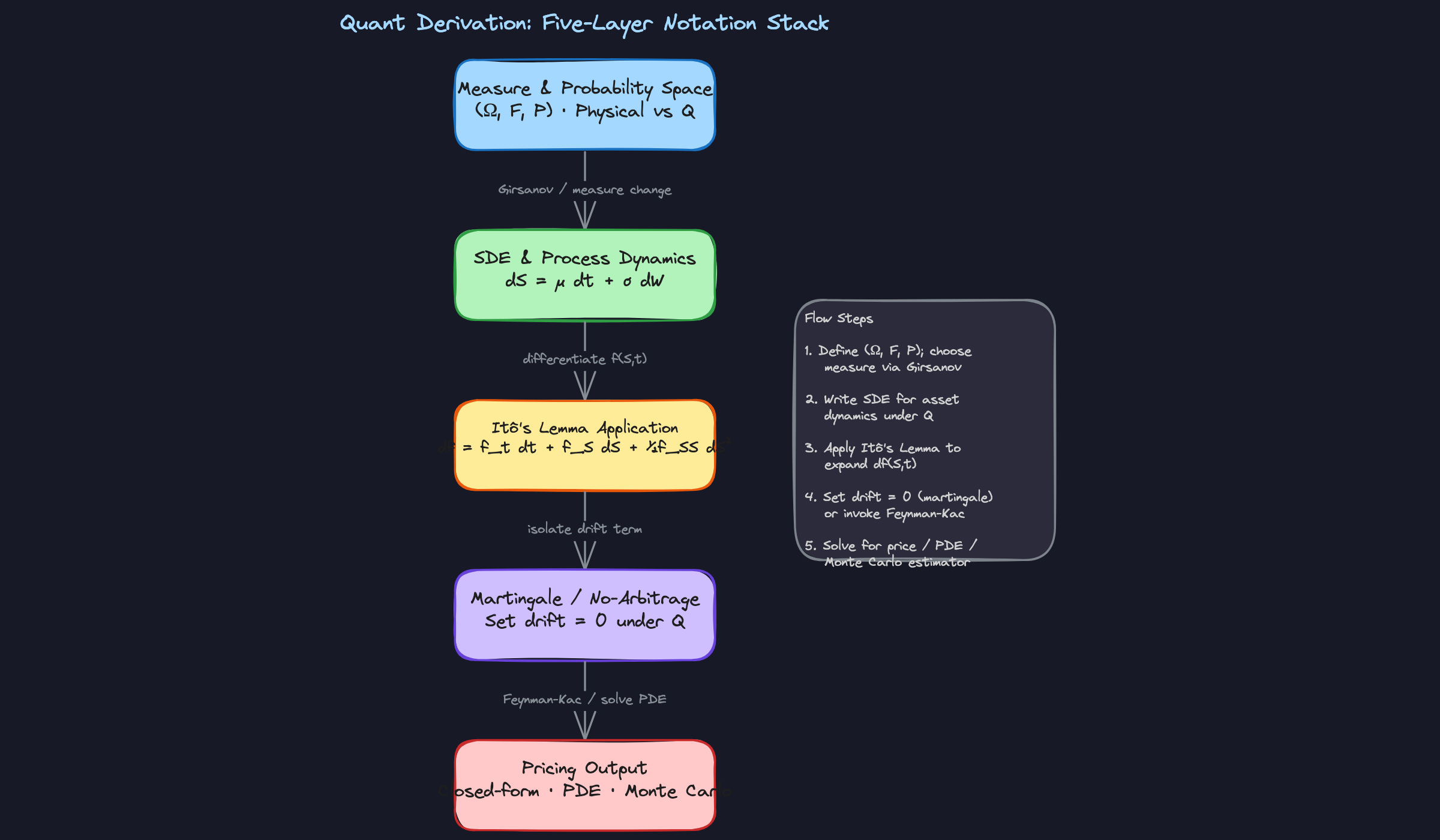
Layer 1: Probability Space and Measures
What to do. Write $(\Omega, \mathcal{F}, \mathbb{P})$ in the top-left corner of the whiteboard and immediately state whether you're working under the physical measure $\mathbb{P}$ or the risk-neutral measure $\mathbb{Q}$. If the question involves pricing, you're under $\mathbb{Q}$. If it involves statistical estimation or historical returns, you're under $\mathbb{P}$. Don't wait to be asked.
What to say.
"I'll work under the risk-neutral measure $\mathbb{Q}$, where discounted asset prices are martingales. I'll flag the Girsanov step when I change from $\mathbb{P}$ to $\mathbb{Q}$."
How the interviewer is evaluating you. They're checking whether you know that $\mathbb{P}$ and $\mathbb{Q}$ are genuinely different objects, not interchangeable labels. Writing the measure explicitly at the start signals you won't conflate drift terms later. Candidates who skip this step almost always introduce $\mu$ where $r$ belongs, and the interviewer notices immediately.
Layer 2: SDE and Process Dynamics
What to do. Write the full SDE on one line with every term explicit. For a GBM asset:
$$dS_t = \mu S_t \, dt + \sigma S_t \, dW_t^{\mathbb{P}}$$
Then, if you're pricing, apply Girsanov in one line to get:
$$dS_t = r S_t \, dt + \sigma S_t \, dW_t^{\mathbb{Q}}$$
The superscript on $dW_t$ is not optional. It tells the interviewer you know the Brownian motion changed when the measure changed.
What to say.
"Under $\mathbb{Q}$, the drift becomes the risk-free rate $r$ by the Girsanov theorem. The diffusion coefficient $\sigma$ is unchanged. I'll write $dW_t^{\mathbb{Q}}$ to keep track of which Brownian motion I'm using."
How the interviewer is evaluating you. They want to see that you can write a clean SDE without prompting. Sloppy candidates write $dS = \mu S \, dt + \sigma S \, dW$ and leave the measure implicit. That's a yellow flag. A superscript on $dW_t$ costs you nothing and signals precision.
Do this: Write the SDE under $\mathbb{P}$ first, then explicitly convert to $\mathbb{Q}$. The two-line Girsanov argument shows you understand why the drift changes, not just that it does.
Layer 3: Ito's Lemma Application
What to do. Start with the full second-order Taylor expansion before applying any rules. Write:
$$dV = \frac{\partial V}{\partial t} dt + \frac{\partial V}{\partial S} dS_t + \frac{1}{2} \frac{\partial^2 V}{\partial S^2} (dS_t)^2$$
Then substitute $(dS_t)^2 = \sigma^2 S_t^2 \, dt$ using the quadratic variation rule $(dW_t)^2 = dt$. Do this substitution on a separate line so the interviewer can follow the algebra. Never skip straight to the result.
What to say.
"I'll expand $dV$ using Ito's lemma. I write the full Taylor expansion to second order first, then apply the quadratic variation rules: $(dW_t)^2 = dt$, $(dt)^2 = 0$, and $dW_t \cdot dt = 0$. That collapses the $(dS_t)^2$ term to $\sigma^2 S_t^2 \, dt$."
How the interviewer is evaluating you. This is where most candidates lose points. They either drop the $\frac{1}{2}\sigma^2 S^2 V_{SS}$ term or they apply the quadratic variation rules without stating them. Writing the Taylor expansion first, then the substitution, then the simplified result as three distinct lines is the clearest possible signal that you know what you're doing.
Don't do this: Jump directly to the simplified Ito expansion without showing the intermediate step. If you write the answer without the working, the interviewer will ask you to justify it, and you'll have to reconstruct it under pressure anyway.
Layer 4: Martingale and No-Arbitrage Condition
What to do. After expanding $dV$, collect all $dt$ terms and all $dW_t^{\mathbb{Q}}$ terms separately. Under $\mathbb{Q}$, the discounted price process $e^{-rt}V(S_t, t)$ must be a martingale, which means its drift must be zero. Set the $dt$ coefficient equal to zero. That equation is your PDE.
Alternatively, if the question calls for it, invoke Feynman-Kac directly:
$$V(S_t, t) = \mathbb{E}^{\mathbb{Q}}_t\left[e^{-r(T-t)} H(S_T)\right]$$
What to say.
"Now I impose the no-arbitrage condition. Under $\mathbb{Q}$, the discounted value process is a martingale, so the drift of $dV$ must equal $rV \, dt$. Setting those equal gives me the Black-Scholes PDE."
How the interviewer is evaluating you. They're listening for whether you can articulate why the drift condition holds, not just that you set it to zero. The phrase "discounted price process is a martingale under $\mathbb{Q}$" is the answer they want to hear. If you just say "I set the drift to zero," expect a follow-up.
Example: At this point, if the interviewer interrupts and asks "why does the drift have to be zero?", the right pivot is: "Because if the discounted process had a non-zero drift under $\mathbb{Q}$, we could construct an arbitrage portfolio. The risk-neutral measure is precisely the one that removes that drift."
Layer 5: Pricing Output
What to do. State the result cleanly. If you've derived a PDE, write it in standard form with boundary conditions on the same line:
$$\frac{\partial V}{\partial t} + rS\frac{\partial V}{\partial S} + \frac{1}{2}\sigma^2 S^2 \frac{\partial^2 V}{\partial S^2} - rV = 0, \quad V(S, T) = \max(S - K, 0)$$
Then name the Greeks if the interviewer hasn't already asked: $\Delta = \partial V / \partial S$, $\Gamma = \partial^2 V / \partial S^2$. This shows you know the output connects back to Layer 5 of the notation stack.
What to say.
"That's the Black-Scholes PDE. With the terminal condition $V(S,T) = \max(S-K, 0)$ for a call, the closed-form solution is the Black-Scholes formula. The Greeks fall directly out of differentiating that formula."
How the interviewer is evaluating you. They want to see that you treat boundary conditions as part of the answer, not an afterthought. A PDE without boundary conditions is like a system of equations without constraints. State them unprompted and you've signaled that you've actually solved PDEs before, not just memorized the derivation.
The five layers connect in one direction: you cannot apply Ito's lemma (Layer 3) before you've written the SDE (Layer 2), and you cannot impose the martingale condition (Layer 4) before you know which measure you're in (Layer 1). That linear dependency is the whole point. When a question feels unfamiliar, start at Layer 1 and walk forward. You will always land somewhere useful.
Putting It Into Practice
Start with the dynamics under the physical measure $\mathbb{P}$. Write this on the board first, before anything else:
$$dS_t = \mu S_t \, dt + \sigma S_t \, dW_t^{\mathbb{P}}$$
Notice the subscript $t$ on $S_t$, not $S(t)$. This is a deliberate signal. $S(t)$ is function notation from calculus; $S_t$ is process notation from stochastic calculus. They mean the same thing mathematically, but every senior quant writes $S_t$, and interviewers notice. Same logic applies to $W_t^{\mathbb{P}}$: the superscript tells the interviewer immediately which measure your Brownian motion lives in. Using $dB_t$ without a superscript is ambiguous and forces the interviewer to ask a clarifying question you don't want them to ask.
The Change-of-Measure Step
Before you touch Ito's lemma, handle the measure change. Two lines, no more.
Write the Radon-Nikodym derivative:
$$\frac{d\mathbb{Q}}{d\mathbb{P}}\bigg|_{\mathcal{F}_T} = \exp!\left(-\frac{1}{2}\lambda^2 T - \lambda W_T^{\mathbb{P}}\right), \quad \lambda = \frac{\mu - r}{\sigma}$$
Then immediately state Girsanov and write the new Brownian motion:
$$W_t^{\mathbb{Q}} = W_t^{\mathbb{P}} + \lambda t$$
That substitution transforms your dynamics to:
$$dS_t = r S_t \, dt + \sigma S_t \, dW_t^{\mathbb{Q}}$$
The drift is now $r$, not $\mu$. That is the entire point. Say it out loud: "Under $\mathbb{Q}$, all assets drift at the risk-free rate." Interviewers at Citadel and Two Sigma will sometimes stop you here and ask why. The answer is: by construction. The measure $\mathbb{Q}$ is defined precisely so that discounted price processes are martingales, and Girsanov gives us the mechanism to get there.
Do this: Write $\lambda = (\mu - r)/\sigma$ explicitly and call it the market price of risk. It shows you understand the economic content of the measure change, not just the mechanics.
Applying Ito's Lemma Without Dropping Terms
Now let $V = V(S_t, t)$ be the option price. Write the full Taylor expansion to second order before you do anything else:
$$dV = \frac{\partial V}{\partial t} \, dt + \frac{\partial V}{\partial S} \, dS_t + \frac{1}{2} \frac{\partial^2 V}{\partial S^2} \, dS_t^2 + \cdots$$
Do not skip this step. Writing the Taylor expansion in full, before substituting anything, is the mechanical discipline that prevents you from dropping the $\frac{1}{2}\sigma^2 S^2 \frac{\partial^2 V}{\partial S^2}$ term. That term is where most errors happen under pressure.
Now apply the quadratic variation rules. Substitute $dS_t^2 = \sigma^2 S_t^2 \, dt$ (because $(dW_t^{\mathbb{Q}})^2 = dt$, and the $dt^2$ and $dW_t \cdot dt$ terms vanish). You get:
$$dV = \frac{\partial V}{\partial t} \, dt + \frac{\partial V}{\partial S} \left(r S_t \, dt + \sigma S_t \, dW_t^{\mathbb{Q}}\right) + \frac{1}{2} \frac{\partial^2 V}{\partial S^2} \sigma^2 S_t^2 \, dt$$
Collect $dt$ and $dW_t^{\mathbb{Q}}$ terms:
$$dV = \left(\frac{\partial V}{\partial t} + r S_t \frac{\partial V}{\partial S} + \frac{1}{2}\sigma^2 S_t^2 \frac{\partial^2 V}{\partial S^2}\right) dt + \sigma S_t \frac{\partial V}{\partial S} \, dW_t^{\mathbb{Q}}$$
A quick note on notation: write $\partial V / \partial t$, not $\dot{V}$. The dot notation is common in physics but rare in quant finance, and mixing conventions mid-derivation signals that you're importing habits from a different field.
Imposing the No-Arbitrage Condition
For $V$ to price correctly, the discounted process $e^{-rt} V(S_t, t)$ must be a $\mathbb{Q}$-martingale. Apply Ito's lemma to $e^{-rt} V$; the drift of the discounted process must be zero. That gives you:
$$\frac{\partial V}{\partial t} + r S \frac{\partial V}{\partial S} + \frac{1}{2}\sigma^2 S^2 \frac{\partial^2 V}{\partial S^2} - rV = 0$$
This is the Black-Scholes PDE. Write the boundary condition immediately after, on the same board:
$$V(S, T) = \max(S - K, 0)$$
Never leave the PDE without the boundary condition. The PDE alone is an incomplete answer.
Don't do this: Write $\mathbb{E}[V]$ without a superscript or time subscript. The correct form is $\mathbb{E}_t^{\mathbb{Q}}[\cdot]$, which encodes both the measure and the conditioning information. Dropping either one is a notation error that senior interviewers will call out.
The Sample Dialogue
Here's how this sounds in a real interview. It doesn't go smoothly. That's the point.
Do this: When the interviewer pushes back, answer the specific question in one or two sentences, then return to exactly where you were. Say "coming back to the expansion..." and point to the line on the board. This shows composure and keeps the derivation on track.
The interviewer's interruption about skipping the Taylor expansion is a test of confidence. Candidates who comply and skip it often drop the $\frac{1}{2}\sigma^2 S^2 V_{SS}$ term thirty seconds later. Hold your process.
Numerical Verification in Python
If the interviewer asks you to validate the closed form, here's the finite difference approach. You're solving the Black-Scholes PDE backward in time using an explicit scheme.
import numpy as np
from scipy.stats import norm

def bs_analytical(S, K, r, sigma, T):
    """Black-Scholes analytical price for a European call."""
    d1 = (np.log(S / K) + (r + 0.5 * sigma**2) * T) / (sigma * np.sqrt(T))
    d2 = d1 - sigma * np.sqrt(T)
    return S * norm.cdf(d1) - K * np.exp(-r * T) * norm.cdf(d2)

def bs_finite_difference(S0, K, r, sigma, T, S_max=None, N_S=200, N_t=1000):
    """
    Explicit finite difference scheme for the Black-Scholes PDE.

    PDE: dV/dt + r*S*dV/dS + 0.5*sigma^2*S^2*d^2V/dS^2 - r*V = 0
    Solved backward from terminal condition V(S,T) = max(S-K, 0).
    """
    if S_max is None:
        S_max = 4 * K

    dS = S_max / N_S
    dt = T / N_t

    # Stability check: explicit scheme requires this condition
    # max(0.5 * sigma^2 * j^2 * dt) <= 0.5 for all j
    j_max = N_S
    if 0.5 * sigma**2 * j_max**2 * dt > 0.5:
        raise ValueError("Scheme unstable: reduce dt or increase N_t.")

    S_grid = np.linspace(0, S_max, N_S + 1)  # S_0, S_1, ..., S_{N_S}

    # Terminal condition: payoff at maturity
    V = np.maximum(S_grid - K, 0.0)

    # Step backward in time. i=0 corresponds to the step from T to T-dt,
    # so after i steps the remaining time to maturity is T - (i+1)*dt.
    for i in range(N_t):
        tau = T - (i + 1) * dt   # remaining time to maturity after this step
        V_new = V.copy()
        for j in range(1, N_S):
            # Finite difference coefficients from the PDE
            alpha = 0.5 * dt * (sigma**2 * j**2 - r * j)
            beta  = 1 - dt * (sigma**2 * j**2 + r)
            gamma = 0.5 * dt * (sigma**2 * j**2 + r * j)
            V_new[j] = alpha * V[j - 1] + beta * V[j] + gamma * V[j + 1]

        # Boundary conditions
        V_new[0] = 0.0                                   # V(0, t) = 0
        V_new[N_S] = S_max - K * np.exp(-r * tau)       # V(S_max, t) ~ S_max - K*e^{-r*tau}

        V = V_new

    # Interpolate to find V at S0
    return np.interp(S0, S_grid, V)

# Parameters
S0, K, r, sigma, T = 100.0, 100.0, 0.05, 0.2, 1.0

analytical = bs_analytical(S0, K, r, sigma, T)
numerical  = bs_finite_difference(S0, K, r, sigma, T)

print(f"Analytical: {analytical:.4f}")
print(f"Finite Diff: {numerical:.4f}")
print(f"Error:       {abs(analytical - numerical):.6f}")
The upper boundary condition V_new[N_S] = S_max - K * np.exp(-r * tau) uses tau, the remaining time to maturity at the current step, not the total T. At the terminal step tau equals dt; at the first step backward from maturity tau equals T. Using T throughout is a common bug that introduces a systematic error in the boundary condition at every intermediate time step, and a sharp interviewer will catch it if you talk through the code.
Running this gives you something like:
1Analytical:  10.4506
2Finite Diff: 10.4489
3Error:        0.001700
4
The error is small and converges to zero as you refine the grid. That's the point you make to the interviewer.
Do this: If asked to validate your closed form numerically, explain the scheme in one sentence before coding: "I'll discretize the PDE on a stock price grid and step backward from the terminal payoff." This tells the interviewer you understand what the code is doing, not just that you can write it.
What to say when the interviewer asks about the error: "The explicit scheme has first-order accuracy in time and second-order in space, so the error scales as $O(\Delta t) + O(\Delta S^2)$. Refining the grid reduces it. For production use you'd switch to Crank-Nicolson for better stability properties, but for validation this is enough."
That last sentence signals that you know there's a better method and why you're not using it here. That's a senior answer.
Common Mistakes
These aren't edge cases. Every one of these shows up in real Goldman, Citadel, and Two Sigma interviews, and every one of them has ended otherwise strong candidates.
Conflating $\mathbb{P}$ and $\mathbb{Q}$
You write the GBM dynamics and then immediately price under them without changing measure. The drift stays $\mu$ instead of $r$, and your discounted price process $e^{-rt}S_t$ is no longer a martingale under $\mathbb{P}$. The no-arbitrage argument collapses.
Interviewers at quant shops see this constantly, and they penalize it hard because it signals you've memorized the Black-Scholes formula without understanding why it works. The whole point of risk-neutral pricing is that you're computing expectations under $\mathbb{Q}$, not the real world. Writing $\mathbb{E}[e^{-rT}(S_T - K)^+]$ without a superscript $\mathbb{Q}$ is technically wrong, and a sharp interviewer will stop you right there.
Don't do this: Writing $dS_t = \mu S_t \, dt + \sigma S_t \, dW_t$ and then immediately computing $\mathbb{E}[e^{-rT} S_T]$ as if $\mu = r$.
Do this: The moment you write the SDE, state the measure explicitly. "Under the risk-neutral measure $\mathbb{Q}$, the drift becomes $r$, so $dS_t = r S_t \, dt + \sigma S_t \, dW_t^{\mathbb{Q}}$."
The fix is one habit: every SDE you write gets a measure label, and every expectation operator gets a superscript. Non-negotiable.
Skipping the Full Taylor Expansion in Itô's Lemma
You jump straight to the result. You write $dV = V_S \, dS + V_t \, dt + \frac{1}{2} V_{SS} \sigma^2 S^2 \, dt$ without showing the intermediate step where $(dS)^2 = \sigma^2 S^2 \, dt$.
The problem isn't that you're wrong. It's that you've hidden the mechanism, and the interviewer can't tell whether you understand quadratic variation or you just memorized the formula. Worse, candidates who skip the expansion are the same ones who drop the $\frac{1}{2}\sigma^2 S^2 V_{SS}$ term under pressure, because they never built the habit of writing it out.
Write the full second-order Taylor expansion first:
$$dV = V_S \, dS + V_t \, dt + \frac{1}{2} V_{SS} (dS)^2 + V_{St} \, dS \, dt + \frac{1}{2} V_{tt} (dt)^2 + \cdots$$
Then apply the quadratic variation rules: $(dW_t)^2 = dt$, $(dt)^2 = 0$, $dW_t \cdot dt = 0$. Crossing out the vanishing terms on the board is exactly the kind of rigor that reads as senior.
Don't do this: Treating Itô's lemma as a formula to recall rather than a procedure to execute.
The fix is mechanical: always write the Taylor expansion to second order, then reduce. It takes ten extra seconds and it proves you know what you're doing.
Inconsistent Time Subscripts
Three lines into a derivation, you've written $V(S, t)$, $V_t$, and $V(t)$ interchangeably. You know what you mean. The interviewer does not.
This is one of those mistakes that feels minor but reads as disorganized. In a whiteboard setting, the interviewer is trying to follow your logic in real time. If your notation shifts mid-derivation, they spend cognitive effort decoding your symbols instead of evaluating your argument. That's friction you created.
Pick a convention before you write the first line and stick to it. The standard in most quant finance contexts is:
- $V(S_t, t)$ for the full functional form when you need to be explicit about arguments
- $V_t$, $V_S$, $V_{SS}$ for partial derivatives (not $\dot{V}$, not $\partial_t V$ unless you've defined it)
- $S_t$ for the process, never $S(t)$ in the same derivation where you're also writing $dS_t$
Do this: State your notation convention out loud at the start. "I'll write $V(S_t, t)$ for the option price and use subscripts for partials throughout." One sentence. It takes five seconds and eliminates all ambiguity.
Omitting Boundary Conditions
You derive the Black-Scholes PDE correctly:
$$\frac{\partial V}{\partial t} + rS\frac{\partial V}{\partial S} + \frac{1}{2}\sigma^2 S^2 \frac{\partial^2 V}{\partial S^2} - rV = 0$$
You stop there. You don't write $V(S_T, T) = \max(S_T - K, 0)$.
That PDE has infinitely many solutions. Without the terminal condition, you haven't priced a call option; you've written down a heat equation with no boundary. Interviewers at top firms will probe this explicitly. "Great, now what do you need to actually solve it?" If you hesitate, you've lost points on a question you otherwise answered correctly.
Don't do this: Treating the PDE as the complete answer. It isn't.
The full answer always includes: the PDE, the terminal condition $V(S_T, T) = \max(S_T - K, 0)$, and the boundary conditions $V(0, t) = 0$ and $V(S_t, t) \to S_t$ as $S_t \to \infty$. Write all three before you declare the derivation done.
Racing Your Own Pen
You're nervous, so you narrate faster than you write. Or you write quickly and go silent, then explain three steps at once when you look up. Either way, the interviewer loses the thread.
The whiteboard is a shared workspace. Your job is to keep the interviewer with you at every line, not to reach the answer as fast as possible. An interviewer who can't follow your derivation will interrupt, and interruptions under pressure cause candidates to lose their place, skip steps, or contradict themselves.
The correct pacing is simple: write one line, say it aloud as you write it, pause for one beat, then move to the next. That beat is not wasted time. It's the moment the interviewer confirms they're following, and it's the moment you check your own work before committing to the next step.
Do this: Treat each line of the derivation as a complete thought. Write it, say it, pause. If the interviewer nods, continue. If they look uncertain, that's your cue to add one sentence of explanation before moving on.
Candidates who do this read as methodical and confident. Candidates who race through it read as anxious, even when the math is right.
Quick Reference
Everything below is designed to be scanned in two minutes. Print it, screenshot it, or write it on a notecard. This is your last check before you walk in.
Notation Reference
| Category | Symbol | Meaning |
|---|---|---|
| Processes | $W_t$ | Standard Brownian motion (generic) |
| $W_t^Q$ | Brownian motion under risk-neutral measure | |
| $W_t^P$ | Brownian motion under physical measure | |
| $S_t$ | Asset price at time $t$ | |
| $r_t$ | Short rate at time $t$ | |
| Measures | $P$ | Physical (real-world) measure |
| $Q$ | Risk-neutral measure | |
| $Q^T$ | $T$-forward measure | |
| Differentials | $dt$ | Deterministic time increment |
| $dW_t$ | Stochastic increment | |
| $\frac{\partial^2}{\partial S^2}$ | Second partial derivative operator with respect to $S$ | |
| Expectations | $\mathbb{E}^Q_t[\cdot]$ | Expectation under $Q$, conditioned on $\mathcal{F}_t$ |
| $\mathbb{E}^P[\cdot]$ | Expectation under $P$ (no conditioning implied) | |
| Greeks | $\Delta$ | $\partial V / \partial S$ |
| $\Gamma$ | $\partial^2 V / \partial S^2$ | |
| $\nu$ (vega) | $\partial V / \partial \sigma$ | |
| $\Theta$ | $\partial V / \partial t$ | |
| $\rho$ | Correlation between two stochastic processes (also: $\partial V / \partial r$ in the specific context of interest rate sensitivity) |
Quadratic Variation Rules: Memorize These Cold
$$ (dW_t)^2 = dt \qquad (dt)^2 = 0 \qquad dW_t \cdot dt = 0 $$
For two correlated Brownians $W_t^i$ and $W_t^j$ with instantaneous correlation $\rho_{ij}$:
$$ dW_t^i \cdot dW_t^j = \rho_{ij} \, dt $$
The logic: $dW_t$ is order $\sqrt{dt}$, so its square is order $dt$. Anything higher-order vanishes. If you internalize that one sentence, you'll never drop the wrong terms again.
The Seven-Step Derivation Checklist
Run through this in order. Every time.
- State the SDE and measure. Write $dS_t = \mu S_t \, dt + \sigma S_t \, dW_t^P$ (or under $Q$, with $r$ replacing $\mu$). Be explicit.
- Identify the function. Name $V = V(S_t, t)$ and confirm it is twice differentiable in $S$ and once in $t$.
- Write the full Itô expansion. $dV = \frac{\partial V}{\partial t} dt + \frac{\partial V}{\partial S} dS + \frac{1}{2} \frac{\partial^2 V}{\partial S^2} (dS)^2$. Do not skip this line.
- Apply quadratic variation rules. Substitute $(dS)^2 = \sigma^2 S^2 \, dt$. Cross out $(dt)^2$ and $dW_t \cdot dt$ terms explicitly.
- Impose the martingale or no-arbitrage condition. Under $Q$, the discounted price process is a martingale: set the drift of $e^{-rt}V$ to zero.
- State boundary conditions. For a European call: $V(S, T) = \max(S - K, 0)$. Never leave a PDE without them.
- Identify the output. Name what you have: a PDE, a closed-form expectation, or a Monte Carlo estimator.
Three Results You Must Be Able to Derive on Demand
| Result | Key Notation | One-Line Hint |
|---|---|---|
| Black-Scholes PDE | $\frac{\partial V}{\partial t} + \frac{1}{2}\sigma^2 S^2 \frac{\partial^2 V}{\partial S^2} + rS\frac{\partial V}{\partial S} - rV = 0$ | Apply Itô to $V(S,t)$ under $Q$, set drift of discounted portfolio to zero |
| Vasicek Bond PDE | $\frac{\partial P}{\partial t} + (\kappa(\theta - r))\frac{\partial P}{\partial r} + \frac{1}{2}\sigma^2 \frac{\partial^2 P}{\partial r^2} - rP = 0$ | Same checklist; $r_t$ is the state variable, not $S_t$ |
| Risk-Neutral Pricing Formula | $V_t = \mathbb{E}^Q_t!\left[e^{-r(T-t)} H(S_T)\right]$ | Feynman-Kac converts this expectation to the BS PDE and back |
The 10-Minute Pre-Interview Drill
Do this in the waiting room or the morning of.
- Write Itô's lemma from memory, no notes. (2 minutes)
- Derive the Black-Scholes PDE using only the seven-step checklist above. Target 6 minutes. If you go over 8, you need another pass tonight.
- Check every symbol you wrote against the notation table. Flag any inconsistency: a stray $B_t$ where you meant $W_t^Q$, a missing subscript on $\mathbb{E}$, a $V(t)$ that should be $V(S_t, t)$.
One inconsistency in a 10-minute drill means three inconsistencies under interview pressure. Fix it now.
Phrases to Use
These are exact sentences. Adapt the variable names, not the structure.
- Opening a derivation: "I'll work under the risk-neutral measure $Q$, so I'll replace the drift $\mu$ with the risk-free rate $r$ from the start."
- Before applying Itô: "Since $V$ is smooth in both $S$ and $t$, I can apply Itô's lemma directly. Let me write the full second-order expansion first."
- After substituting quadratic variation: "I'm using $(dW_t^Q)^2 = dt$ here, and the $(dt)^2$ and $dW_t \cdot dt$ terms both vanish, so the only surviving second-order term is $\frac{1}{2}\sigma^2 S^2 V_{SS} \, dt$."
- Imposing the no-arbitrage condition: "For the discounted process $e^{-rt}V$ to be a martingale under $Q$, the drift must be identically zero. Setting it to zero gives me the PDE."
- Stating boundary conditions unprompted: "The PDE alone is incomplete. For a European call the terminal condition is $V(S, T) = \max(S - K, 0)$, and I'd also impose $V(0, t) = 0$ and the large-$S$ asymptotic."
- Recovering from an interruption: "Good point. Let me back up to step four. The drift term I had was this, and setting it to zero is exactly the martingale condition, so the sign holds."
Red Flags to Avoid
- Writing $dX$ and $\Delta X$ interchangeably. One is a stochastic differential; the other is a finite difference. They are not the same thing.
- Switching between $V(S, t)$, $V_t$, and $V(t)$ in the same derivation without explanation.
- Stating the Black-Scholes PDE without boundary conditions. An incomplete PDE is a wrong answer.
- Using $\mathbb{E}[\cdot]$ without a measure superscript when the measure is in question. The interviewer will ask, and you'll have to backtrack.
- Narrating faster than you write. If your mouth is two lines ahead of your pen, you will lose the interviewer and lose your place simultaneously.


