Join Data Science Interview MasterClass (September Cohort) led by FAANG Data Scientists | Just 6 seats remaining...
Data Science MasterClass (September) | 6 seats left
[Amazon] Hyperparameter Tuning
[Amazon] Hyperparameter Tuning
Last Updated: April 2024
Problem
How do you conduct hyperparameter tuning?
Solution
Hyperparameter tuning is the process of finding the optimal settings for a machine learning model’s hyperparameters. Here are three common techniques for hyperparameter tuning:
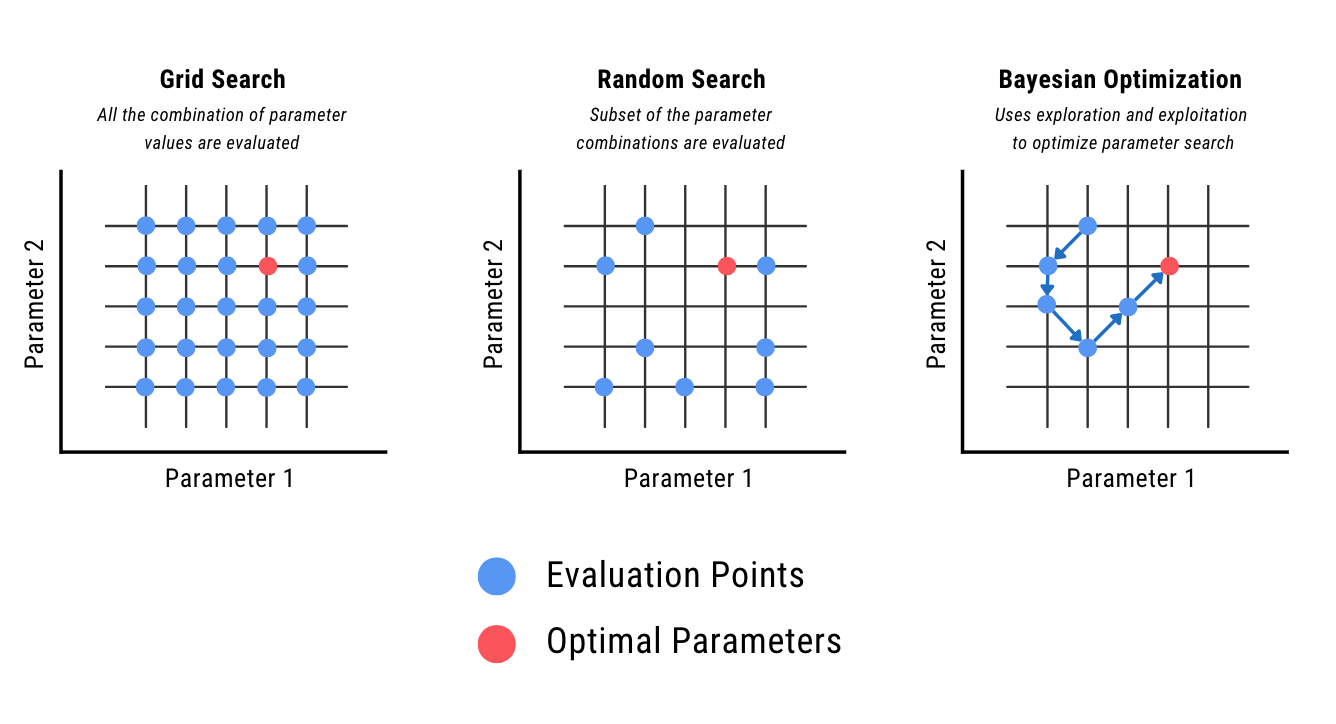
1. Grid Search:
- Concept: Grid search evaluates a model’s performance on a predefined grid of hyperparameter values. This grid is created by specifying a range and a number of steps for each hyperparameter.
- Exhaustive Search: It tries every single combination of hyperparameter values within the defined grid. This can be computationally expensive, especially for models with many hyperparameters.
- Finding the Best: The combination that yields the best performance metric (e.g., accuracy, F1-score) on a validation set is considered the optimal hyperparameter configuration.
2. Random Search:
- Concept: Similar to grid search, random search also evaluates a model on different hyperparameter combinations. However, instead of an exhaustive grid, it randomly samples values from predefined ranges for each hyperparameter.
- More Efficient: Random search is often more computationally efficient than grid search, especially for large hyperparameter spaces. It avoids evaluating unnecessary combinations that might occur in a grid search with a dense grid.
- Stochastic Approach: Although random, it ensures each hyperparameter value has a chance of being selected, preventing biases towards specific regions of the search space.
3. Bayesian Optimization:
- Concept: Bayesian optimization is a more sophisticated approach that uses a probabilistic model to guide the search for optimal hyperparameters. It iteratively selects the most promising hyperparameter combinations to evaluate based on past evaluations and a statistical model of the objective function (e.g., loss function).
- Intelligent Search: It prioritizes regions of the search space that are more likely to contain good hyperparameter combinations based on past evaluations. This makes it efficient, especially when dealing with expensive-to-evaluate models.
- Requires More Setup: Compared to grid search and random search, it requires more initial setup to define the statistical model and the acquisition function used to select the next hyperparameter configuration.
Choosing the Right Technique:
- Grid Search: A good choice for low-dimensional hyperparameter spaces (few hyperparameters) or when interpretability of the search process is important. It guarantees exploration of the entire defined grid.
- Random Search: A strong alternative to grid search, especially for high-dimensional spaces. It’s generally faster and less prone to getting stuck in bad regions of the search space.
- Bayesian Optimization: Ideal for expensive-to-evaluate models or complex hyperparameter spaces. Its efficiency comes from focusing on promising areas and avoiding redundant evaluations. However, it requires more expertise to set up and interpret the results.


Put what you learned to the test
Book a 1:1 mock interview with a FAANG data coach and get real-time, role-specific feedback.
Schedule a mock interview →