Join ML Engineer Interview MasterClass (October Cohort) led by FAANG Data Scientists | Just 4 seats remaining...
ML Engineer MasterClass (October) | 4 seats left
The Trading Systems Design Interview Framework
The Trading Systems Design Interview Framework
Most candidates who fail trading systems design interviews know their distributed systems cold. They can sketch a Kafka-backed event pipeline, reason about consistency models, and size a database cluster without breaking a sweat. They still get rejected, because they walked into a trading systems interview and designed a web backend.
The interviewer at Citadel or HRT isn't asking whether your system works. They're asking whether you understand what it costs when it doesn't. A dropped order isn't a retry. A phantom fill isn't a cache miss. A latency spike at market open isn't a p99 SLA breach you can fix next sprint. These are events with real financial and regulatory consequences, and the interviewer is listening for whether you feel that weight in every design decision you make.
What separates strong candidates isn't deeper knowledge. It's a structured way of thinking that surfaces the right trade-offs in the right order, under pressure, in 45 minutes. Trading systems sit at the intersection of two demands that pull in opposite directions: microsecond performance and absolute correctness. You need kernel bypass and lock-free data structures, and you need a full audit trail that satisfies MiFID II. You need deterministic execution, and you need graceful failover when the primary matching engine dies mid-session. The candidates who get offers aren't the ones who know the most. They're the ones who can navigate that tension out loud, fluently, without defaulting to generic patterns that signal they've never shipped anything near a live market.
The Framework
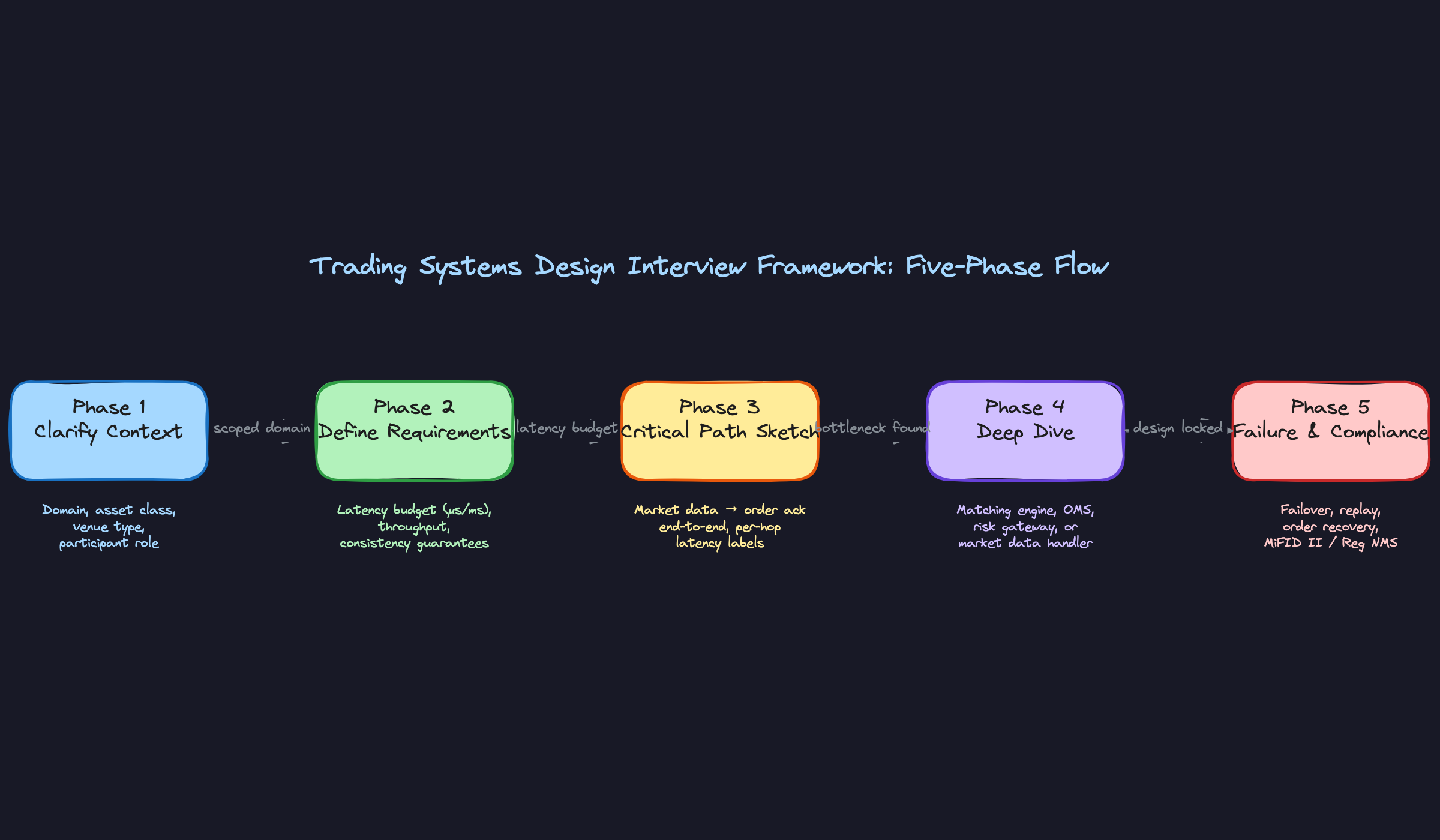
Memorize this table. It's your interview GPS. If you ever lose track of where you are in the conversation, glance at this mentally and reorient.
| Phase | Time | Goal | Output |
|---|---|---|---|
| 1. Clarify Context | 0–5 min | Establish trading domain, venue, and your system's role | Scoped problem statement |
| 2. Define Requirements | 5–12 min | Pin down latency budget, throughput, and consistency needs | Concrete numbers you'll design to |
| 3. Sketch the Critical Path | 12–22 min | Draw end-to-end data flow with per-hop latency labels | Architecture sketch with bottleneck identified |
| 4. Deep Dive | 22–38 min | Fully design the highest-risk component | Detailed design with explicit trade-offs |
| 5. Failure and Compliance | 38–45 min | Address failover, recovery, and regulatory requirements | Production-ready design |
The time allocations aren't rigid. But if you're still in Phase 1 at the 10-minute mark, you're in trouble.
Phase 1: Clarify the Trading Context (0–5 min)
The first thing you need to know is what kind of trading system you're actually building. "Low-latency trading system" could mean a co-located market maker running at 2 microseconds or a multi-venue execution algorithm running at 2 milliseconds. Those are completely different designs.
Ask exactly these three questions:
- "What asset class and venue are we targeting?" Equities on NYSE, futures on CME, FX on an ECN? The venue determines your connectivity model, protocol choices, and latency targets.
- "What role does our system play: market maker, aggressive taker, or exchange-side matching?" A market maker needs to quote and cancel fast. An aggressive taker needs to react to market data fast. These optimize for different things.
- "Are we co-located at the exchange, or connecting remotely?" Co-location changes your entire latency budget. A co-located system targeting 5 microseconds end-to-end is a fundamentally different engineering problem than a remote system at 500 microseconds.
What to say:
"Before I start sketching anything, I want to make sure I understand the trading context. Are we building for a specific asset class? And what role does our system play at the venue, are we a market maker, a taker, or something else?"
The interviewer is watching whether you know that "trading system" isn't a monolith. Asking about co-location specifically signals that you understand physical infrastructure matters at this latency tier. Candidates who skip this and jump straight to drawing boxes have never worked in a real trading environment.
Do this: Write down the answers as you get them. Repeat them back: "So we're building a co-located equity market maker on a single venue. I'll design to that." This confirms alignment and shows structured thinking.
Phase 2: Define Latency and Throughput Requirements (5–12 min)
Once you know what you're building, you need numbers. Not ranges. Not "fast." Actual numbers you'll commit to and design against.
Ask these three questions:
- "What's our end-to-end latency target, from market data receipt to order acknowledgment from the exchange?" If they say "as low as possible," push back gently: "For a co-located equity market maker, teams typically target somewhere between 1 and 10 microseconds. Should I design to that range?"
- "What's the peak order submission rate and market data event rate we need to handle?" A system handling 10,000 market data events per second is very different from one handling 10 million.
- "What are the consistency requirements? Can we tolerate a duplicate order on failover, or is that catastrophic?" This question alone tells the interviewer you understand that trading systems have specific correctness constraints that generic distributed systems don't.
What to say:
"I want to nail down the requirements before I design anything, because the right architecture for a 1-microsecond system looks nothing like the right architecture for a 1-millisecond system. Can we say we're targeting a 10-microsecond end-to-end latency budget, and I'll size the components to fit within that?"
The interviewer is evaluating whether you can translate vague product requirements into engineering constraints. Proposing a specific number and asking for confirmation is exactly the right move. It shows calibration, not guessing.
Don't do this: Accept "low latency" as a requirement and move on. If you design without a number, you can't make principled trade-offs later. When the interviewer asks "why did you choose a lock-free ring buffer over a blocking queue?" you need a latency budget to point to.
Phase 3: Sketch the Critical Path (12–22 min)
This is where most candidates either win or lose the interview. You're not drawing a full architecture. You're drawing the hot path: the sequence of operations that happens for every single market data event, from the moment a packet hits your NIC to the moment your order leaves the box.
Label every hop with a latency contribution. A good sketch looks like this:
1NIC (hardware timestamp) → Kernel bypass / DPDK → Market data decoder
2→ Signal / pricing engine → Risk pre-check → Order encoder → NIC out
3
4[~0.5μs]    [~0.5μs]         [~1μs]          [~2μs]        [~1μs]    [~0.5μs]
5
That's your latency budget made visible. Every component has a cost, and they have to sum to your target.
What to say:
"Let me sketch the critical path first, because that's where every microsecond decision lives. I'll label each hop with a rough latency contribution so we can see where the budget goes."
Then narrate as you draw. "Market data comes in over UDP multicast. We're using kernel bypass here, so we skip the kernel network stack entirely, that saves us roughly a microsecond. The decoder converts the binary protocol into our internal representation..."
The interviewer is checking whether you understand that latency is additive across hops, and whether you know the actual cost of common operations. If you draw a box labeled "message queue" between market data and your signal engine without acknowledging that a queue adds latency and jitter, that's a red flag.
Phase 4: Deep Dive on the Highest-Risk Component (22–38 min)
You have 16 minutes. Pick one component from your critical path sketch and design it properly. Don't try to cover everything. The interviewer would rather see one component designed with real depth than five components described at surface level.
The right component to pick is usually the one with the tightest latency constraint or the most interesting correctness challenge. For a market-making system, that's almost always the order management system or the matching engine. For an execution algorithm, it might be the market data handler.
What to do:
- State your choice explicitly: "I want to focus on the OMS, because that's where order state consistency is hardest to get right under low-latency constraints."
- Start with the data structure, not the API. What does an order look like in memory? How do you index it for fast lookup by order ID and by symbol?
- Make every trade-off explicit. Don't just say "I'd use a lock-free ring buffer." Say "I'd use a lock-free ring buffer here because we're on a single-writer, single-reader path, and a mutex would introduce unpredictable latency spikes under contention. The trade-off is that we lose flexibility if we need multiple writers later."
What to say:
"I want to deep-dive on the OMS. The interesting problem here is maintaining consistent order state while staying on the critical path. Let me walk through the data model first, then talk about how we handle concurrent access without introducing lock contention."
The interviewer is evaluating whether you can go deep. Anyone can name components. The question is whether you can design one from the inside out, including the failure cases and the trade-offs you rejected.
Example: "Okay, I think I have a good understanding of the requirements and the overall flow. Let me go deep on the matching engine, since that's the component with the most interesting correctness constraints."
Phase 5: Failure Modes and Regulatory Constraints (38–45 min)
Most candidates never get here because they spent too long on Phase 3. That's a mistake. Skipping this phase signals that you've only ever designed systems on the happy path.
Cover three things, in this order:
- Primary failure mode: What happens when your matching engine process crashes mid-session? How do you recover order state without replaying the entire day's events? (Answer: sequence numbers on every event, persistent event log, warm standby with replicated state.)
- Risk circuit breaker: How do you halt all outbound orders within microseconds when a risk limit is breached? This needs to be on the critical path, not a background check.
- Regulatory requirements: MiFID II requires nanosecond-precision timestamps on order events. Reg NMS requires best execution documentation. You need hardware timestamps from the NIC, not software timestamps from the OS, because OS clock resolution isn't sufficient.
What to say:
"Before I wrap up, I want to cover failure modes and compliance, because in a production trading system these aren't afterthoughts. Let me talk through what happens when the primary OMS fails, how the risk gateway halts orders under a breach, and what we need for MiFID II timestamp compliance."
The interviewer is checking whether you've shipped to production. Mentioning hardware timestamps for MiFID II compliance specifically, rather than just "we log everything," is the kind of detail that separates candidates who've read about trading systems from candidates who've built them.
Do this: If you're running low on time, compress Phases 3 and 4 slightly rather than skipping Phase 5. A design with no failure handling isn't a production design. The interviewer knows that.
Putting It Into Practice
The prompt lands: "Design a low-latency equity market-making system for a single venue."
Most candidates start drawing boxes. Don't. The first two minutes of your response determine whether the interviewer sees a trading systems engineer or a backend developer who read a blog post about HFT.
Here's how the full five-phase framework plays out in a real interview, including the moments where the interviewer pushes back.
Phase 1: Clarifying the Context (Minutes 0-3)
Do this: Notice the candidate asked about the venue type specifically. IEX's 350-microsecond speed bump changes your entire architecture. Asking that question signals you've actually thought about venue microstructure, not just generic networking.
That last question is a signal. Most candidates forget the regulatory layer entirely and get caught flat-footed when the interviewer brings it up in the final five minutes. You just showed you know it exists.
Phase 2: Pinning the Latency Budget (Minutes 3-8)
This is the moment most candidates freeze. Have your latency budget ready.
| Stage | Budget |
|---|---|
| NIC receive + kernel bypass (DPDK/Solarflare) | ~1 µs |
| Market data decode (binary ITCH protocol) | ~1 µs |
| Order book update | ~1 µs |
| Signal computation (quote pricing) | ~3 µs |
| Risk check (pre-trade limits) | ~2 µs |
| Order encode + NIC send | ~2 µs |
| Total | ~10 µs |
Do this: When the interviewer challenges a technical choice, don't back down immediately. Explain the reasoning behind the trade-off. "Deterministic latency, not just average-case fast" is exactly the kind of phrase that tells an interviewer you've debugged a production system at 3am.
Phase 3: Sketching the Critical Path (Minutes 8-18)
"Market data comes in via NASDAQ's ITCH 5.0 binary protocol over UDP multicast. We're not using the FIX protocol here because FIX is text-based and adds hundreds of nanoseconds of parsing overhead. ITCH is binary and designed for exactly this throughput. Our kernel bypass layer, I'd use DPDK or Solarflare OpenOnload, hands the packet directly to user space without a syscall."
"From there, a dedicated market data handler thread updates the order book. This is a price-level aggregated book, not full depth, because we only need the top 5 levels for quoting decisions. The book is stored in a cache-line-aligned struct per symbol, 50 symbols means 50 structs, all pinned in L2 cache."
Do this: When you name a pattern, immediately explain why it fits this specific problem. "LMAX designed it for exactly this use case" is good. Stopping at "it's a lock-free ring buffer" is not.
Phase 4: Deep-Diving the Risk Gateway (Minutes 18-30)
"For position tracking, I'd use a simple array indexed by symbol ID. Symbol IDs are integers, so this is a direct array lookup, not a hash map. Hash maps have non-deterministic lookup time under collision. Arrays don't."
"The latency cost is that a fill might not be reflected in the risk state for a few microseconds after it arrives. That's acceptable because we're tracking gross exposure, and a few microseconds of lag on a fill update won't cause a limit breach in practice. If we needed sub-microsecond fill reflection, we'd need hardware timestamps and a different architecture."
The Pivot (Minute 30)
This is where interviews get interesting.
Don't panic. Don't throw away your design. Identify what breaks and what survives.
"For 50 venues, the first problem is market data. Each venue has its own protocol: NASDAQ uses ITCH, NYSE uses Pillar, CBOE has its own binary format. I'd add a protocol normalization layer that converts each venue's native format into a common internal representation. This adds latency, maybe 500 nanoseconds to 1 microsecond, but it's unavoidable unless we write 50 separate strategy implementations."
"The second problem is the risk check. With 50 venues, our position in a symbol is spread across multiple venues' open orders. The risk sequencer now needs to aggregate exposure across venues before checking limits. That's still doable in a single-threaded model, but the state it maintains gets larger."
"The third problem is co-location. You can't be co-located at 50 venues simultaneously from one box. So we'd need a distributed architecture: one co-located instance per venue cluster, with a central risk aggregator that each instance reports to. The central aggregator runs on a slightly longer latency path, maybe 50-100 microseconds for cross-venue risk, which is acceptable because cross-venue limit breaches are less time-sensitive than per-venue ones."
Do this: When the interviewer introduces a new constraint, explicitly say what survives and what breaks. "The core components survive, what breaks is..." shows structured thinking under pressure. It also means you don't have to start from scratch, which saves time and demonstrates that your original design was principled, not accidental.
Phase 5: Failure Modes and Compliance (Minutes 35-42)
"First: primary order gateway fails mid-session. We need a hot standby that's receiving the same order state via synchronous replication. Failover has to be sub-second, because a gap in quoting costs real money. I'd use a primary-backup model with a shared sequence number so the backup can resume without replaying the full order log."
"Second: a runaway strategy sends orders too fast. The risk sequencer should have a rate limiter, not just a position limit. If we're sending more than X orders per second, something is wrong and we should halt and alert before the exchange cancels our membership."
"Third: Reg NMS audit trail. Every order event needs a timestamp with microsecond precision, logged to a persistent store before the order leaves the building. I'd use a memory-mapped file for this: writes are fast because they go to page cache, and the OS flushes to disk asynchronously. If we crash, we recover the log from the last flush point."
That's the close. You've covered the full system, defended your choices under challenge, pivoted gracefully when the constraints changed, and addressed compliance without being prompted. That's what a strong candidate looks like.
Common Mistakes
Most candidates who fail trading systems design interviews don't fail because they can't design systems. They fail because they design the wrong kind of system, for the wrong constraints, and never notice.
These mistakes are common enough that interviewers at Citadel and HRT have seen them hundreds of times. Don't be the candidate who triggers a silent checkbox.
Reaching for Kafka Before You Know Your Latency Budget
It sounds like this: "So I'd use Kafka for the market data feed, and then we can have microservices consuming from different topics..."
The interviewer hears: "I design web backends."
Kafka's p99 latency is measured in milliseconds. A co-located equity market-making system has an end-to-end budget of 10 microseconds. Proposing Kafka before you've established latency requirements doesn't just suggest a wrong answer; it suggests you don't know what questions to ask first. Kubernetes and microservices carry the same signal. They're fine tools for a different class of problem.
Don't do this: Open with infrastructure choices before you've pinned down whether you're designing for 10 microseconds or 10 milliseconds. Those are different systems entirely.
Do this: Spend the first two minutes asking about latency targets, asset class, and venue type. Let those answers determine your technology choices, not the other way around.
Treating Correctness and Performance as Separate Problems
Candidates often say something like: "We can handle performance first and then layer in correctness guarantees later." That framing is exactly backwards, and experienced interviewers will call it out immediately.
In trading systems, correctness and performance are in constant tension at the design level. The choice between a single-threaded sequencer and a multi-threaded order processor isn't a performance decision; it's a correctness decision with performance consequences. A single-threaded sequencer gives you deterministic ordering with no locking overhead. Multi-threaded designs give you throughput but require you to solve the ordering problem explicitly, often with a disruptor pattern or sequence barriers.
The same tension appears with consistency. Eventual consistency is fine for a reporting dashboard. It is catastrophic for an order book. If a risk limit update propagates 50 milliseconds late and an order slips through, that's a real loss and potentially a regulatory breach.
Don't do this: Talk about performance optimizations in isolation without anchoring them to the correctness guarantees they preserve or violate.
The fix: whenever you propose a concurrency model, immediately state what ordering or consistency property it guarantees and why that property matters for this specific component.
Forgetting the Regulatory Layer Exists
This one is quiet. You design a beautiful matching engine, nail the latency budget, handle failover gracefully, and then the interviewer asks: "How do you timestamp order events for regulatory reporting?"
If your answer is "we'd use system time," you've just told them you've never shipped a trading system to production.
MiFID II requires nanosecond-precision timestamps on order events, synchronized to UTC via PTP (IEEE 1588) or GPS-disciplined clocks. Reg NMS requires best execution documentation. These aren't optional features you bolt on at the end; they shape your architecture from the start because hardware timestamping has to happen at the NIC, before the kernel even sees the packet.
Don't do this: Design the entire system and treat compliance as an afterthought you'll "add a logging layer" for.
Mention the regulatory timestamp requirement during your critical path sketch, when you're labeling each hop with its latency contribution. That's when it matters architecturally, and that's when mentioning it signals that you've thought about production reality.
Living Entirely on the Happy Path
You've sketched the flow: market data in, signal computed, risk check passed, order sent, acknowledgment received. Clean. Correct. Incomplete.
The interviewer will ask: "What happens when the primary matching engine fails mid-session?" If you haven't thought about it, you'll start improvising, and improvised fault tolerance designs in trading systems are how you get phantom fills and duplicate orders.
The failure modes that matter in trading are specific. A risk gateway that goes down needs to fail closed, not open. Every outbound order must stop within microseconds, not after a timeout. An OMS that crashes mid-session needs to recover order state from a persisted sequence log, not from memory, and it needs to reconcile that state against the exchange's view before resuming. A market data handler that drops a packet needs to detect the sequence gap and request retransmission before the stale book state causes a bad fill.
Don't do this: Spend 40 minutes on the happy path and then offer "we'd add redundancy" as your failure story.
Reserve at least 8 to 10 minutes for failure modes. The interviewer is specifically watching to see if you think about the system under stress, because that's when trading systems actually matter.
Saying "Low Latency" Without Saying a Number
"The system will be low latency." That sentence means nothing to an interviewer at Jump Trading.
Vague latency language is one of the clearest signals that a candidate has read about trading systems but hasn't operated one. Real systems have budgets. A co-located market-making system targeting a 10-microsecond round trip allocates roughly 1 to 2 microseconds for NIC receive and kernel bypass via DPDK, 2 to 3 microseconds for market data decode and order book update, 1 microsecond for signal computation, 1 microsecond for the risk check, and 2 to 3 microseconds for order encoding and NIC transmit. You don't need to memorize those exact figures, but you need to be able to sketch a budget and defend the allocations.
Don't do this: Use "fast," "low latency," or "near real-time" as design goals without attaching numbers.
When you don't know the exact figure, say so and reason toward it: "For a co-located setup, I'd expect the NIC-to-application path with kernel bypass to cost around 1 to 2 microseconds. Does that match your environment?" That's calibrated thinking. The interviewer respects the reasoning even when the number needs adjustment.
Quick Reference
Everything below is designed to be scanned, not read. Review it once before you walk in.
The Five-Phase Framework at a Glance
| Phase | Time Budget | Key Output | Signal Phrase |
|---|---|---|---|
| 1. Clarify Context | 3-5 min | Asset class, venue type, participant role confirmed | "Before I sketch anything, I want to confirm whether we're talking about a market maker or an agency algo, because the latency profile is completely different." |
| 2. Define Requirements | 5-7 min | Latency budget in microseconds, throughput in events/sec | "For a co-located equity market maker, I'd target sub-10-microsecond order-to-wire. Let me break that budget down across each hop." |
| 3. Critical Path Sketch | 8-10 min | End-to-end data flow with per-hop latency labels | "The critical path is: market data decode, signal compute, risk check, OMS state update, order encode, NIC transmit. I'll assign a latency budget to each." |
| 4. Deep Dive | 12-15 min | Fully designed highest-risk component with trade-offs | "The matching engine is the most latency-sensitive piece here, so I want to spend most of our time on the sequencer design and the order book data structure." |
| 5. Failure and Compliance | 5-7 min | Failover strategy, replay mechanism, regulatory timestamps | "For MiFID II compliance, every order event needs a hardware timestamp at the NIC with nanosecond precision. Let me walk through how that feeds into the audit trail." |
Latency Reference Card
Commit these numbers to memory. Citing them without hesitation signals you've worked in real trading infrastructure.
| Component | Typical Latency |
|---|---|
| NIC interrupt (kernel stack) | 5-20 microseconds |
| Kernel bypass (DPDK / Solarflare) | 1-3 microseconds |
| FPGA packet processing | 100-500 nanoseconds |
| Co-located round-trip to exchange | 1-5 microseconds |
| PCIe DMA transfer | ~200 nanoseconds |
| L3 cache access | ~10 nanoseconds |
| Main memory (DRAM) access | ~60-100 nanoseconds |
If your design requires sub-microsecond processing, you're in FPGA territory. If you're at 1-10 microseconds, kernel bypass with a busy-polling NIC driver is your answer. Anything above 10 microseconds and you can use a standard userspace network stack, but you should still say why you made that choice.
The Five Trade-offs You'll Almost Certainly Face
Single-threaded sequencer vs. multi-threaded. Single-threaded wins for a matching engine. It eliminates lock contention entirely and gives you deterministic ordering. Multi-threaded only makes sense when you're sharding by instrument and can guarantee no cross-instrument dependencies.
TCP vs. UDP multicast for market data. UDP multicast for distribution to multiple consumers (strategies, risk systems) because you can't afford the retransmission latency of TCP. You handle packet loss with sequence numbers and a gap-fill mechanism, not by relying on the transport layer.
In-memory vs. persisted order state. In-memory during the trading session for speed, with a write-ahead log to a memory-mapped file for recovery. Never synchronous disk writes on the critical path.
Hardware timestamps vs. software timestamps. Hardware timestamps at the NIC for regulatory reporting (MiFID II requires this). Software timestamps are fine for internal profiling but not for audit trails submitted to regulators.
FIX vs. binary protocol. FIX for external connectivity to brokers and venues where you don't control both ends. Binary (SBE, ITCH, proprietary) for internal messaging where you do. FIX parsing overhead is 5-10x higher than a well-designed binary protocol.
Five Clarifying Questions for the First Two Minutes
Ask these in order. Each one narrows the design space and signals that you think like someone who has shipped trading systems.
- "What's the participant role: market maker, agency algo, or exchange-side?" This determines whether latency symmetry matters (market making) or just outbound speed (directional algo).
- "Single venue or multi-venue?" Multi-venue immediately introduces smart order routing, venue latency arbitrage, and consolidated order state, which triples the design complexity.
- "What asset class and what's the expected order rate?" Equities at a major venue might be 100k events/sec on the market data feed. FX spot is different. Derivatives have different margin and risk semantics.
- "Is this a greenfield build or are we integrating with existing infrastructure?" Greenfield lets you choose kernel bypass and custom binary protocols. Integration means you probably have FIX adapters and a legacy OMS to work around.
- "What does the regulatory environment look like: MiFID II, Reg NMS, both?" This tells you whether you need nanosecond hardware timestamps, best execution reporting, or both. Asking this early shows you know compliance isn't an afterthought.
Prompt Keywords: Where to Start
When the interviewer gives you a prompt, the first two words that jump out should tell you which phase to lead with and what to anchor on.
| If you hear... | Lead with... | Anchor on... |
|---|---|---|
| "low-latency", "co-located" | Phase 2 (latency budget) | Kernel bypass, FPGA offload |
| "matching engine", "order book" | Phase 4 (deep dive) | Single-threaded sequencer, price-time priority |
| "market data", "feed handler" | Phase 3 (critical path) | UDP multicast, sequence gap detection |
| "risk system", "pre-trade risk" | Phase 4 (deep dive) | Lock-free risk counters, hard limits vs. soft limits |
| "multi-venue", "smart order routing" | Phase 2 then Phase 3 | Venue latency profiling, order state reconciliation |
| "audit trail", "compliance", "reporting" | Phase 5 (failure and compliance) | Hardware timestamps, write-ahead log, MiFID II |
Phrases to Use
Keep these ready. They're not scripts; they're anchors that let you sound fluent when you're thinking on your feet.
- "Let me put a latency budget on the critical path before I go any deeper, otherwise we're just guessing at the design."
- "I'd use a single-threaded sequencer here. Lock contention on the order book is the fastest way to blow your latency budget."
- "For market data distribution, I'd go UDP multicast with sequence-numbered packets and a gap-fill channel. TCP retransmission latency is non-deterministic and that's not acceptable here."
- "The regulatory timestamp has to come from the NIC, not the application layer. MiFID II requires nanosecond precision and software clocks drift."
- "If the primary matching engine fails mid-session, I need to replay from the write-ahead log and reconstruct order state before re-opening. The question is how fast I can do that replay."
- "I'd co-locate and use kernel bypass as the baseline. If we're still not hitting the latency target after that, FPGA offload for the market data decode and risk check is the next lever."
Red Flags to Avoid
- Saying "I'd use Kafka for the order flow" before you've established the latency requirement. Kafka is a millisecond-range tool.
- Describing your design as "low latency" without ever committing to a number.
- Spending 30 minutes on the happy path and never mentioning what happens when the primary fails.
- Omitting the regulatory layer entirely. Interviewers at firms that ship to production will notice immediately.
- Treating the risk check as a simple if-statement. Pre-trade risk under microsecond constraints is a design problem in its own right.


