Join Data Science Interview MasterClass (September Cohort) led by FAANG Data Scientists | Just 6 seats remaining...
Data Science MasterClass (September) | 6 seats left
Order-of-Magnitude Reasoning
Order-of-Magnitude Reasoning
Jane Street doesn't care if you know the exact daily notional volume of the US options market. They care whether you know it's in the hundreds of billions, not the millions, and whether you can get there without freezing.
That's the whole game. Order-of-magnitude reasoning means getting within a factor of 10 of the true answer using structured logic and a handful of benchmarks you already trust. No memorized facts, no false precision. Just a clean chain of reasoning that lands you in the right ballpark.
The stakes are real. A trader who knows S&P 500 daily volume is "tens of billions" can size a position, estimate market impact, and sanity-check a model output. One who guesses "a few million" is operating in a different universe, and the interviewer knows it immediately. These questions show up as rapid-fire warm-ups in first-round screens at Optiver, IMC, and SIG, before the probability problems even start. Getting one badly wrong doesn't just cost you that question; it signals that your quantitative intuition isn't calibrated, and that's a harder hole to climb out of.
The mental posture that separates good candidates from great ones: you're not guessing, you're bounding. Every estimate you give should carry an implicit range, and you should know which of your assumptions is doing the most work and which direction it's likely to push your answer.
The Four-Step Loop Every Trading Interviewer Wants to See
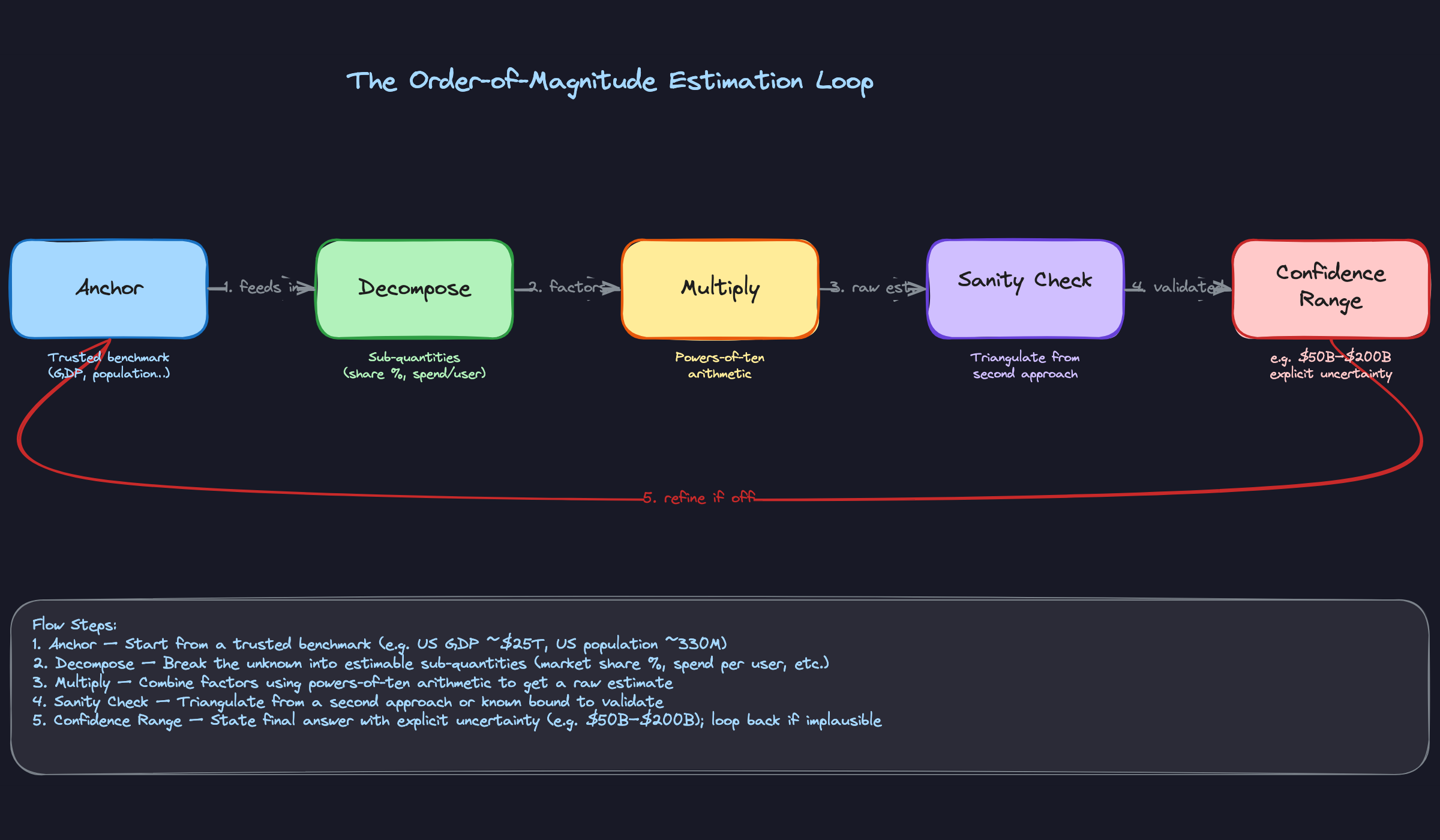
Every estimation problem, whether you're asked about daily FX turnover or the number of ETF shares outstanding globally, runs through the same four steps: Anchor, Decompose, Multiply, Sanity-Check. That's it. The interviewer isn't testing your memory of market statistics. They're testing whether you have a repeatable process that produces defensible answers under pressure.
Think of it like dead reckoning on a ship. You don't know exactly where you are, but you know your last confirmed position, your speed, and your heading. You work forward from what you trust.
Here's what that flow looks like:
Anchor First, Always
Your first move is to plant a flag in something you actually know. US GDP is roughly $28 trillion. The S&P 500 market cap sits around $45 trillion. NYSE daily equity volume runs about $50 billion. US population is 330 million. These are your footholds.
The reason this matters in an interview isn't just accuracy. It's that anchoring signals you have calibrated financial intuition. A candidate who says "I'll start from US equity market cap and scale from there" sounds like a trader. A candidate who starts from scratch and builds up from first principles often drifts by two or three orders of magnitude before they realize something went wrong.
Decompose Into a Product
Once you have an anchor, break the unknown into a multiplication of smaller, more estimable quantities. If you're estimating the US options market daily volume, you might factor it as: number of underlying stocks with liquid options, times average contracts per stock per day, times average notional per contract.
Say the factoring out loud. Literally say "I'm going to think of this as A times B times C." This does two things. It forces you to be explicit about your assumptions, and it gives the interviewer a chance to redirect you if one of your factors is obviously wrong. You want that feedback early, not after you've multiplied five numbers together.
The goal isn't a perfect factoring. It's a factoring where each individual piece is something you can estimate with reasonable confidence.
Multiply in Powers of Ten
Convert each factor to scientific notation before you multiply. If your factors are 4,000, 200, and $50, rewrite them as 4 x 10^3, 2 x 10^2, and 5 x 10^1. Then add the exponents: 3 + 2 + 1 = 6. Multiply the coefficients: 4 x 2 x 5 = 40. Final answer: 40 x 10^6, or $40 million.
This approach keeps the arithmetic clean across many steps. When you multiply five numbers in your head using their full values, rounding errors compound and you lose track of whether you're in the billions or the trillions. Powers of ten let you separate "what scale are we at" from "what's the coefficient," and the scale question is almost always more important.
Sanity-Check From a Second Angle
After you get a raw estimate, triangulate. Come at the same quantity from a different direction and see if the two answers roughly agree. If your top-down estimate of US daily options volume is $50 billion and your bottom-up estimate from individual stock activity is $40 billion, you're in great shape. If one gives you $50 billion and the other gives you $5 trillion, one of your assumptions has a serious problem and you should say so explicitly.
"These two estimates disagree by a factor of 100, which tells me my assumption about average contract size is probably wrong. Let me revisit that." That sentence, delivered calmly, is worth more to an interviewer than a confident wrong answer. It shows you know how to catch your own errors, which is exactly what a market maker needs to do when a position starts moving against them.
Patterns You Need to Know
In an interview, you'll usually need to pick a specific approach. Here are the ones worth knowing.
Pattern 1: Market Volume Estimation
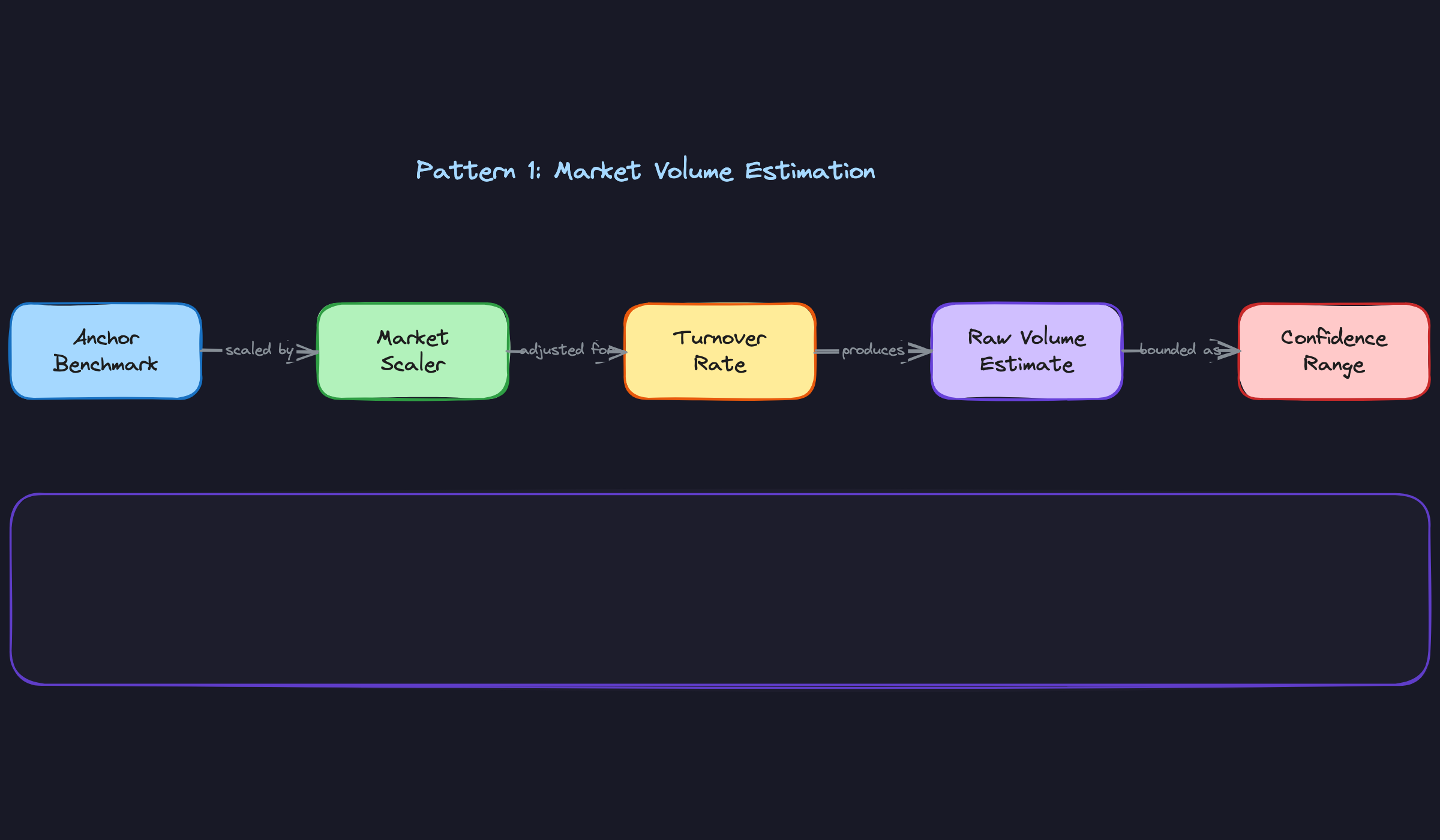
This is the most common pattern in first-round screens. You're given a market (equities, options, FX, credit) and asked how much trades in a day, a month, or a year. The move is to anchor on a market you already know, then scale.
Start with NYSE daily equity volume: roughly $50B per day. From there, you can scale up or down based on how the target market compares in terms of participants, liquidity, and turnover. If you're estimating US options volume, you know options are more leveraged and attract a different mix of participants, so you'd expect notional volume to be a fraction of equity volume, maybe 10-20%. That gives you $5B to $10B in notional terms, though contract count is a separate calculation. Show the scaler explicitly. "I'm treating this as roughly 15% of US equity volume because..." is exactly what the interviewer wants to hear.
When to reach for this: any question that asks "how much trades" or "what's the daily/annual volume" in a financial market.
Pattern 2: Population-Rate-Size Decomposition
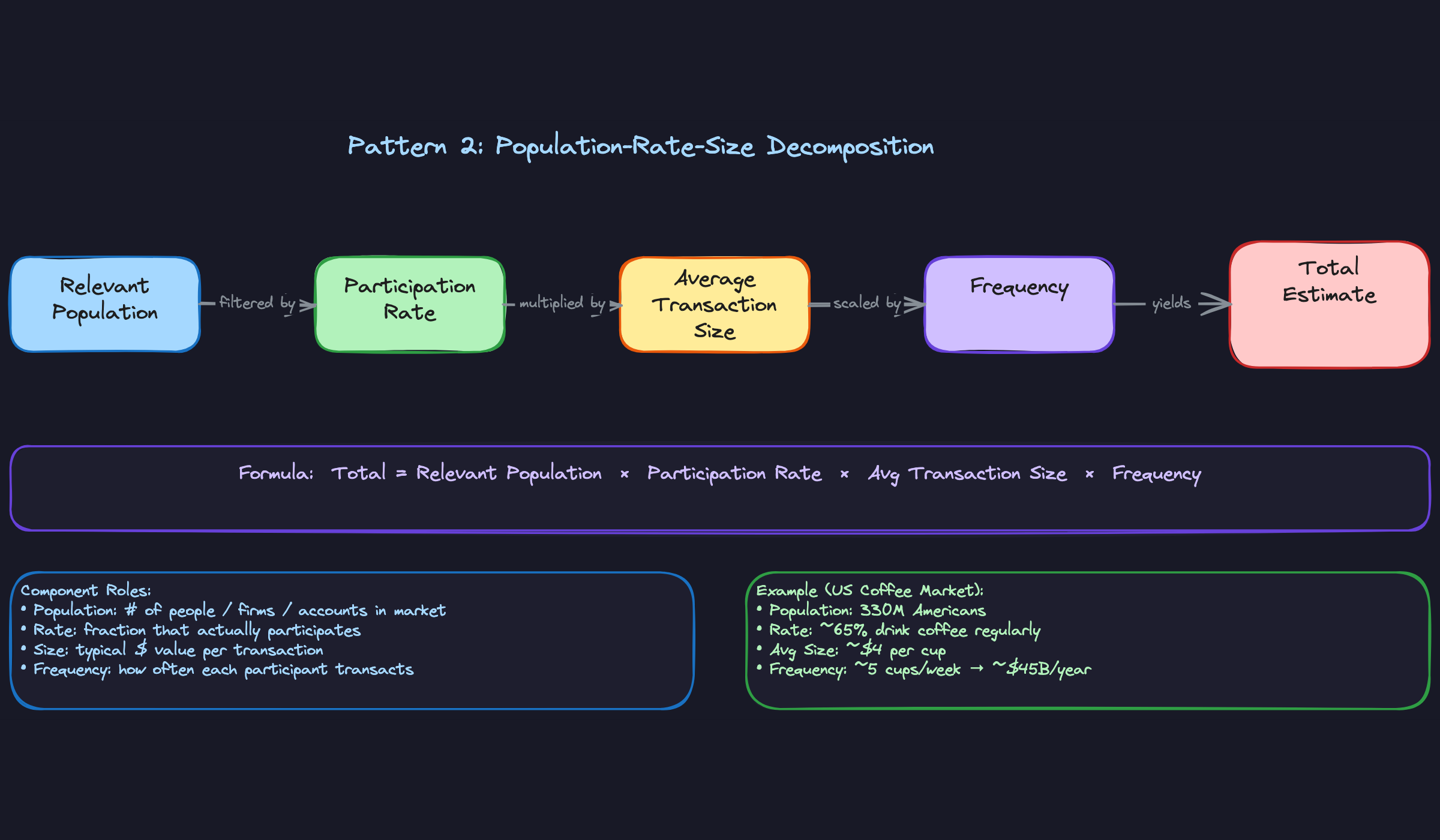
When there's no obvious market benchmark to anchor on, build the estimate from the ground up using participants. The structure is always the same: how many people (or firms) could plausibly do this, what fraction actually do, how often, and how much per transaction.
Say you're estimating the annual volume of retail brokerage trades in the US. Start with 330M Americans. Maybe 20% have a brokerage account, so 66M accounts. Of those, active traders might represent 10%, around 6-7M people. Each makes perhaps 20 trades per year at an average size of $5,000. That's 6M x 20 x $5,000 = 6 x 10^6 x 2 x 10^1 x 5 x 10^3 = 6 x 10^11, or roughly $600B per year. Sanity check: that's about 30 trading days of NYSE volume, which feels plausible for retail alone.
This pattern shines when the market is unfamiliar or when the interviewer deliberately picks something obscure. The decomposition structure is transferable even when your knowledge of the specific market is thin.
When to reach for this: questions about consumer financial behavior, retail participation, or any market where you can reason from a known population base.
Pattern 3: Compound Growth and Doubling Time
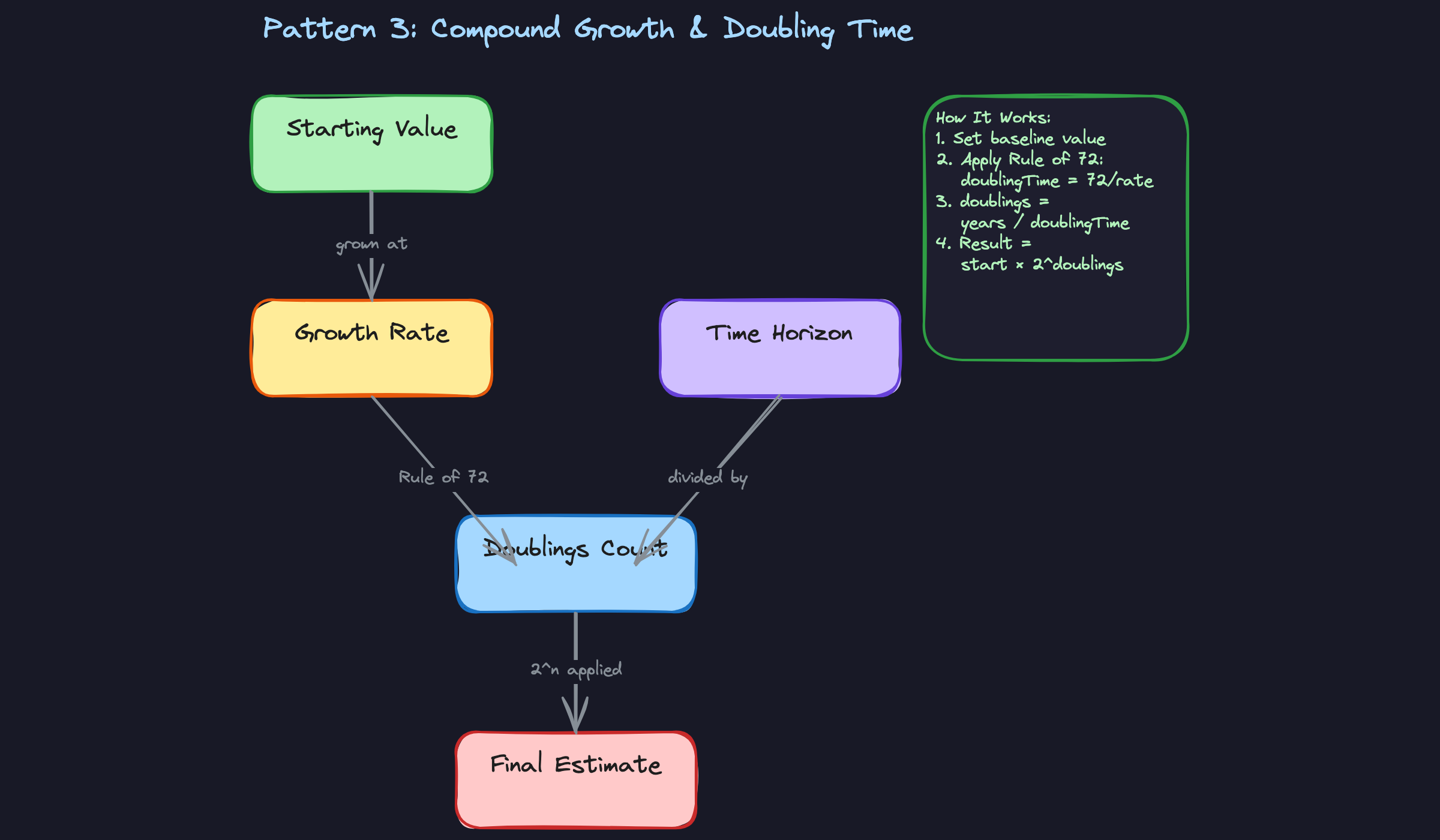
This pattern comes up less in first-round screens and more in later-round discussions about market evolution, portfolio growth, or historical comparisons. The core tool is the Rule of 72: divide 72 by the annual growth rate to get the approximate doubling time.
At 7% annual growth, a quantity doubles every 10 years. At 10%, every 7 years. At 36%, every 2 years. Once you know the doubling time, count how many doublings fit in your time horizon and multiply the starting value by 2 raised to that count. If someone asks you to estimate the size of the global ETF market in 2030 given it was roughly $10T in 2023 and has been growing at around 15% per year, the doubling time is about 5 years. One doubling by 2028, nearly two by 2033. So by 2030 you're somewhere between $10T x 2 and $10T x 4, call it $15T to $25T. State that as your range.
The key is converting the exponential into a count of doublings. Trying to compute 1.15^7 in your head is painful and unnecessary. Two to the power of something is much easier to reason about.
When to reach for this: any question involving growth over time, projected market sizes, or "how long until X doubles."
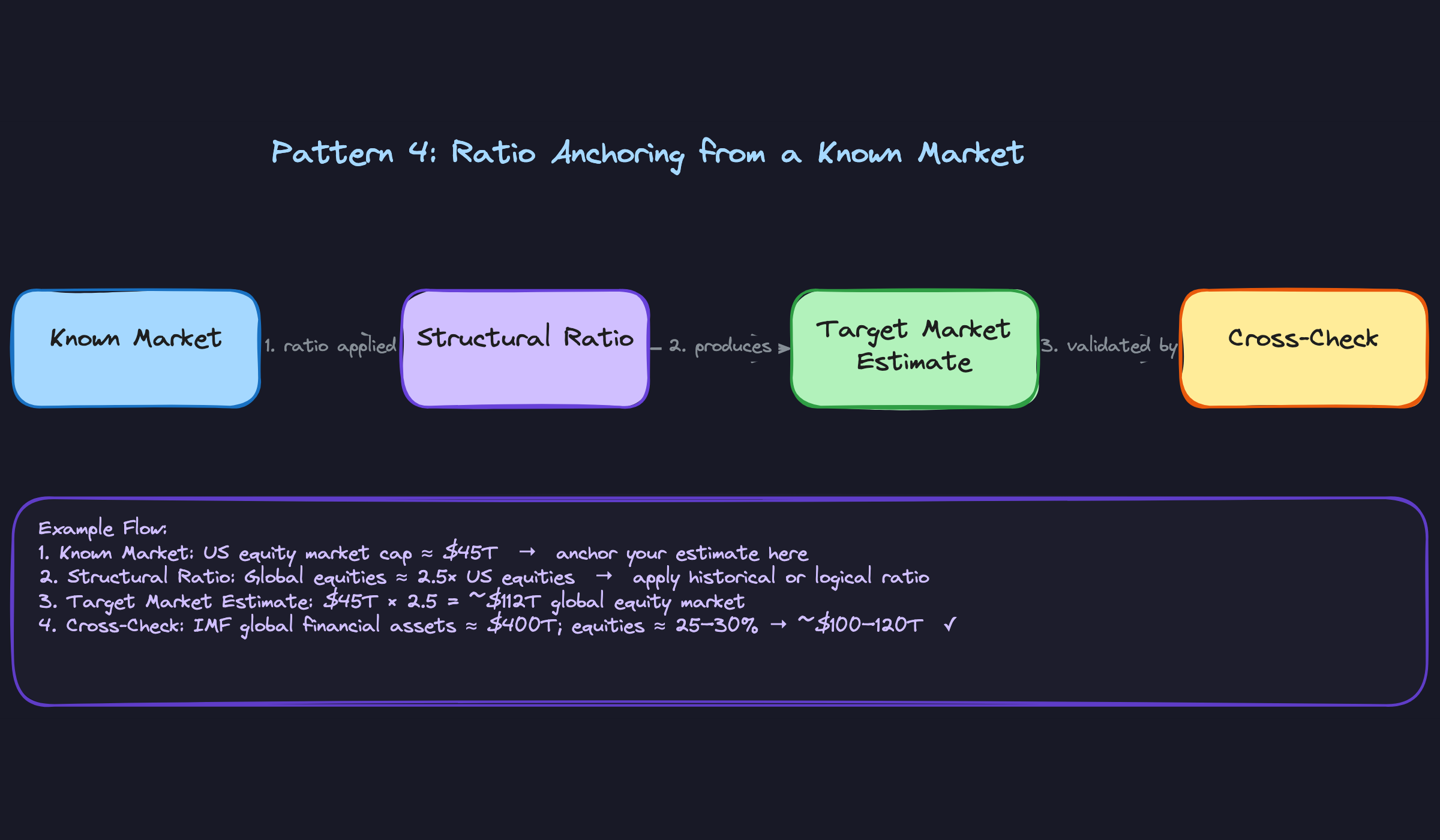
Pattern 4: Ratio Anchoring from a Known Market
Sometimes the fastest path to an estimate is a structural ratio between two markets you can defend. These ratios are stable enough to be useful anchors, but you need to be precise about what you're comparing. Global FX turnover is about 150x global equity turnover. The US options market notional is a fraction of the underlying equity market it references. And the total US bond market (including Treasuries, agency debt, municipal bonds, and corporate bonds) is roughly 2-3x US equity market cap by outstanding value, though if you're isolating just investment-grade corporate bonds, that ratio drops to around 0.2-0.3x.
That distinction matters. The workflow is: identify a known market, be explicit about which slice of the target market you're sizing, recall or reason through the ratio, apply it, then cross-check from a second angle. If you're asked about the size of the US corporate bond market, you know US equity market cap is around $45T. Corporate bonds are typically in the range of 0.2x to 0.3x equity market cap for a developed economy, so you'd estimate $9T to $14T. The actual figure is around $10T in investment-grade corporate bonds outstanding. That's well within one order of magnitude. That's a pass.
This pattern is particularly useful when the interviewer gives you a derivative or related market and expects you to reason from the underlying. It also signals financial market literacy, which matters at firms like Jane Street and Citadel Securities where interviewers are active practitioners.
When to reach for this: questions about a market you can relate to a more familiar one, or when you need a fast cross-check on a Population-Rate-Size estimate.
Choosing Your Pattern
| Pattern | Best For | Key Anchor | Typical Interview Round |
|---|---|---|---|
| Market Volume Estimation | Direct "how much trades" questions | NYSE ~$50B/day, FX ~$7.5T/day | First round |
| Population-Rate-Size | Consumer or retail market sizing | US population ~330M | First round |
| Compound Growth / Doubling Time | Projections, growth questions | Rule of 72, 2^10 ≈ 10^3 | Later rounds |
| Ratio Anchoring | Related or derivative markets | US equity cap ~$45T | Later rounds |
For most first-round screens, you'll default to Market Volume Estimation or Population-Rate-Size. They're fast, they're auditable, and they work on almost any market-sizing question. Reach for Compound Growth when the question has a time dimension, and Ratio Anchoring when you recognize a structural relationship between the target market and something you already know. In practice, the strongest answers combine two patterns, using one to generate the estimate and the other to sanity-check it.
What Trips People Up
Here's where candidates lose points — and it's almost always one of these.
The Mistake: Starting From Zero
You ask for a moment to think, and then you say "I don't really have a reference point for this, so let me try to build it up from scratch..." and then you spend three minutes constructing a shaky tower of guesses that collapses somewhere around step four.
The problem isn't that you're thinking out loud. It's that you skipped the most important step: anchoring. Without a benchmark, your first assumption has no constraint, and every subsequent assumption inherits that looseness. By the end, you're off by two orders of magnitude and you don't even know it.
Before you say anything else, ask yourself: what do I already know that's in the same neighborhood? NYSE daily equity volume is around $50B. US GDP is $28T. Global FX turnover is $7.5T per day. You don't need to memorize a hundred numbers. You need five or six solid anchors you can defend, and the habit of reaching for one before you start.
The Mistake: False Precision
This one is subtle, and it trips up candidates who are actually good at math. They work through the decomposition carefully, multiply everything out, and then say "so my estimate is $47,382,000,000."
The interviewer hears: "I don't understand what this exercise is testing."
You're not being asked to compute. You're being asked to demonstrate that you know the difference between billions and trillions, that you can reason about scale, and that you won't confuse a $50B market for a $500B one when sizing a trade. Reporting six significant figures on an estimate built from five rounded assumptions is a category error. It suggests you're optimizing for arithmetic accuracy in a problem where the uncertainty is already plus or minus a factor of three.
Round aggressively. "$50 billion" is a better answer than "$47.4 billion." Say the round number, then optionally note that your estimate could be as low as $20B or as high as $100B depending on your turnover assumption. That's what calibration looks like.
The Mistake: Stopping at the Number
A candidate works through a clean decomposition, gets a reasonable answer, and then... stops. "So I'd estimate about $30 billion per day."
Full stop. Waiting.
What's missing is the sanity check, and interviewers notice its absence. In practice, a trader who produces an estimate and never asks "does this make sense?" is a liability. The whole point of order-of-magnitude reasoning is that you can catch your own errors before they cost you money.
After you land on a number, spend fifteen seconds triangulating. "That's roughly 60% of NYSE equity volume, which feels plausible for the options market given how active it's been." Or: "That implies each of the 50 largest hedge funds is doing $600M in daily FX flow, which seems a bit high, so maybe my turnover assumption is aggressive." Either way, you're showing the interviewer that you know how to audit your own work.
The Mistake: Conflating Stock and Flow
Someone asks you to estimate "the US mortgage market" and you launch into an estimate of outstanding mortgage balances. But they meant annual originations. Your answer is off by a factor of six, and neither of you realizes it until the conversation gets awkward.
Stock and flow are genuinely different quantities. Outstanding balances (a stock) represent the total accumulated value sitting on lenders' books right now, around $13T for US mortgages. Annual originations (a flow) represent new loans written in a given year, closer to $2T. Same market, same words, completely different numbers.
This is an easy fix. Before you start any estimation, spend one sentence clarifying the quantity. "Just to confirm, are we estimating the total outstanding notional, or the annual transaction volume?" That question alone signals financial literacy. It also protects you from building a beautiful estimate of the wrong thing.
The Mistake: Folding Under Pushback
The interviewer says "that seems high to me." And the candidate immediately says "you're right, let me redo that" and starts over from scratch, abandoning a perfectly reasonable estimate because someone raised an eyebrow.
Don't do this.
Pushback in a trading interview is often a test of conviction, not a signal that you're wrong. The interviewer wants to see whether you'll defend a well-reasoned position or whether you'll just agree with whoever is in the room. Traders who cave at the first sign of disagreement don't last long on a desk.
When you get pushback, walk through your assumptions explicitly. "The number does look large. The assumption I'm least confident in is the turnover rate. If I drop that from 2x to 1x, the estimate falls to $15B, which might feel more reasonable. But I'd want to understand which part of my reasoning you're questioning before I change the answer." That's the response of someone who knows the difference between a load-bearing assumption and a rounding choice. That's who they want to hire.
How to Talk About This in Your Interview
When to Bring It Up
Estimation questions at trading firms are rarely telegraphed. The interviewer won't say "now we'll do a Fermi problem." Instead, watch for these cues:
- "How big do you think that market is?" This is the direct version. Anchor immediately, don't hedge.
- "Roughly how many..." or "What's your sense of..." These signal they want order-of-magnitude intuition, not a precise formula.
- "Let's say you're sizing a position in X market..." They're testing whether your quantitative instincts are calibrated to reality.
- Any unfamiliar market name dropped casually. If they mention "Korean equity futures" or "US swaptions" and ask about volume, they're checking whether your estimation pattern transfers, not whether you've memorized that specific number.
The moment you hear any of these, your internal monologue should snap to: anchor, decompose, multiply, sanity-check. Say that structure out loud. Don't just start calculating silently.
Sample Dialogue
This is a realistic Jane Street first-round exchange. Notice how the interviewer pushes mid-calculation.
That last response is the one that actually impresses interviewers. You didn't panic. You diagnosed the error, named which assumption was load-bearing, and showed you understand the difference between being wrong and reasoning poorly.
Follow-Up Questions to Expect
"What's the biggest assumption you'd want to verify first?" Name the one factor your estimate is most sensitive to, and explain why a small change in that number moves your answer the most.
"How would your estimate change if we were talking about index options instead of single-stock?" This tests whether you understand market structure; say that index options (especially SPY and SPX) dominate volume and have much higher notional per contract, which would shift your contract count down but notional up.
"Can you give me a range rather than a point estimate?" If you haven't already given a range, this is a gentle correction; always close with a range and name the uncertainty driving the spread.
"What would make you revise this estimate significantly?" They want to see you distinguish between rounding choices (which barely matter) and structural assumptions (which can flip your answer by an order of magnitude). Name one of each.
What Separates Good from Great
- A good candidate produces a reasonable number and stops. A great candidate gives a range, names the dominant uncertainty, and offers to refine it. The range signals that you understand your own model's limitations, which is exactly what risk management looks like in practice.
- When challenged, a good candidate either defends their original answer rigidly or abandons it entirely. A great candidate updates the specific assumption that was questioned, recalculates, and shows how the estimate shifts. Graceful updating under pressure is the whole skill.
- Great candidates narrate their reasoning in real time using auditable language: "I'm going to anchor on...", "my key assumption here is...", "this could be off by a factor of two if the turnover rate is higher than I think." This makes your thinking visible and gives the interviewer something to engage with. Silent calculation followed by a single number tells them almost nothing.
Rapid-Fire Practice Set
Drill these before your interview. For each one, the goal is to say your decomposition path out loud before you do any arithmetic.
1. What is the daily notional volume of the global FX market? Anchor on the $7.5T global FX daily turnover benchmark. For a sanity check, total US equity volume across all exchanges runs roughly $500B to $1T per day, so $7.5T is about 7 to 15 times that figure. That ratio makes intuitive sense: FX is the world's largest market, runs 24 hours across global time zones, and includes massive interbank flows that have no equity equivalent. Note that NYSE-only volume ($50B per day) is a much narrower slice; if you anchor your sanity check there, $7.5T looks like 150x, which is correct arithmetic but a misleading comparison since NYSE is just one exchange.
2. How many shares of Apple trade each day? Anchor on Apple's market cap (~$3T) and a typical large-cap daily turnover rate of 0.5 to 1 percent. That gives $15B to $30B in daily notional. Divide by Apple's share price (~$200) to get 75 to 150 million shares.
3. What is the total notional value of outstanding US Treasury bonds? Anchor on US national debt (~$33T). Most of that is in marketable securities, so your estimate should be in the $25T to $30T range. Sanity-check against the fact that the Fed holds roughly $5T on its balance sheet.
4. How large is the global ETF market by assets under management? Anchor on US equity market cap (~$45T). US ETFs hold roughly 15 to 20 percent of US equity market cap, so US ETF AUM is around $7T to $9T. Global is maybe 1.5x that, so $10T to $15T total.
5. How many futures contracts on the S&P 500 (ES) trade each day? Anchor on S&P 500 index level (~5,000) and contract multiplier ($50 per point), so one ES contract is ~$250,000 notional. S&P 500 futures notional volume is probably in the range of $200B to $400B per day. Divide by $250,000 to get 800,000 to 1.6 million contracts.


