Join Data Science Interview MasterClass (September Cohort) led by FAANG Data Scientists | Just 6 seats remaining...
Data Science MasterClass (September) | 6 seats left
Mental Math Speed Techniques
Mental Math Speed Techniques
At Jane Street and Optiver, candidates who get the exact right answer but can't explain their steps get rejected. Candidates who land within 20% with clear, audible reasoning get offers. The number is almost secondary.
That's the reality of quantitative trading interviews. The interviewer isn't grading your arithmetic. They're watching whether you can decompose a messy problem under pressure, hold your assumptions in your head while talking through them, and know when to round aggressively versus when a factor of two actually matters. That's the job. The interview is a simulation of it.
Mental math here isn't a party trick. It's a structured skill: break the problem into chunks, apply the right approximation technique to each chunk, and verify the result against something you already know. Get that process down cold, and the specific numbers almost take care of themselves.
The Framework
Every estimation question at Jane Street, Optiver, or IMC runs through the same three phases. Memorize this table before anything else.
| Phase | Time Allocation | Goal |
|---|---|---|
| Decompose | 30-40% | Break the problem into pieces you can actually calculate |
| Approximate | 40-50% | Apply speed techniques to each piece and combine |
| Sanity Check | 15-20% | Verify the answer isn't absurd before you commit to it |
The time splits are rough guides, not rules. A simple problem might collapse Decompose into 30 seconds. A gnarly one might need you to cycle back from Sanity Check into Decompose if your first answer looks wrong. The point is that all three phases happen, every time, out loud.
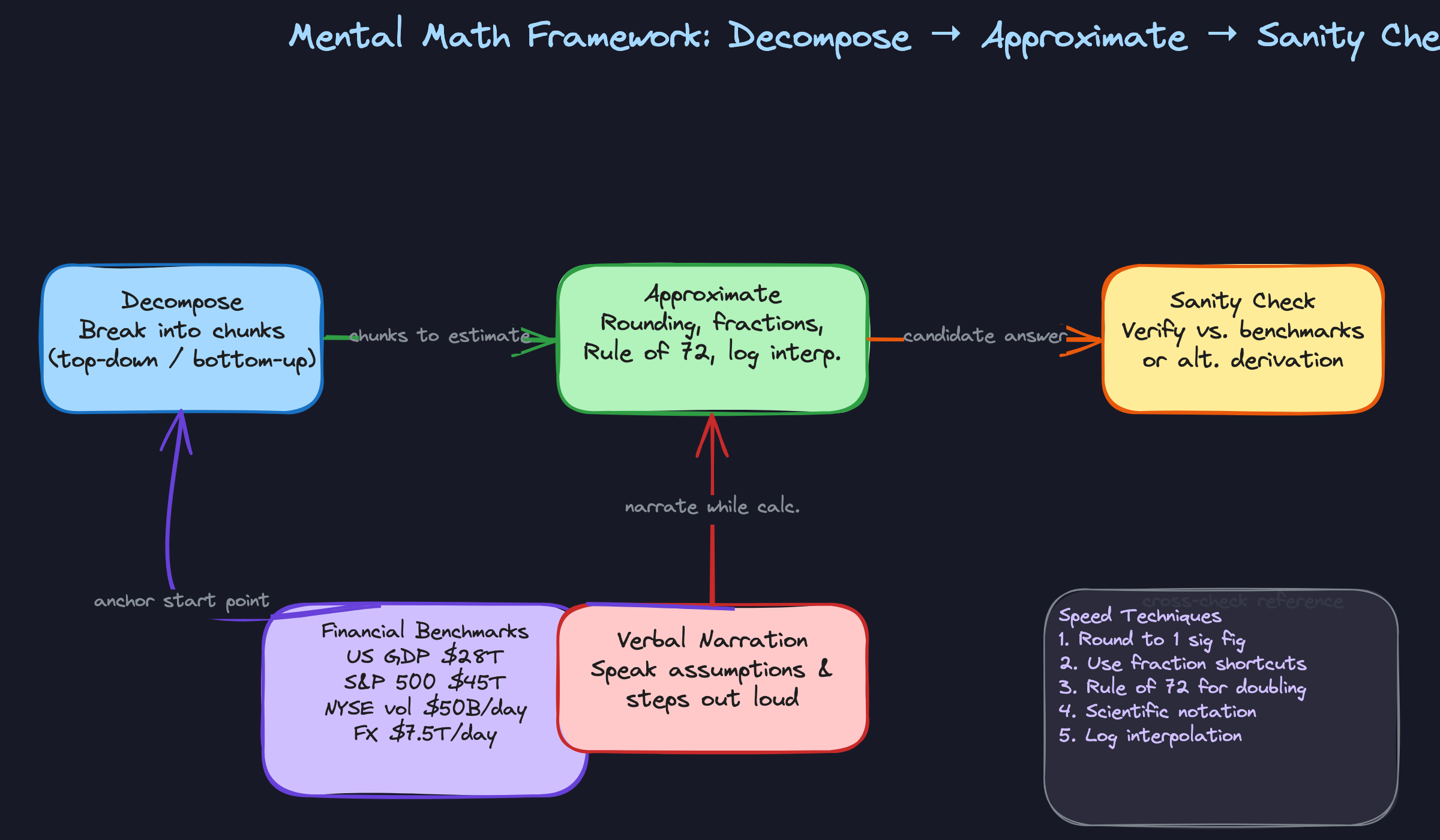
Phase 1: Decompose
What to do:
First, classify the problem as top-down or bottom-up. Top-down starts from a known aggregate and divides down. Bottom-up starts from a unit (one trader, one contract, one tick) and scales up. Choosing the right direction saves you from dead ends.
Use top-down when the problem gives you a market-level quantity to work from: "Estimate total US equity trading revenue" starts from NYSE daily volume ($50B), not from individual traders. Use bottom-up when the problem is about a specific firm, desk, or strategy: "Estimate a market maker's daily P&L" starts from spread per trade, not from GDP.
Then write out your decomposition as a product of terms before touching any numbers. If you are estimating annual options premium traded in the US, your skeleton might be: (number of contracts traded daily) x (average premium per contract) x (250 trading days). Get the structure right first.
What to say:
"Let me think about how to decompose this. I'll approach it top-down, starting from US equity market volume and working toward the specific number you're asking about."
"My decomposition is: [term A] times [term B] times [term C]. I'll estimate each one separately and then combine them."
"I'm going to anchor this to NYSE daily volume, which I'll take as roughly $50 billion. From there I need to figure out what fraction of that is relevant to the question."
How the interviewer evaluates you:
They are watching whether you impose structure before calculating. A candidate who jumps straight to arithmetic is guessing. A candidate who writes out the product of terms first is showing they understand the problem. They are also checking whether your decomposition is sensible: too many terms and you are overcomplicating it; too few and you are hiding assumptions inside a single number.
Do this: State your decomposition strategy (top-down vs. bottom-up) and explain why in one sentence. It signals you made a deliberate choice, not a random one.
Phase 2: Approximate
What to do:
Work through each term in your decomposition using one of five techniques. You do not need to pick the same technique for every term. Round-then-correct works well for percentages of large numbers. Fraction shortcuts work for common percentages like 5%, 25%, or 33%. Scientific notation keeps you from losing zeros when multiplying billions by thousands. The Rule of 72 handles anything involving doubling or compounding. Log-linear interpolation fills in gaps when you know two order-of-magnitude anchors but need something in between.
Round aggressively on terms where precision does not matter much, and be more careful on terms that dominate the final answer. If one term is 10x larger than the others, a 20% error there swamps everything else.
Keep your running total visible. Say the intermediate result out loud after each term so the interviewer can follow along and so you do not lose your place.
What to say:
"For this term, I'll round $47 billion to $50 billion to make the arithmetic cleaner, and I'll correct downward at the end."
"Ten percent of $50 billion is $5 billion, so 7% is roughly $3.5 billion. I'll use $3.5 billion for now."
"I'm using the Rule of 72 here: at 8% annual growth, this doubles in about 9 years. That gives me a reasonable range to work with."
"Combining those three terms: $50 billion times 0.3% times 250 days. That's $50B times 0.003 times 250, which is $50B times 0.75, so roughly $37 billion annually."
How the interviewer evaluates you:
Speed matters here, but clarity matters more. They want to see that you have a technique for each step, not that you are grinding through long multiplication in your head. If you round, say why. If you use a fraction shortcut, name it. Silence for more than 10 seconds is a red flag; it suggests you are stuck rather than thinking.
Phase 3: Sanity Check
What to do:
Cross-check your answer using a different approach than the one you just used. If you went top-down, try a quick bottom-up estimate and see if the two numbers are in the same ballpark. If you cannot do a full re-derivation, compare your answer to a known benchmark: does it represent a plausible fraction of US GDP, NYSE daily volume, or S&P 500 market cap?
Ask yourself one explicit question: "At the scale of the market I am describing, does this number make sense?" A daily P&L estimate for a single market maker that comes out larger than the entire NYSE daily volume is obviously wrong. A revenue estimate for the whole US equity market that comes out smaller than one mid-sized hedge fund's AUM is also wrong.
Then state your confidence range explicitly before you close. Not a point estimate. A range.
What to say:
"Let me do a quick sanity check. My estimate is $4 billion annually. NYSE daily volume is about $50 billion, so this represents roughly 0.008% of daily volume per year, which seems plausible for a mid-sized market maker's revenue."
"As a cross-check, I can approach this bottom-up: if there are roughly 500 active market makers and total industry revenue is around $20 billion, that's $40 million per firm on average. My estimate of $35 million for a mid-sized firm sits just below that, which feels right."
"My central estimate is $4 billion, and I'd put the range at $2.5 billion to $6 billion. The main uncertainty is my assumption about average spread, which could easily be off by 30% in either direction."
How the interviewer evaluates you:
This is where a lot of candidates leave points on the table. They get to a number and stop. The sanity check signals that you understand estimation is inherently uncertain and that you have the financial intuition to know whether your answer is in the right universe. Giving a range with explicit uncertainty drivers is what separates a quant candidate from someone who just did arithmetic.
Do this: Always name the assumption that creates the most uncertainty in your estimate. "The number I'm least confident in is X, because..." shows intellectual honesty and tells the interviewer exactly where to probe if they want to go deeper.
The transition between phases should be explicit and brief. After Decompose, say: "Okay, I have my structure. Let me work through the numbers now." After Approximate, say: "I have a candidate answer of roughly $4 billion. Let me do a quick sanity check before I commit to that."
Those two sentences cost you five seconds and buy you enormous credibility.
Putting It Into Practice
The five techniques from the framework only become useful when you can deploy them fast, under pressure, while talking. Here's how each one actually looks in motion.
Technique 1: Round-Then-Correct
The interviewer asks: "What's 7.3% of $47 billion?"
Don't try to compute 7.3 × 47 in your head. Instead, say this out loud:
"I'll round to 7% of $50B to make the arithmetic clean. That's $3.5B. Now I need to correct for two things: I inflated the base by about 6%, and I reduced the rate slightly. Those roughly cancel, so I'll nudge down to about $3.4B."
That's the whole technique. Round aggressively, then reason about whether your rounding over- or under-shot, and apply a small correction. The correction doesn't need to be precise. It just needs to show you're tracking the direction of your error.
Do this: Always say "I'll round to make the arithmetic clean" before you round. It signals intentionality, not sloppiness.
Technique 2: Percentage as Fraction Shortcuts
Memorize this short table and you can decompose almost any percentage in seconds:
| Percentage | Shortcut |
|---|---|
| 1% | Divide by 100 |
| 5% | Half of 10% |
| 10% | Divide by 10 |
| 25% | Divide by 4 |
| 33% | Divide by 3 |
| 50% | Divide by 2 |
The real power is chaining these. If someone asks for 15% of $80B: take 10% ($8B) and add 5% ($4B). Answer: $12B. Done in five seconds.
Trickier example: 37.5% of $240M. That's 25% ($60M) plus 12.5%, which is half of 25% ($30M). Total: $90M. You can chain any percentage this way as long as you decompose it into fractions you already know.
Technique 3: Rule of 72
If a portfolio compounds at 8% annually, it doubles in 72 / 8 = 9 years. That's the forward direction. The reverse is just as useful: if something doubled in 6 years, the implied annual growth rate is 72 / 6 = 12%.
This shows up more than you'd expect. Options questions sometimes embed compounding assumptions. You might get asked to estimate the future value of a trading book, or to back out an implied return from a given doubling period. When you hear "doubles" or "growth rate," the Rule of 72 should fire immediately.
One calibration point: the rule is most accurate between 6% and 10% annual rates. Outside that range, it still gives you a useful order-of-magnitude anchor, but flag that you know it's approximate.
Technique 4: Scientific Notation for Large Market Numbers
When you're working with billions and trillions, losing track of zeros is the most common failure mode. Scientific notation prevents that.
Say you want to estimate total annual US equity trading revenue. Start with what you know: NYSE daily volume is roughly $50B. That's $5 × 10^10. There are about 250 trading days per year, so annual volume is $5 × 10^10 × 2.5 × 10^2 = $12.5 × 10^12, or $12.5 trillion.
Now apply a revenue assumption. Market makers might capture 0.5 basis points (0.5 bps = 0.005% = 5 × 10^-4) on each side. Revenue per dollar traded is roughly $5 × 10^-4. Multiply: $1.25 × 10^13 × 5 × 10^-4 = $6.25 × 10^9, or about $6B annually across the industry.
The key habit: write the exponents explicitly when you're narrating. Say "that's 10 to the 10th" out loud. It keeps you anchored and lets the interviewer follow your scaling.
Don't do this: Say "a few billion" without showing how you got there. Vague scaling is not the same as scientific notation reasoning. Show the multiplication step, even if it's rough.
The Full Dialogue: Daily P&L of a Market Maker
This is where everything comes together. The question: "Estimate the daily P&L of a market maker quoting 500 stocks."
Now trades per stock per day. A liquid stock might trade 50,000 times a day in total. A market maker with meaningful presence might be on one side of maybe 5% of those. That's 2,500 trades per stock per day.
Do this: When the interviewer challenges an assumption, don't defend it reflexively. Engage with the challenge, update if it's valid, and show how the answer scales. That's exactly what they want to see.
I'd put the range at $300K to $600K, with $400K as my central estimate. If you want, I can sanity-check that against what we'd expect from a mid-sized market-making desk's annual revenue.
The interviewer's interruption about the 5% assumption was a test, not a trap. Candidates who dig in and defend a shaky number fail that test. Candidates who say "fair point, let me adjust" and show how the answer scales pass it.
One more thing: the final sanity check against annual revenue wasn't asked for. The candidate offered it. That's a strong move. It shows you're not just executing a procedure; you're actually thinking about whether the answer makes sense in the real world.
Common Mistakes
These aren't edge cases. Every interviewer at a quant trading firm has seen all five of these in the last month.
Wrong Anchor, Wrong Everything
A candidate opens with "so US GDP is roughly $10 trillion..." and the interviewer's pen stops moving. The real number is $28 trillion. That's not a rounding error; it's a 3x mistake before you've touched the actual problem. Every subsequent calculation inherits that error, and your final answer will be off by the same factor.
Don't do this: Guessing at benchmark numbers you should have memorized cold.
The fix is simple: commit five numbers to memory before you walk in.
| Benchmark | Value | Common Use |
|---|---|---|
| US GDP | ~$28T | Macro scaling, market size sanity checks |
| S&P 500 market cap | ~$45T | Equity market sizing |
| NYSE daily volume | ~$50B | Trading revenue, market maker estimates |
| Global FX daily turnover | ~$7.5T | FX market sizing |
| US population | ~330M | Per-capita decompositions |
If you're unsure of a benchmark mid-interview, say so explicitly and offer a range. That's recoverable. Stating a wrong number with confidence is not.
Going Silent and Presenting a Magic Number
You hear the question, nod, go quiet for 25 seconds, and then say "$4.2 billion." The interviewer writes nothing down.
They can't give you credit for reasoning they never heard. At Jane Street and Optiver especially, the process is the answer. A candidate who arrives at $4.2B through visible, logical steps beats a candidate who produces the exact right number from silence. The second candidate looks like they either guessed or memorized something, neither of which is what the firm is hiring for.
Do this: Narrate every step as you go. "I'm starting with NYSE daily volume at $50B, assuming market makers capture roughly 1 basis point per dollar traded, that's $5M per day across the whole market, now I need to figure out what share one firm captures..."
Talking while calculating feels awkward at first. Practice it until it doesn't.
Fake Precision
"My estimate is approximately $3.847 billion."
That number has four significant figures. Your estimate has maybe one. The word "approximately" doesn't save you here; the false precision screams that you don't understand what estimation actually is.
Don't do this: Carrying your arithmetic to the decimal place just because your mental math happened to produce one.
Trading firms think in orders of magnitude and ranges. When you report a spuriously precise number, you signal that you're computing mechanically rather than reasoning about uncertainty. Round aggressively and own it: "$3B to $4B, call it $3.5B."
No Confidence Range
Giving a single point estimate with no range is the estimation equivalent of saying "the answer is 42" with no units. It tells the interviewer you haven't thought about where your assumptions could be wrong.
Every estimation answer should end with a range and a central estimate. Something like: "I'd put this between $3B and $6B, with $4B as my central estimate. The main uncertainty is the spread assumption; if that's 2x wider than I assumed, the answer doubles."
If you genuinely think your estimate is tight, say that too. "I'm fairly confident in this one; I'd narrow it to $3.5B to $4.5B because both inputs are well-anchored." That's a different signal than just dropping a number.
Freezing When Your Assumption Gets Challenged
The interviewer interrupts: "Actually, let's say the average spread is half what you assumed." You stare at your work. You start over from the top. You lose two minutes and your composure.
This is a deliberate test. Interviewers at Optiver and IMC push back on assumptions specifically to see if you can update in place without restarting. Restarting from scratch signals that you don't understand how your own model works.
Do this: When challenged, say "good point, that assumption was doing X in my calculation, so halving it roughly halves that term, which brings my estimate from $4B down to about $2B. I'll update my range accordingly."
You don't need to recompute everything. You need to understand which lever just got pulled and how sensitive your answer is to it. That's the skill they're actually testing.
Skipping the Sanity Check
You finish your calculation, get a number, and move on. The number is $500 trillion. You don't notice.
A sanity check takes 15 seconds and catches the kind of error that ends interviews. After you land on an answer, ask yourself: does this number make sense relative to something I know? If you estimated annual equity trading revenue at $500T and NYSE daily volume is $50B, that's 10,000 trading days of volume. Something is wrong.
Don't do this: Presenting an answer that's obviously impossible at the scale of the market you're describing.
The fix is to build the sanity check into your verbal template. Before you commit to a final answer, say "let me just cross-check this against..." and take the 15 seconds. It shows rigor, and it saves you from the most embarrassing category of mistake.
Quick Reference
The Five Numbers You Must Know Cold
Blank on a benchmark mid-interview and your whole estimate unravels. Memorize these before you walk in.
| Benchmark | Value | Typical Use Case |
|---|---|---|
| US GDP | ~$28 trillion/year | Sanity-checking macro estimates; anchoring revenue or volume questions |
| S&P 500 market cap | ~$45 trillion | Equity market sizing; estimating index-level dollar moves |
| NYSE daily volume | ~$50 billion/day | Market maker P&L estimates; liquidity and spread questions |
| Global FX daily turnover | ~$7.5 trillion/day | FX market sizing; currency flow estimation |
| US population | ~330 million | Bottom-up consumer or retail investor estimates |
The Five Approximation Techniques
| Technique | What It Does | The Shortcut | Micro-Example |
|---|---|---|---|
| Round-then-correct | Gets you close fast, then nudges | Round to a clean number, adjust directionally | 7.3% of $47B: round to 7% of $50B = $3.5B, correct down to ~$3.4B |
| Percentage as fraction | Eliminates division by converting | 5% = ÷20, 25% = ÷4, 33% = ÷3, chain for odd %s | 15% of $80B: 10% = $8B, 5% = $4B, total = $12B |
| Scientific notation scaling | Keeps zeros from eating you alive | Express everything as X × 10^n, add exponents when multiplying | 500 stocks × $2M daily volume = $1B. Scale to 250 days = $250B/year |
| Rule of 72 | Converts growth rates to doubling times instantly | Doubling time = 72 ÷ annual rate (and reverse) | 8% annual growth: doubles in 9 years. Doubled in 4 years: implied ~18% growth |
| Log-linear interpolation | Bridges order-of-magnitude gaps | Halfway between 10^n and 10^(n+1) is roughly 3× the lower bound | Midpoint between $1B and $10B is ~$3B, not $5B |
Fraction-to-Percentage Conversions
These come up constantly in spread, fee, and return calculations. Don't derive them on the spot.
| Fraction | Percentage |
|---|---|
| 1/8 | 12.5% |
| 1/6 | 16.7% |
| 1/4 | 25.0% |
| 1/3 | 33.3% |
| 3/8 | 37.5% |
| 1/2 | 50.0% |
| 2/3 | 66.7% |
| 7/8 | 87.5% |
Your Verbal Template
Internalize this structure so it comes out automatically under pressure:
"The question is asking for [X]. I'll approach this top-down, starting from [known benchmark]. My key assumptions are: [A], [B], [C]. Working through the math: [narrate each step out loud]. My central estimate is [Z], and I'd put the range at [low] to [high] depending on [the assumption I'm least confident about]."
The last clause matters. Naming your weakest assumption signals that you understand the limits of your own reasoning. That's exactly what a trading firm wants to see.
60-Second Morning Warm-Up
Run these three problems before you walk into the building. Don't aim for the exact answer. Aim to finish each one in under 20 seconds with your reasoning narrated out loud.
Problem 1. What is 37.5% of $48 billion? Target range: $17B to $19B. (Hint: 37.5% = 3/8.)
Problem 2. A portfolio earning 6% annually. How long to double? Target range: 11 to 13 years. (Rule of 72: 72 ÷ 6 = 12.)
Problem 3. A market maker quotes 200 stocks, earns a 0.5 bps spread per share, trades 1,000,000 shares per stock per day at an average price of $50. Estimate daily gross revenue. Target range: $45M to $55M. (Hint: 200 stocks × 1,000,000 shares × $50 = $10B total notional. 0.5 bps = 0.00005. $10B × 0.00005 = $500,000... wait, that's spread on notional. But spread per share means: 0.5 bps × $50/share = $0.0025/share. 200 × 1,000,000 shares × $0.0025 = $500,000 per day. That's well below the target range, so revisit your share count or spread. Try 10 bps spread instead: $0.05/share × 200M shares = $10M. That lands in range. The key lesson: always check whether "bps" applies to notional or per-share price before you commit to a calculation path.)
Actually, let's make the numbers clean. Revised Problem 3: A market maker quotes 200 stocks, earns a spread of $0.05 per share (roughly 10 bps on a $50 stock), and trades 1,000,000 shares per stock per day. Estimate daily gross revenue. Target range: $8M to $12M. (200 stocks × 1,000,000 shares × $0.05 = $10M.)
If Problem 3 took you more than 30 seconds, slow down on the decomposition step, not the arithmetic.
Phrases to Use
Keep these ready. Each one handles a specific moment in the interview.
- When starting: "I'll approach this top-down from NYSE daily volume as my anchor, since this is an equity market question."
- When rounding: "I'm going to round $47B to $50B to keep the math clean, then correct at the end."
- When challenged on an assumption: "Fair point. If I adjust that from X to Y, the estimate scales roughly proportionally, so my new central estimate is around Z."
- When presenting your answer: "My estimate is $4 billion, with a range of $3B to $5B. The biggest source of uncertainty is my assumption about average trade size."
- When you need a moment: "Let me just work through the order of magnitude first to make sure I'm in the right ballpark before I refine."
- When sanity-checking: "As a cross-check: that implies roughly 2% of NYSE daily volume, which feels plausible for a mid-sized market maker."
Red Flags to Avoid
- Giving a single point estimate with no range. It signals you don't understand what estimation means.
- Going silent for more than 10 seconds. Narrate the gap, even if you're just saying "I'm working through the units here."
- Using stale benchmarks. "US GDP is about $10 trillion" ends your credibility before the real math starts.
- Restarting from scratch when challenged. Update the affected assumption and scale; don't rebuild the whole estimate.
- Over-precise answers like "$3.847 billion." Round to one or two significant figures and own it.


