Join Data Science Interview MasterClass (September Cohort) led by FAANG Data Scientists | Just 6 seats remaining...
Data Science MasterClass (September) | 6 seats left
The Fermi Estimation Framework for Trading
The Fermi Estimation Framework for Trading
A candidate who aced every probability question, every brain teaser, and every mental math drill still got cut at Optiver because when asked to estimate daily equity options volume in the US, they stared at the ceiling for 90 seconds and then said a number with no explanation. The interviewer pushed back: "How did you get there?" Silence. That was the end of the process.
Trading firms ask Fermi questions because they are not testing whether you memorized NYSE volume figures. They are testing whether you think the way a trader thinks: decompose an uncertain problem into manageable pieces, make your assumptions explicit so they can be challenged, and arrive at a defensible range rather than a false-precision point estimate. That is exactly what you do when you size a position with incomplete information. The interview question is a proxy for the job.
What interviewers at Jane Street, IMC, and Citadel Securities are actually scoring is your process. Decomposition clarity, assumption transparency, arithmetic speed, and calibrated confidence. A candidate who says "I'm going to anchor to NYSE daily notional volume, take Apple's share of that, and cross-check against market cap turnover" and lands on a number that's 40% off will outscore someone who silently computes the right answer. This playbook gives you a four-step structure that makes your reasoning visible and your answer defensible, every time.
The Framework
Four steps. Every time. No exceptions.
Internalize this table before anything else. It's the skeleton of every estimation answer you'll give.
| Phase | Time | Goal |
|---|---|---|
| Anchor | ~30 sec | Ground the problem in a known financial benchmark |
| Decompose | ~60 sec | Break into 2-4 independent sub-quantities |
| Compute | ~60 sec | Combine sub-estimates with explicit, narrated arithmetic |
| Sanity Check + State Range | ~60 sec | Validate against a second path; deliver a range with named uncertainty |
Three to five minutes total. If you're going longer, you're over-engineering it.
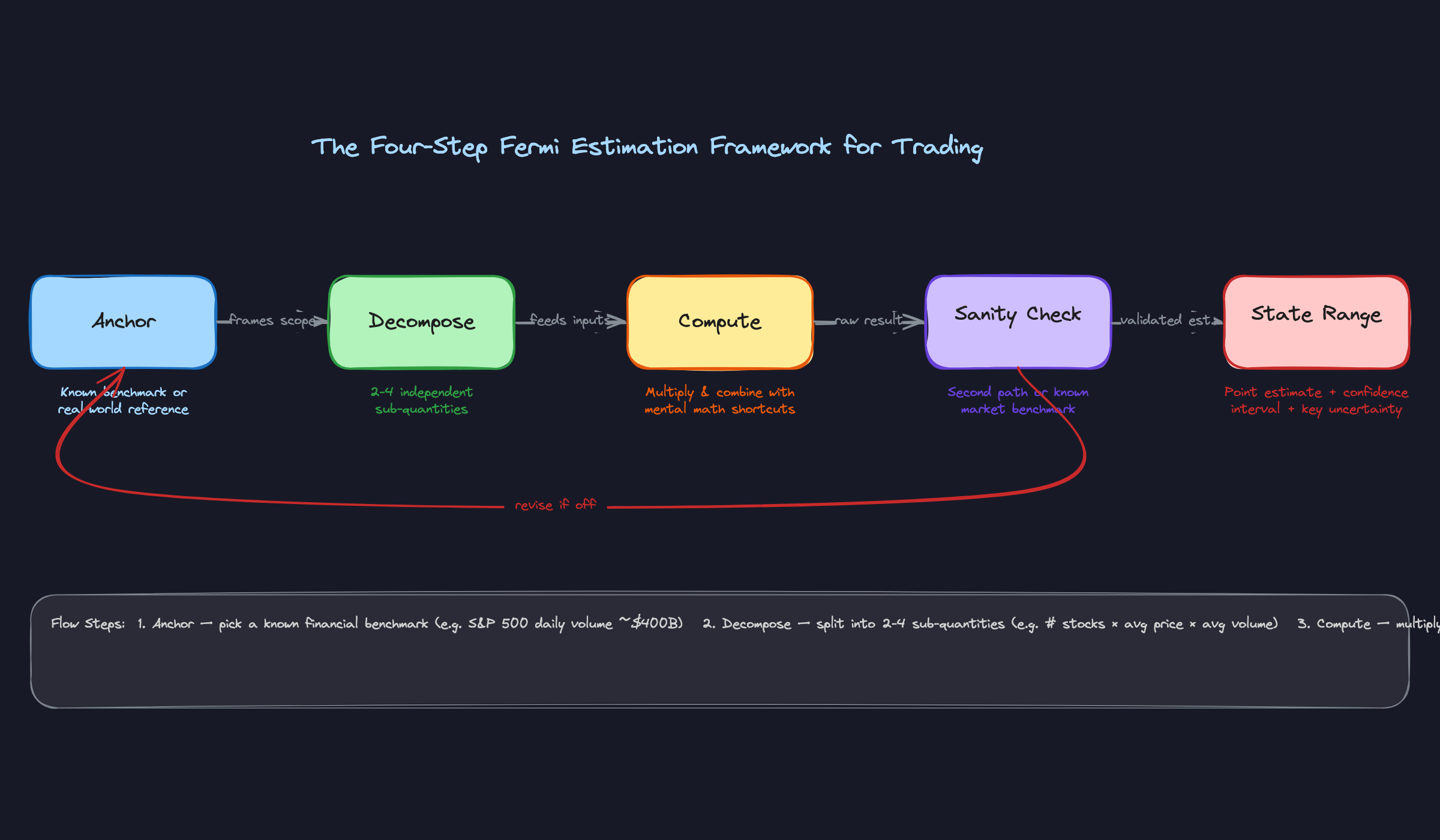
Step 1: Anchor
Your first job is to pick a number you actually trust. Not a guess, a reference point. The anchor frames the entire problem, so naming it out loud lets the interviewer catch a bad starting assumption before you've built ten minutes of reasoning on top of it.
What to do: 1. Scan the problem for a financial quantity you already know (market cap, daily volume, GDP, population). 2. State the anchor explicitly with its approximate value. 3. If you don't know the exact number, derive it from two things you do know. For example, if you need an average S&P 500 company's market cap, take the index's total market cap (~$45T) and divide by the number of names (~500) to get roughly $90 billion per company. Always triangulate from aggregates you trust.
What to say:
"Let me anchor this to NYSE daily equity volume, which I'll put at roughly $50 billion notional per day. That's my starting reference point."
Or, when you're deriving:
"I don't have the exact number memorized, but I can back into it. The S&P 500 market cap is around $45 trillion, and there are roughly 500 names, so average market cap per name is about $90 billion. That gives me a reasonable starting point."
How the interviewer evaluates you here: They want to see that you don't just start computing. Candidates who jump straight to arithmetic without anchoring signal that they don't have a mental model of market scale. Naming your anchor shows calibration.
Step 2: Decompose
This is where most candidates lose points, not because they pick wrong numbers, but because they skip this step and go straight to multiplying things together. The interviewer cannot follow reasoning they can't see.
What to do: 1. State your decomposition structure before you compute anything. Say the formula out loud. 2. Choose top-down or bottom-up depending on what you know. Top-down works when you have a reliable macro aggregate and want to carve out a slice (US equity market to one stock). Bottom-up works when you have a reliable unit rate and want to scale it up (revenue per trade times number of trades). 3. Keep it to 2-4 sub-quantities. More than four and you're adding noise, not precision.
Top-down example: "How many shares of Apple trade daily?" Start from $50B NYSE daily notional, estimate Apple's share of that (~5-7% given its weight in major indices), then divide by share price to get share count.
Bottom-up example: "How much does a mid-size market maker earn per year?" Start from average bid-ask spread captured per trade, multiply by trades per day, scale to annual, then apply a win-rate adjustment.
What to say:
"Okay, I'm going to decompose this as: total market notional times Apple's market share of volume, divided by share price. Let me work through each piece."
How the interviewer evaluates you here: They're watching whether your sub-quantities are genuinely independent. If two of your inputs are correlated (e.g. you use both market cap and price-to-earnings when one implies the other), you're double-counting. Independence is the whole point of decomposition.
Step 3: Compute
Show every step. Not because the interviewer can't do arithmetic, but because silent computation is invisible reasoning.
What to do: 1. Round aggressively and say so. "$47.3 billion" is not more accurate than "$50 billion" when your inputs are estimates. Round to one significant figure unless you have a strong reason not to. 2. Use scientific notation mentally to avoid losing track of zeros. $50B is $5 × 10^10. Multiply by 0.06 and you get $3 × 10^9, or $3 billion. Clean. 3. Narrate each multiplication as you do it. Don't go quiet.
What to say:
"So I've got $50 billion in daily NYSE volume, and I'm assuming Apple accounts for roughly 6% of that, which gives me $3 billion in daily notional. Apple's share price is around $190, so that's about 15 to 16 million shares. I'll round to 15 million."
Do this: When you round, say why. "I'm rounding 16 down to 15 because my volume share estimate is probably a ceiling." This signals that you understand the direction of your errors, which is exactly how traders think.
How the interviewer evaluates you here: Speed matters, but accuracy of reasoning matters more. A candidate who gets 14 million with clean logic beats one who gets 15.3 million after a long silence. They're testing whether you can operate under uncertainty without freezing.
Step 4: Sanity Check and State Your Range
A failed sanity check is not a failure. It's a feature. Catching your own error before the interviewer does is exactly what a good trader does before putting on a position.
What to do: 1. Approach the answer from a completely different angle. If you went top-down, now try bottom-up. If you estimated from volume, now try from market cap turnover rate. 2. Check the order of magnitude. If your answer is 15 million shares for Apple and you know Apple is one of the most liquid stocks in the world, does that feel right? (For reference, Apple typically trades 50-80 million shares daily. If you got 15 million, something's off, probably your volume share assumption.) 3. State your final answer as a range, not a point estimate. Name the assumption that drives the most variance.
What to say:
"Let me do a quick sanity check. Apple's market cap is about $3 trillion, and if we assume roughly 0.5% of market cap turns over daily, that's $15 billion in notional, which at $190 per share is about 80 million shares. That's higher than my first estimate of 15 million, so my 6% volume share was probably too low. I'd revise that up to maybe 20-25%, giving me something in the 50-70 million share range. I'll put my central estimate at 60 million shares, with the main uncertainty being Apple's exact share of daily volume."
If your two paths agree within a factor of 2, you're in good shape. If they're an order of magnitude apart, go back to your anchor and figure out which assumption broke.
Don't do this: Don't skip the sanity check because you're running low on time. A confident wrong answer is worse than a slightly slower correct one. The sanity check is where you earn the interviewer's trust.
How the interviewer evaluates you here: They want to see calibrated confidence. Saying "I'd put this at 50 to 80 million shares, central estimate 60 million, and the main uncertainty is volume share" tells them you understand what you know and what you don't. That's the mindset of someone who can size a position responsibly.
Putting It Into Practice
Three worked examples, fully decomposed. Read through all three before your interview. The goal isn't to memorize the answers; it's to internalize the rhythm so the structure comes out automatically under pressure.
Example 1: How Many Shares of Apple Trade on a Typical Day?
Anchor: NYSE total daily equity volume runs around $50B notional. That's your starting point.
Decompose (top-down): - Apple's market cap is roughly $3T. Total US equity market cap is around $40-45T, so Apple represents about 7% of the market. - But Apple is one of the most actively traded stocks. Mega-cap tech names tend to trade at a premium to their market-cap weight, maybe 1.5-2x. Call it 10-12% of daily volume. - 10% of $50B notional = $5B in Apple notional per day.
Compute: - Apple's stock price is around $180-200. Call it $190. - $5B / $190 per share = roughly 26 million shares. - Round to 25-30 million shares per day.
Sanity check: The actual number is typically 50-80 million shares. You're off by about 2x. Where did you lose it? Probably the notional anchor. NYSE alone is $50B, but Apple also trades heavily on NASDAQ and dark pools. Total consolidated US equity volume is closer to $400-500B notional. Revise: 10% of $400B = $40B Apple notional. $40B / $190 = ~210 million shares. That's too high now. The 10% weight was too aggressive for the full consolidated tape. Drop to 3-4%: $400B x 3.5% = $14B, divided by $190 = ~74 million shares. That lands right in range.
State your range: "I'd estimate 50-100 million shares, central estimate around 70 million. The biggest uncertainty is what fraction of consolidated volume Apple commands on a given day; that number moves with news flow and volatility."
Example 2: Total Notional Value of S&P 500 Options Traded Daily
This one trips up candidates because they reach for a number they don't have. Don't freeze. Decompose from what you know.
Anchor: S&P 500 market cap is ~$45T. Options volume is a derivative of that, so start there.
Decompose (bottom-up):
Start with index-level products, because they dominate. SPX and SPY options are among the most actively traded derivatives in the world.
- SPY options: SPY has roughly $500B in AUM. On an active day, options notional traded can run 40-60% of AUM. Call it 50%: $250B.
- SPX options: SPX is cash-settled and trades at roughly 10x SPY's notional scale in terms of index exposure. But daily volume is lower than SPY in share terms. A reasonable estimate is $150-200B notional per day. Call it $175B.
- Index products combined: ~$425B.
Now add single-stock options. These are harder to anchor directly, so use a turnover-based approach.
- Options open interest across S&P 500 constituents is typically 3-5x daily equity volume for those names. Daily equity volume for S&P 500 stocks runs roughly $200B (about half of consolidated tape). Options notional at 3x equity volume: $600B. But open interest isn't the same as daily turnover; daily options volume is roughly 5-10% of open interest. That gives $30-60B in single-stock options notional per day.
- Concentrate that in the top 100 names, which account for maybe 70% of single-stock options activity: ~$25-45B from the top tier, the rest from smaller names.
Total: $425B (index) + $45B (single-stock) = ~$470B. Round to $400-600B for single-stock plus index, and add uncertainty around index product volume on any given day.
Sanity check: SPY options alone can hit $200-300B on active days, and SPX adds more on top. Your index estimate of $425B is plausible for a moderately active session. Single-stock options are a much smaller contributor than many candidates assume. The total of $500-700B feels right for a normal day, with index products doing the heavy lifting.
State your range: "I'd put total S&P 500 options notional at $400B to $800B per day, with $600B as my point estimate. The dominant driver is index-level products like SPX and SPY; single-stock options are real but secondary. The range widens a lot around macro events or VIX spikes."
Do this: Notice the explicit separation of index products from single-stock options. That's not padding. It shows you understand the actual structure of the options market, which is exactly what a trading interviewer is probing for. Candidates who lump everything together and apply a single heuristic to all 500 names will get challenged immediately.
Example 3: Annual Revenue of a Mid-Size Market Maker
Bottom-up from unit economics. This is the most common archetype for firm-level revenue questions.
Anchor: Define "mid-size." A firm like Virtu or Flow Traders, not Jane Street or Citadel Securities. Maybe 50-200 traders, active in equities and ETFs.
Decompose: - Pick one asset class: US equities. A mid-size market maker might handle 1-3% of daily US equity volume. Use 2% of $400B consolidated = $8B notional per day. - Average bid-ask spread captured: in liquid equities, the effective spread a market maker earns is roughly 0.5-2 basis points (bps) of notional. Use 1 bp. - Daily revenue from equities: $8B x 0.0001 = $800K per day. - Trading days per year: 252. Annual equities revenue: $800K x 252 = ~$200M. - Add other asset classes (ETFs, options, FX): maybe 50% uplift. Total: ~$300M gross revenue. - Subtract hedging costs, technology, and execution: market makers typically run 40-60% margins at the gross-to-net level. Net revenue: $120-180M.
Compute check: $800K/day x 250 days = $200M. That's clean arithmetic. The 1 bp assumption is doing a lot of work here, so flag it.
Sanity check: Virtu Financial's annual net trading revenue is publicly reported at roughly $1-1.5B. They're larger than "mid-size," probably 5-10x the volume share you assumed. Scaling down by 5-10x gives $100-300M. Your estimate of $120-180M net sits right in that range. Good.
Do this: When a publicly traded comparable exists, use it. Virtu, Flow Traders, and Virtu's SEC filings are fair game as sanity-check anchors. Mentioning them signals market awareness.
State your range: "I'd estimate $100-250M in annual net trading revenue, central estimate around $150M. The dominant uncertainty is the effective spread captured per dollar of notional; that's highly sensitive to market conditions and the firm's mix of liquid versus less-liquid names."
Mental Math You Need to Be Fast At
You don't need a calculator. You need a handful of shortcuts that work reliably under pressure.
Percentages: To find 1% of a number, move the decimal two places. To find 0.1 bps (0.00001), move it five places. $8B x 1 bp = $8B x 0.0001 = $800K. Practice this until it's automatic.
Powers of 10: Keep a mental log scale running. $1M is 10^6. $1B is 10^9. $1T is 10^12. When you multiply two large numbers, add the exponents first to check the order of magnitude before doing the fine arithmetic. If you're multiplying $300B by 0.02%, the answer should be around 10^11 x 10^-3 = 10^8, so somewhere in the hundreds of millions. If your arithmetic gives you $4T, you know immediately something broke.
Rule of 72: If something grows at r% per year, it doubles in roughly 72/r years. Revenue growing at 8%/year doubles in 9 years. Useful for sanity-checking growth-rate assumptions in firm valuation questions.
Scientific notation for big multiplications: $45T x 3% = 4.5 x 10^13 x 3 x 10^-2 = 13.5 x 10^11 = $1.35T. Writing it this way prevents you from losing a zero.
The "I Don't Know This Benchmark" Recovery
You will hit a number you don't have memorized. The substitution technique: derive the unknown from two things you do know.
Say you're asked about average daily volume for a mid-cap stock and you don't have a number. You know: total US equity market has ~4,000 listed stocks, total consolidated volume is ~$400B/day, and mid-caps are roughly the middle third by count but maybe 15% of notional. $400B x 15% / 1,300 mid-cap stocks = ~$46M notional per stock per day. At an average price of $50, that's about 900K shares. You derived a reasonable anchor from two numbers you did know.
The interviewer doesn't expect you to have memorized average mid-cap ADV. They want to see that you can construct an estimate when you're missing a piece, because that's what trading is.
Do this: Say out loud "I don't have that number memorized, but I can derive it from..." Narrating the substitution earns more credit than silence followed by a guess.
The Dialogue: Handling a Challenge Mid-Solve
This is what a real exchange looks like. Not clean, not scripted.
Do this: When the interviewer challenges a number, don't defend it reflexively. Acknowledge the uncertainty, show the sensitivity ("if that input is X instead, the answer moves to Y"), and update gracefully. That's how traders talk about positions, and it's exactly the behavior the interviewer is testing for.
Timing
A strong Fermi answer runs 3-5 minutes total. Here's how to allocate it:
| Phase | Time | What You're Doing |
|---|---|---|
| Anchor | 30 sec | Name your benchmark and justify it in one sentence |
| Decompose + Compute | 90 sec | State the structure, then do the arithmetic out loud |
| Sanity check | 30 sec | One independent validation path or known comparable |
| State range | 30 sec | Point estimate, confidence interval, name the key uncertainty |
If you're past 5 minutes and still computing, you've over-decomposed. Collapse two sub-estimates into one and move forward. A slightly rougher answer delivered cleanly beats a precise answer that never arrives.
Common Mistakes
Most candidates who fail Fermi questions in trading interviews don't fail because they got the wrong number. They fail because they revealed they don't know how to think under uncertainty. These mistakes are distinct patterns, and if you recognize yourself in any of them, fix it tonight.
Diving Straight Into Arithmetic
You hear the question, you know a relevant number, and you start computing. The interviewer watches you scribble for 90 seconds and has no idea what you're doing or why.
Don't do this: "Okay so NYSE volume is about $50 billion, and Apple is maybe 5% of that, so that's $2.5 billion, and the stock is around $180, so... 14 million shares?"
The interviewer can't follow that. They can't tell if your 5% figure is a guess or a reasoned estimate. They can't give you credit for the parts you got right because the structure is invisible.
Do this: State your decomposition out loud before you touch a single number. "I'm going to anchor to total NYSE notional volume, estimate Apple's share of that based on its weight in the index, then convert to share count using the stock price." Two sentences. Then compute.
The fix is mechanical: narrate your structure first, always, even if it costs you fifteen seconds.
False Precision in Your Final Answer
"I'd estimate $47.3 billion." This is one of the fastest ways to signal to a trading interviewer that you don't understand what you just did.
You built your answer on three or four assumptions, each with meaningful uncertainty. Multiplying them together and reporting six significant figures implies a level of accuracy that the inputs simply don't support. At a firm where traders think in terms of confidence intervals and position sizing, this reads as a calibration failure.
Don't do this: Giving a single point estimate with decimal precision after an estimation problem.
The right answer sounds like: "I'd put this somewhere in the $35 to $65 billion range, with $50 billion as my central estimate." That's not hedging. That's accurate representation of what your model actually tells you.
Treating Your Anchor as Sacred
You pick a benchmark, build on it, and never look back. The problem is that if your anchor is off by an order of magnitude, every calculation downstream is wrong too, and you'll never catch it.
Candidates do this because naming an anchor feels like committing to it. It's not. The whole point of stating your anchor explicitly is to give the interviewer a chance to correct you early, before you've built a tower of arithmetic on a bad foundation.
Do this: Say "I'm anchoring to NYSE daily notional volume at roughly $50 billion. Does that match your understanding?" You're not showing weakness. You're showing that you know the difference between an input and a conclusion.
If you're wrong about the anchor and the interviewer lets it go, that's on them. If you never name it, that's on you.
Skipping the Sanity Check When You're Running Short on Time
This is the mistake that feels responsible in the moment. You're at four minutes, you have a number, you want to wrap up cleanly. So you skip the sanity check and state your answer.
Don't. The sanity check is where you catch the errors that make you look incompetent, not just imprecise. A final answer that's 100x off from a known market reference is a disqualifying signal. A slightly slow answer that catches its own error is a strong one.
Even a ten-second gut check ("does this number make sense relative to total US equity market cap?") is enough to catch order-of-magnitude errors.
Going Silent While You Compute
You're multiplying large numbers in your head and you need to concentrate. So you stop talking. The interviewer sits there for forty-five seconds watching you write.
This is a communication interview as much as a math interview. Silence is dead air, and in trading roles, the ability to articulate your reasoning while you work is part of the job. An interviewer who can't follow your thinking in real time will assume there isn't much thinking to follow.
Don't do this: Disappearing into your scratch paper and surfacing only with a final number.
Narrate the arithmetic as you go. "I'm rounding $28 trillion down to $25 trillion to keep the math clean, then taking 2% of that..." It doesn't have to be polished. It just has to be audible.
Refusing to Commit When Challenged
An interviewer pushes back on one of your assumptions mid-solve. "Are you sure NYSE volume is $50 billion? That seems high." A surprising number of candidates immediately cave: "Oh, maybe it's $20 billion then, let me redo this."
That's not intellectual humility. That's the absence of a view. Trading firms hire people who form opinions and defend them with evidence, then update when they see better evidence.
Do this: "I'm fairly confident it's in the $40 to $60 billion range based on what I've read about equity market structure. If you think it's materially different, I'm happy to rerun with your number, but I'd want to understand why before I change my anchor."
Hold your position until you hear a reason to move. Then move cleanly, without apologizing.
Quick Reference
Everything below is designed to be scanned, not read. Review this the morning of your interview.
Financial Benchmarks: Memorize These
| Quantity | Benchmark |
|---|---|
| US GDP | ~$28 trillion/year |
| S&P 500 total market cap | ~$45 trillion |
| Total US equity market daily notional volume | ~$300–400 billion (all venues) |
| NYSE daily equity notional volume | ~$50 billion (NYSE alone) |
| Global FX daily turnover | ~$7.5 trillion |
| US Treasury daily volume | ~$600 billion |
| Average S&P 500 stock price | ~$80–100 |
| Number of listed US equities | ~6,000–7,000 |
| US equity options contracts daily | ~40–50 million contracts |
If you blank on a number mid-interview, derive it. For a rough average stock price across an index, divide the total market cap by the total shares outstanding across constituents. That gives you a weighted average price, which is close enough for Fermi purposes. To estimate total shares traded in a day, divide total notional volume by that average price. Be clear you're approximating, and the interviewer will respect the transparency.
Mental Math Shortcuts
| Technique | How to use it |
|---|---|
| Powers of 10 | $28T = $2.8 × 10^13. Keep exponents separate to avoid dropping zeros. |
| 10% shortcut | Find 10%, then halve for 5%, double for 20%. Never multiply by 0.15 directly. |
| Rule of 72 | Divide 72 by annual growth rate to get doubling time. 8% growth doubles in ~9 years. |
| Rule of 114 | Same logic for tripling. Useful for decade-scale compound growth checks. |
| Order-of-magnitude sanity | If your answer is a single firm's revenue and it exceeds US GDP, something is wrong. |
| Scientific notation discipline | Write $50B as $5 × 10^10 during computation. Recombine at the end. |
Framework Timing Checklist
Use this to pace yourself. A full answer should land in 3–5 minutes.
| Phase | Time | What you must do |
|---|---|---|
| Anchor | ~30 sec | Name your benchmark out loud. Invite correction. |
| Decompose | ~45 sec | State the 2–4 sub-quantities before touching any arithmetic. |
| Compute | ~60 sec | Show rounding steps explicitly. No silent calculation. |
| Sanity check | ~30 sec | Validate against a second path or known reference. |
| State range | ~30 sec | Give a point estimate, a range, and name the biggest uncertainty. |
Do this: Before computing anything, say "Here's how I'm going to break this down." That one sentence signals structured thinking and gives the interviewer a map to follow.
Problem Archetypes and Decomposition Approach
Market volume estimate (e.g. "How much notional trades in US equities daily?") Start top-down, and anchor to total US equity market volume across all venues, roughly $300–400 billion. NYSE alone is only one piece of a fragmented market. Carve from there by segment or instrument share.
Firm revenue estimate (e.g. "How much does a mid-size market maker earn per year?") Go bottom-up: spread per trade × daily volume × trading days. Unit economics first, then scale.
Instrument count estimate (e.g. "How many S&P 500 options contracts exist?") Top-down from universe size: number of underlyings × strikes × expirations × call/put.
Price or rate estimate (e.g. "What's the bid-ask spread on a typical S&P 500 ETF?") Anchor to a known comparable (SPY spread ~$0.01), then adjust for liquidity differences.
Phrases to Use
Keep these ready. They signal trader-style thinking, not consultant-style hedging.
- When stating an assumption: "I'm going to assume X here. If that's off, flag me and I'll adjust."
- When anchoring: "My starting point is total US equity market volume at roughly $300–400 billion across all venues. I'll work from there."
- When flagging uncertainty: "The number this estimate is most sensitive to is Y. A 2x error there swings my final answer by roughly the same factor."
- When an interviewer challenges your number: "Fair point. If we use your figure instead, the final answer scales roughly proportionally, so we'd land around Z instead."
- When your sanity check fails: "That result looks too high against what I'd expect. Let me trace back to the assumption that's most likely driving the discrepancy."
- When delivering the final answer: "I'd put this at roughly $40–80 billion, with a central estimate around $55 billion. The dominant uncertainty is the turnover assumption."
Red Flags to Avoid
- Giving a single precise number ("$47.3 billion") with no range. It signals false confidence.
- Computing silently for 60 seconds. The interviewer is evaluating your process, not your answer.
- Never naming your anchor. If it's wrong, they can't help you, and your whole answer collapses.
- Anchoring to NYSE-only volume when the question is about the broader US equity market. US equity trading is fragmented across dozens of venues; NYSE is roughly 10–15% of total activity.
- Skipping the sanity check because you're running short on time. A 100x error you missed is worse than a 30-second overrun.
- Treating a challenge as a correction. When the interviewer pushes back on a number, they may be testing how you handle pressure, not telling you that you're wrong.


