Join Data Science Interview MasterClass (September Cohort) led by FAANG Data Scientists | Just 6 seats remaining...
Data Science MasterClass (September) | 6 seats left
Estimate Daily Trading Volume on the NYSE
The Question
Interview question: "Estimate the total daily trading volume on the NYSE in dollars."
That's the whole prompt. No additional context, no hints, no follow-up. The silence afterward is intentional.
You'll encounter this type of question at Jane Street, Optiver, IMC, SIG, Citadel Securities, Jump Trading, and Flow Traders. It shows up in first-round screens and on-site loops alike, often as a warm-up before harder market microstructure questions. Don't let the simplicity fool you.
What the interviewer is actually testing: can you decompose an ambiguous financial quantity from first principles, anchor your reasoning to real benchmarks, and do clean arithmetic while talking out loud? Market knowledge matters, but structured thinking under pressure matters more.
Expect to spend 3-5 minutes on this. That's enough time to clarify scope, walk two estimation paths, and sanity-check your answer.
Clarify Before You Calculate
The first thing you should do is ask one or two scoping questions. Not because you're lost, but because "NYSE volume" is genuinely ambiguous and naming that ambiguity signals market awareness.
The questions worth asking:
- NYSE-listed stocks only, or all US equities? The NYSE exchange (Tape A securities) is a subset of total US equity trading. Nasdaq-listed stocks, off-exchange dark pools, and other venues add several multiples on top. This distinction will matter enormously when you sanity-check your answer.
- Dollar notional or share count? For a trading interview, dollar notional is almost always the more useful metric. Confirm it.
- Regular session only? Pre-market and after-hours volume is thin, maybe 5-10% of regular session volume. Assume 9:30am-4pm ET unless told otherwise.
A good way to frame this: "I want to make sure I'm estimating the right thing. I'll assume NYSE-listed securities, dollar notional, regular session only. Does that match what you're looking for?" One sentence. Then move on.
What "Trading Volume" Actually Means
Trading volume is the total dollar value of all shares that change hands in a single session, counted once per transaction (the buyer's side). A $10,000 trade between a buyer and a seller contributes $10,000 to volume, not $20,000.
This sounds obvious, but candidates occasionally double-count or confuse volume with market cap. Market cap is a stock, not a flow. Volume is what actually moved on a given day.
Two Paths to the Answer
There are two valid approaches here, and you should name your choice before diving in.
The top-down path starts from NYSE market cap (roughly $25 trillion for NYSE-listed stocks) and applies a daily turnover rate: what fraction of that market cap changes hands on a typical day?
The bottom-up path starts from share count: how many shares trade on the NYSE per day, and what's the average price per share?
Both paths should converge. If they don't, one of your assumptions is off and you should say so.
On Precision
You're not expected to produce the Bloomberg terminal figure. The interviewer wants to see order-of-magnitude accuracy and a defensible chain of reasoning. Saying "I expect to land within 2x of the true answer" at the start is a good calibration signal. It shows you understand the nature of estimation without hedging so much that you never commit to a number.
The candidates who struggle aren't the ones who get the wrong number. They're the ones who freeze, refuse to commit, or give a single point estimate with no range and no explanation of how they got there.
Structured Estimation
Choosing an Approach
Two paths get you to the same destination here, and the smart move is to run both.
The top-down path starts from NYSE-listed market cap and applies a daily turnover rate. It's fast and anchors to a number you should already have memorized. The bottom-up path builds from shares traded per day multiplied by average share price. It's more granular and forces you to think about market microstructure.
Neither approach is "better." Running both and showing they converge is the actual flex. It tells the interviewer your assumptions are internally consistent, not just lucky. That's what separates a good answer from a great one.
Step-by-Step Breakdown: Top-Down
Step 1: Anchor to NYSE market cap
NYSE-listed companies carry roughly $30-35 trillion in market cap. Call it $30T as a conservative working number. This is NYSE-specific, not all US equities. Total US equity market cap (NYSE plus Nasdaq-listed names plus smaller exchanges) runs closer to $50-55T. Keeping that distinction sharp matters, and we'll come back to it.
Step 2: Estimate daily turnover rate
What fraction of that $30T changes hands on a typical day? Think about it at the stock level first. A large-cap stock with a $10B market cap that trades $50M/day has a daily turnover of 0.5%. Mega-caps like JPMorgan or Exxon are heavily traded by institutions, ETF arbitrageurs, and HFT desks, so they run hot. Illiquid small-caps might turn over 0.05% or less on a quiet day.
Blended across the NYSE universe, 0.3-0.5% per day is defensible. Call it 0.4% as your working number.
Step 3: Calculate
$30T x 0.4% = $30T x 0.004 = $120B
Mental math shortcut: 1% of $30T is $300B. Take 40% of that and you get $120B. Under five seconds.
Range: At 0.3% turnover, you get $90B. At 0.5%, you get $150B. Your top-down estimate is $90B-$150B.
Step-by-Step Breakdown: Bottom-Up
Step 1: Estimate daily share volume
This is where scope matters most. Total US equity share volume runs 10-15 billion shares per day across all venues. NYSE-listed securities (traded everywhere, including dark pools, off-exchange, and competing lit venues like Nasdaq and CBOE) account for a large portion of that. A reasonable estimate for NYSE-listed stock volume across all trading venues is 5-8 billion shares per day. Use 6B shares as your midpoint.
Step 2: Estimate average share price
The blended average share price across NYSE-listed stocks is trickier than it sounds. Berkshire Hathaway Class A trades at $600,000+, but that's one stock. Most NYSE names cluster in the $20-$100 range. Weight by volume (cheaper stocks trade more shares), and a blended figure of $50-$60 per share is reasonable. Use $55.
Step 3: Calculate
6B shares x $55 = $330B
Wait, that's too high. That's total US equity volume territory. The issue is that NYSE-listed securities are also traded heavily on Nasdaq, CBOE, and dozens of dark pools. If you want NYSE-listed volume across all venues, $330B is actually in the right ballpark for a busy day. If you want NYSE-specific exchange volume, you need to apply a market share factor.
NYSE Group's share of US equity volume is roughly 20-25%. So:
$330B x 22% ≈ $73B
Shortcut: 20% of $330B is $66B. Add a bit for the extra 2%, and you land around $73B.
Range: At the low end (5B shares x $50 x 20%), you get $50B. At the high end (8B shares x $60 x 25%), you get $120B. Bottom-up estimate: $50B-$120B.
Converging the Two Paths
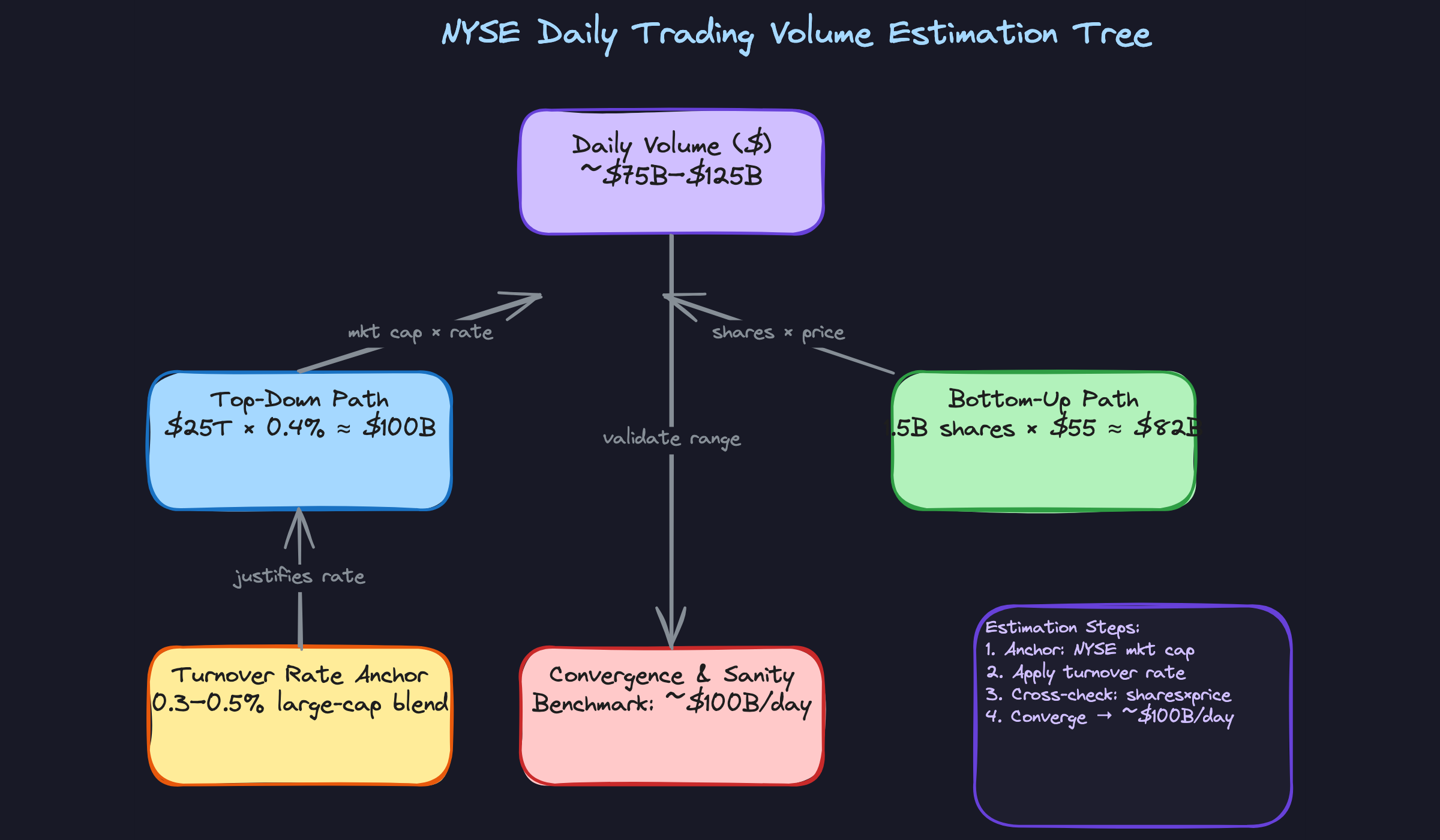
The two approaches overlap solidly in the $90B-$120B neighborhood when you're estimating all trading in NYSE-listed securities across all venues. That convergence is exactly what you want to show the interviewer. It means your turnover rate assumption and your shares-times-price assumption are telling the same story.
Here's where candidates get surprised: the actual NYSE-only figure (Tape A, NYSE-listed securities traded on the NYSE exchange itself) is closer to $20-25B per day. Include all NYSE Group venues (NYSE Arca, NYSE American) and you're around $50B. Include all trading in NYSE-listed securities regardless of where it executes (dark pools, off-exchange, competing lit venues), and you approach the $90B-$150B range your top-down model produced.
This is also why the question "estimate NYSE daily volume" is deliberately ambiguous. The interviewer wants to see whether you catch the scope trap, not just whether you can multiply.
Mental Math Shortcuts
A few techniques worth internalizing before your interview:
Percentage of a large round number. To find 0.4% of $30T: find 1% first ($300B), then take 40% of that ($120B). Always decompose small percentages this way rather than multiplying directly.
Rounding to friendly factors. 6B x $55 is awkward. Reframe it as 6 x 55 = (6 x 50) + (6 x 5) = 300 + 30 = 330. Distributive property saves you every time.
Order-of-magnitude sanity check. Your answer should be in the tens-to-low-hundreds-of-billions range. US GDP runs about $110B per trading day. NYSE-listed stock volume at $90B-$150B means equities alone are trading notional comparable to the entire economy's daily output. Large, but not absurd. If your arithmetic spits out $2T, something broke.
Sanity Checks and Validation
You've run two paths and they converged around $75B-$125B. Now you need to stress-test that range before you commit to it. This is where you separate yourself from candidates who just do the math and stop.
Cross-Check with US GDP
US GDP is roughly $28T per year. Spread across ~252 trading days, that's about $110B of economic output per day.
Your NYSE volume estimate of $75B-$125B means US equity markets are turning over notional value roughly equal to the entire economy's daily output. That sounds alarming until you remember that stocks trade many times over the course of a year. It's a large number, but it's not absurd. If your estimate had come out at $5T/day, that would be the red flag.
Cross-Check Against the S&P 500
The S&P 500 trades roughly $30-40B per day in notional volume across all US venues combined, including Nasdaq, CBOE, and off-exchange dark pools. That's not a direct floor for NYSE volume. The NYSE exchange itself only captures a fraction of S&P 500 trading, probably 20-30% of it, because US equity markets are highly fragmented and order flow is distributed across a dozen venues.
So the more useful way to use this benchmark is as a ceiling check on your market share assumption. If NYSE captures roughly 20-25% of S&P 500 component trading, that's $6-10B from large-caps alone. Add mid- and small-caps, and NYSE-listed volume on NYSE venues plausibly reaches $20-50B. An estimate below $10B should make you suspicious. An estimate above $150B implies NYSE has somehow captured more than the entire US market, which is the actual impossibility to watch for.
Use $20B as a soft floor, not because NYSE volume must exceed total S&P 500 volume, but because anything lower implies an implausibly small market share for the world's largest exchange by listed market cap.
The Annual Turnover Implied by Your Estimate
Here's a check that takes ten seconds and sounds impressive. If NYSE market cap is $25T and your daily volume estimate is $100B, then annual volume is roughly $100B x 252 = $25T. That implies 100% annual turnover of the entire NYSE market cap in a single year.
Academic research on US large-cap equities puts annual turnover at roughly 100-150%. So your estimate lands right in the middle of that range. That's not a coincidence; it's confirmation that your turnover rate assumption was calibrated correctly.
The Scope Trap
This is where a lot of candidates lose points without realizing it.
Total US equity volume across all venues, NYSE, Nasdaq, CBOE, and off-exchange dark pools, runs closer to $400-500B per day. If your estimate lands there, you've answered the wrong question. The NYSE is one exchange in a fragmented market. Conflating it with "all US stock trading" is the single most common scoping error in this problem.
Naming this distinction explicitly, even if the interviewer didn't ask, signals that you understand market structure. Say something like: "I want to flag that I'm estimating NYSE-listed volume on NYSE venues specifically. If we included Nasdaq and off-exchange, the total US figure would be 4-5x larger."
Sensitivity Analysis
Your estimate is most sensitive to two assumptions: the NYSE market cap you used, and the daily turnover rate.
The market cap figure is relatively stable and publicly verifiable, so it's not where your uncertainty lives. The turnover rate is where you should focus. You assumed 0.4%. If that's actually 0.2%, your top-down estimate halves to roughly $50B. If it's 0.6%, you're at $150B. That's a 3x swing from a single assumption, which is why you anchored it carefully with stock-level examples in the first place.
The bottom-up path has its own sensitivity: average share price. A blended $55 is reasonable for NYSE large-caps, but if you're including more small-caps, that number drops. A $40 average price instead of $55 moves your bottom-up estimate from $82B to $60B. Meaningful, but not order-of-magnitude.
Stating Your Final Range
Given the uncertainty in turnover rates and the NYSE-versus-all-venues ambiguity, a range of $20B-$120B is honest. For NYSE Group venues specifically (which includes NYSE Arca and NYSE American in addition to the main exchange), narrowing to $40B-$80B is defensible given the benchmarks above.
The actual NYSE Tape A figure (NYSE-listed stocks on the NYSE exchange itself) runs closer to $20-25B on a typical day. NYSE Group as a whole, including its other venues, is closer to $50B. Total US equities across all exchanges and dark pools is where you hit $400-500B.
Your estimate of $75B-$125B is slightly high for NYSE-only but reasonable for NYSE Group, and the discrepancy is entirely explained by the scope question you should have clarified upfront.
Follow-Up Questions
Interviewers at prop trading firms rarely let you stop at the headline number. Once you land in the $50-100B range, expect them to probe the edges. Here's how to handle the most common follow-ups.
"How would volume change during a market crash?"
The intuition most candidates reach for is "volume goes up." That's right, but incomplete. Share volume can spike 3-5x during a panic, driven by forced liquidations, margin calls, and institutional de-risking all hitting simultaneously. March 2020 is the cleanest recent example: NYSE volume roughly tripled over a two-week window.
The wrinkle is dollar notional. Prices are falling at the same time, so the notional increase is smaller than the share count increase. If share volume triples but prices drop 30%, your dollar volume roughly doubles rather than triples. VIX spiking above 40 is a reliable signal you're in that regime.
"Can you estimate Apple's daily trading volume?"
This is a natural single-stock extension. Pivot to bottom-up immediately.
AAPL market cap is roughly $3T. Mega-caps with deep institutional ownership and heavy retail interest turn over faster than the blended market average. A daily turnover rate of 0.5-0.8% is defensible here, giving you:
$3T x 0.6% = $18B/day
Your sanity check: AAPL is consistently the highest-notional stock in the US market, often representing 5-8% of total US equity volume. If total US equity volume is around $400B/day, 5-8% puts AAPL at $20-32B. Your bottom-up estimate of $18B is right in the neighborhood. That convergence is exactly what you want to narrate out loud.
"What fraction of NYSE volume is HFT?"
The honest answer is roughly 50-60% of share volume by count. But the follow-up insight matters more: HFT firms hold positions for milliseconds, so they contribute far less to dollar notional held overnight than their share count implies. They're adding to the turnover rate you used in your original estimate, not sitting outside it.
If the interviewer pushes on whether this inflates your estimate, the answer is no. HFT activity is already baked into observed turnover rates. You didn't build your estimate from a "natural" turnover baseline and then forget to add HFT on top.
"How confident are you in your estimate?"
Be honest and structured. Your range is probably $40-120B for NYSE Group venues, with the wide spread driven by three things:
- Scope ambiguity. NYSE-only (Tape A) is closer to $20-25B. NYSE Group including all affiliated venues is closer to $50B. "NYSE" in casual usage sometimes means all US equities, which is $400-500B. The single biggest source of variance in this problem is not the math, it's what you're actually measuring.
- Turnover rate assumption. Moving from 0.4% to 0.2% daily turnover cuts your top-down estimate in half. You justified 0.4% with stock-level examples and the implied annual turnover check, but a skeptical interviewer can push it lower. Know where your floor is.
- Market regime. Your estimate is for a normal trading day. Volume on a Fed decision day or during an index rebalancing event can run 50-100% above baseline.
If you had more time, you'd refine this with NYSE's own published daily volume statistics (freely available), or cross-reference against FINRA ATS data for off-exchange share.
Mental Math Speed Round
These are the quick calculations an interviewer might throw at you mid-conversation. Practice doing them in under 20 seconds.
If NYSE volume is $50B/day, what's the annual total? $50B x 252 trading days = $12.6T. Call it ~$13T.
AAPL is 6% of US equity volume. US equity volume is $400B/day. What's AAPL's daily notional? 6% x $400B = $24B.
If a stock has a $500B market cap and trades $2B/day, what's its daily turnover rate? $2B / $500B = 0.4%. Right in line with your blended assumption.
NYSE volume triples during a crash but prices fall 25%. What's the notional multiplier? 3 x 0.75 = 2.25x. Dollar volume roughly doubles, not triples.
What is Expected at Each Level
Junior Trader / Analyst
The bar here is structure, not precision. Pick one approach (top-down or bottom-up), state your assumptions out loud, and walk through the arithmetic step by step. If you land anywhere in the $20B-$200B range with a coherent path, that's a pass.
You need at least one external anchor. "NYSE market cap is roughly $25 trillion" or "the S&P 500 alone trades around $30-40B a day" tells the interviewer you have some market awareness. You don't need to know the exact figure from memory; you need to know enough to sanity-check yourself.
Clean mental math matters more than most candidates expect. Writing "$25T x 0.4% = $100B" and getting it right, quickly, is the actual test. Fumbling the arithmetic while explaining a sophisticated model is a red flag.
Don't refuse to commit. Give a number. "I'd estimate roughly $75-100B for NYSE-listed equities" is a complete answer. "It depends on a lot of factors" is not.
Senior Trader / Quant
At this level, you're expected to know the scope distinction cold. Total daily volume of NYSE-listed securities (Tape A) across all US trading venues is roughly $20-25B. NYSE Group venues (NYSE, Arca, American, and their affiliated platforms) collectively handle around 15-20% of all US equity volume, putting their total daily figure closer to $60-100B across all tapes. All US equities, including Nasdaq-listed names and off-exchange activity, is closer to $400-500B. Conflating any of these is an immediate credibility hit.
You should run both approaches in parallel and converge them. If your top-down and bottom-up estimates diverge by more than 2x, you should notice that and explain why, not just pick one and move on. Convergence is the signal that your assumptions are internally consistent.
Turnover rate variation by market cap tier should come naturally. Mega-caps like Apple turn over faster (0.5-0.8%/day) because of institutional flows, ETF rebalancing, and retail interest. Small-caps might be 0.05-0.1%. Your blended estimate needs to reflect that mix, not just apply one rate uniformly.
The interviewer will push. "Why 0.4% and not 0.1%?" is not a gotcha; it's an invitation to show you can defend a number. The right response is to walk through what 0.1% would imply ($25B), compare it to the S&P 500 benchmark, and explain why that feels too low. Changing your answer under pressure without a logical reason is worse than being wrong.
Lead / Portfolio Manager
Instant anchoring is the expectation. You should be able to say "NYSE-listed securities trade roughly $20-25B on a normal day across all venues, and NYSE Group's own platforms collectively see $60-100B when you include all tapes; that spikes to multiples of those figures on a high-vol day like a Fed announcement" within the first 30 seconds, because you've seen these numbers in your actual work.
The more interesting question at this level is sensitivity. What moves volume? Earnings season, index reconstitution, VIX regime, options expiration. A strong answer connects the estimate to the conditions under which it changes by 2x or 5x, not just what it is on an average Tuesday.
You're also expected to connect the estimate to a decision. Volume is a liquidity proxy. If you're sizing a position in a stock that trades $500M/day, you know you can move $50M without significant market impact. If it trades $5M/day, that same position takes a week to build. The estimation isn't academic; it informs execution.
Validation matters at this level too. Knowing that NYSE TAQ data, FINRA ATS transparency reports, and exchange monthly statistics are all publicly available, and being able to say "I'd cross-check this against last month's NYSE stats," signals that you treat estimation as a starting point, not a final answer.


